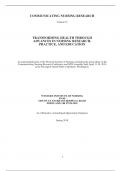
COMMUNICATING NURSING RESEARCH Volume 51 TRANSFORMING HEALTH THROUGH ADVANCES IN NURSING RESEARCH, PRACTICE, AND EDUCATION
COMMUNICATING NURSING RESEARCH Volume 51 TRANSFORMING HEALTH THROUGH ADVANCES IN NURSING RESEARCH, PRACTICE, AND EDUCATION An annual publication of the Western Institute of Nursing containing the proceedings of the Communicating Nursing Research Conference and WIN Assembly held April 11-14, 2018 at the Davenport Grand Hotel in Spokane, Washington. WESTERN INSTITUTE OF NURSING SN-4S 3455 SW US VETERANS HOSPITAL ROAD PORTLAND, OR An Affirmative Action/Equal Opportunity Employer Spring 2018 1 COMMUNICATING NURSING RESEARCH issues previously published: Volume 1: The Research Critique Volume 2: Problem Identification and the Research Design Volume 3: Methodological Issues in Research Volume 4: Is the Gap Being Bridged? Volume 5: The Many Sources of Nursing Knowledge Volume 6: Collaboration and Competition in Nursing Research Volume 7: Critical Issues in Access to Data Volume 8: Nursing Research Priorities: Choice or Chance Volume 9: Nursing Research in the Bicentennial Year Volume 10: Optimizing Environments for Health: Nursing’s Unique Perspective Volume 11: New Approaches to Communicating Nursing Research Volume 12: Credibility in Nursing Science Volume 13: Directions for the 1980’s Volume 14: Health Policy and Research Volume 15: Nursing Science in Perspective Volume 16: The Image of Nursing Research: Issues and Strategies Volume 17: Advancing Nursing Science: Qualitative and Quantitative Approaches Volume 18: Influencing the Future of Nursing Research through Power and Politics Volume 19: The Winds of Change: New Frontiers in Nursing Research Volume 20: Collaboration in Nursing Research: Advancing the Science of Human Care Volume 21: Nursing: A Socially Responsible Profession Volume 22: Choices within Challenges Volume 23: Nursing Research: Transcending the 20th Century Volume 24: Partnerships: Putting It All Together Volume 25: Silver Threads: 25 Years of Nursing Excellence Volume 26: Scholarship in Practice Volume 27: Research, Practice, and Education within the Health Care Agenda Volume 28: Innovation and Collaboration: Responses to Health Care Needs Volume 29: Advancing Nursing through Research, Practice, and Education Volume 30: Nursing: Changing the Environment Volume 31: Quality Research for Quality Practice Volume 32: Nursing Research: For the Health of Our Nation Volume 33: Building on a Legacy of Excellence in Nursing Research Volume 34: Health Care Challenges Beyond 2001: Mapping the Journey for Research and Practice Volume 35: Health Disparities: Meeting the Challenge Volume 36: Responding to Societal Imperatives through Discovery and Innovation Volume 37: Hallmarks of Quality: Generating and Using Knowledge Volume 38: Looking Ahead: Innovations in Nursing Science, Practice, and Education Volume 39: Building Knowledge for Practice Volume 40: 50 Years of Advancing Nursing in the West 1957 – 2007 Volume 41: The Circle of Nursing Knowledge: Education, Practice and Research Volume 42: Networks in Nursing Science: Creating our Future Volume 43: Nursing Science: Informing Practice and Driving Policy Volume 44: Transitions: Unifying Practice, Education, and Research to Improve Health Volume 45: Advancing Scientific Innovations in Nursing Volume 46: Creating a Shared Future of Nursing: Research, Practice, and Education Volume 47: Taking It Global: Research, Practice, and Education in Nursing Volume 48: Equity and Access: Nursing Research, Practice, and Education Volume 49: Innovations in Engagement through Research, Practice, and Education Volume 50: 50 Years of Leadership: Continuing the Vision The Cumulative Index of the Communicating Nursing Research Conference Proceedings, Volumes 1 to 25, () was published in 1992. COMMUNICATING NURSING RESEARCH has been published annually by the Western Institute of Nursing. Each volume contains the addresses and abstracts of papers presented at the annual Communicating Nursing Research Conference. 2 FOREWORD With my retirement planned later this year, this is the last Foreword I will write for the Communicating Nursing Research Conference proceedings. I will complete 22 years as the Executive Director of the Western Institute of Nursing (WIN). I have been so honored to stand on the “shoulders of the giants” who served before me, Jo Eleanor Elliott and Jeanne Kearns. Looking back over 22 years, the advancements the organization have made are striking. I became the Executive Director during a time of rapid technology growth. During that time, we have moved from a paper operation to an electronic operation. We initiated the first WIN webpage and upgraded it several times, most recently for use on various electronic devices; developed a database to facilitate the work of staff and members; instituted social media channels to better communicate with members; and started the use of a conference application (app). We initiated the “Nursing Education Xchange: NEXus” by which doctoral students in one of the consortium member school may take distance education classes from another member school. In 2017, we celebrated the 60th Anniversary of WIN and the 50th Communicating Nursing Research Conference, both a testimony to the work of our members and the longevity of the mission and vision of the organization. While these advances happened on my “shift”, I have used the term “we” deliberately. It certainly takes a strong and committed team to enact all these changes. I have been extremely fortunate to have partnered with Presidents, Board members, and Committee members, all of whom are wholeheartedly dedicated to the WIN vision and the tasks to move the organization forward. The Program Committees over the past 22 years have worked diligently to create conference programs that stimulate and educate with a gentle Western welcome to all who attend. The staff team over the years has not only made the work of the Board and Committees easier, but staff members have contributed skill and advancements to their respective jobs. The WIN staff works very hard, and none of the advances noted above could have happened without their commitment. To echo Jeanne Kearns’ final Foreword, each has certainly made my professional life an exceptional experience. This organization has extraordinary members who are dedicated to their careers in research, practice, and education, and accomplished students who are engaged in educational programs to enhance their contributions to nursing science. My wish for all members is that you continue to facilitate the growth of WIN and to remain committed to the 60-year WIN vision of excellence in research, practice, and education. WIN has been greatly enriched through its partnership with the Oregon Health & Science University School of Nursing. The School and its deans, Carol Lindeman, Kate Potempa, Michael Bleich, and now Susan Bakewell-Sachs, have been supportive and nourishing in the relationship between the school and the western regional nursing organization. We owe them a debt of gratitude. I close with my appreciation and fondness to each and every one, within and outside the organization, who has made my tenure here such an amazing experience. I will miss you all. Paula A. McNeil, RN, MS Executive Director Western Institute of Nursing April 2018 3 PREFACE The 51st Annual Communicating Nursing Research Conference, “Transforming Health through Advances in Nursing Research, Practice, and Education,” was held April 11-14, 2018 at the Davenport Grand Hotel in Spokane, Washington. The keynote address was delivered by Bobbie Berkowitz, PhD, RN, NEA-BC, FAAN, Dean and Mary O’Neil Mundinger Professor, Columbia University School of Nursing and Senior Vice President, Columbia University Medical Center, New York, NY. State of the Science presentations were delivered by: Eileen Cody, BSN, RN, Representative of the 34th Legislative District, Washington State Legislature and Neuro-Rehab Nurse, Group Health Cooperative, Seattle, WA; Usha Menon, PhD, RN, FAAN, Professor and Associate Dean for Research & Global Advances, College of Nursing, The University of Arizona, Tucson, AZ; and Carolyn Montoya, PhD, CPNP, FAANP, FAAN, Interim Dean, College of Nursing, University of New Mexico, Albuquerque, NM. Two award papers were presented: Distinguished Research Lectureship Award: Patricia Butterfield, PhD, RN, FAAN, Professor and Associate Dean for Research, Elson S. Floyd College of Medicine, Washington State University, Spokane, WA; and Carol A. Lindeman Award for a New Researcher: Daniel T. Linnen, MS, RN-BC, PhD Candidate, School of Nursing, University of California, San Francisco and Health Systems Research Resident, Kaiser Permanente Northern California, Oakland, CA. The Proceedings include the abstracts of symposium, podium, and poster presentations. One hundred and fifty-seven papers were presented in podium sessions on a wide variety of topics, including completed research, theoretical papers, and projects. Fifty papers were presented in eleven symposia, and one hundred and seven papers were organized in twentyfive other sessions. Four hundred and twenty-one posters were displayed over four poster sessions, representing projects and research, completed or in progress. A total of two hundred and thirteen posters were submitted from member institutions for the Research & Information Exchange. Awards were given to numerous WIN individual members during the 2018 conference. Please consult the Table of Contents for the location of the aforementioned papers, the list of awardees honored by WIN, and the name and subject indexes. The conference was planned and organized by the WIN Program Committee, and we extend our gratitude to the Program Committee members: Anthony McGuire, Chair, ME; Judith Berg, AZ; Katreena Collette-Merrill, UT; Mary Ellen Dellefield, CA; Linda Edelman, UT; Bronwyn Fields, CA; Bonnie Gance-Cleveland, CO; Lori Hendrickx, SD; Kathryn Lee, CA; Judy Liesveld, NM; Kristin Lutz, OR; Paula Meek, CO; Usha Menon, AZ; Annette Nasr, CA; Joanne Noone, OR; Jennifer Peterson, CA; Kristine Qureshi, HI; Roberta Rehm, CA; Sharon Ruyak, NM; Hilaire Thompson, WA; and Catherine Van Son, WA. We thank all of the nurse researchers who submitted papers and participated in the 2018 conference. Charlene A. Winters, PhD, RN President, Western Institute of Nursing Anthony W. McGuire, PhD, CCRN-K, ACNP-BC, FAHA Chair, Program Committee, Western Institute of Nursing 4 State of the Science Paper WHAT WOULD FLORENCE DO? SURVEY RESULTS OF SELECTED NURSING PROGRAMS IN WESTERN STATES: IMPLICATION FOR THE FUTURE OF NURSING EDUCATION Carolyn Montoya, PhD, PNP, FAAN, FAANP Robert Wood Johnson Fellow Associate Professor and Interim Dean College of Nursing University of New Mexico Albuquerque, NM 5 WHAT WOULD FLORENCE DO? SURVEY RESULTS OF SELECTED NURSING PROGRAMS IN WESTERN STATES: IMPLICATION FOR THE FUTURE OF NURSING EDUCATION Carolyn Montoya, PhD, PNP, FAAN, FAANP Robert Wood Johnson Fellow Associate Professor and Interim Dean College of Nursing University of New Mexico Albuquerque, NM In 2017, the Western Institute of Nursing (WIN) celebrated 60 years of advancing nursing science, education, and practice to improve health outcomes. As is the tradition at the WIN annual conferences, state of the science papers on nursing research, education, and practice were presented with a focus on the future of nursing in each of these areas. The 2017 state of the science presentation on nursing education identified the following three areas expected to influence the future of nursing education: student traits and major trends in both health care and higher education. (Young, 2017). Young’s literature review provided compelling evidence regarding the challenges that face nursing education including the greying of the nursing workforce, the aging of the U.S. population, the diversity of our culture, declining state support for higher education resulting in ever increasing tuition and fees, the transformation of education due to advances in technology, and the diversity of student learning preferences. The literature on challenges facing nursing education continues to grow. Fang and Kesten (2017) used American Association of Colleges of Nursing (AACN) full-time faculty data from the AACN Annual Survey of Baccalaureate and Graduate Programs in Nursing to estimate faculty retirements in and the impact of these retirements on the nursing faculty workforce. They projected that one-third of U.S. nursing faculty active in 2015 would retire between 2016 and 2025. Concerns about a shortage of nursing faculty extend beyond the United States. Nardi and Gyurko (2013), in their review of the global nursing faculty shortage, described several challenges including aging faculty, poor salaries, lack of funding, faculty dissatisfaction with the role, and a decreasing number of full-time equivalent faculty positions. Among the most intriguing possible challenges facing nursing education are disruptive innovations. The concept of a disruptive innovation was originally developed in the business sector to describe the process of a smaller company displacing an established company by providing a service or product to a segment of the customers whose needs were either overlooked or not deemed significantly important by the established company (Christensen, Raynor, & McDonald, 2015). True disruptors generally start by engaging clients who are either not currently served or are at the low-end of the market and then evolve to include more mainstream consumers. Christensen et al. (2015) noted that disruptive innovations are initially considered inferior by mainstream consumers. Rather than trying the new “product” because it is less expensive, mainstream consumers wait until the quality of the new product improves. The concept of disruptive innovation has been discussed within the context of higher education and in health care delivery. Christensen, Horn, Caldera, and Soares (2011), in a report for the Center for American Progress, cited the use of online learning as an enabler for disruption in higher education. The proliferation of for-profit higher education businesses that offer online programs is an exemplar of disruptive innovation. While universities have adopted online courses and programs, the authors described the current model of offering research, teaching, and career preparation as overly complex for the focused purpose of educational program delivery, resulting in significant overhead expenditures. In contrast, for-profit educational businesses are able to keep their overhead lower as they focus solely on providing online educational programs. Thompson (2016a, 2016b) used the concept of disruptive innovation to advocate for embracing distance education using online delivery in graduate nursing education. While 6 state and private universities have embraced o
Written for
- Institution
- COMMUNICATING NURSING RESEARCH Volume 51 TRANSFORM
- Course
- COMMUNICATING NURSING RESEARCH Volume 51 TRANSFORM
Document information
- Uploaded on
- August 19, 2023
- Number of pages
- 523
- Written in
- 2023/2024
- Type
- Exam (elaborations)
- Contains
- Questions & answers
Subjects
- communicating
-
communicating nursing research volume 51 transform
-
communicating nursing research volume 51
-
communicating nursing research
Also available in package deal