
Proteins
All enzymes are proteins
Essential components of cell membrane – functions such as receptor
proteins and signally proteins
Hormones – insulin and glycogen
Oxygen carrying pigment in haemoglobin
Antibodies
Collagen – adds strength to animal tissues such as bones and walls of
arteries
Keratin – hair, nails and surface layer of the skin
Actin and myosin for muscle contraction
Can be storage products
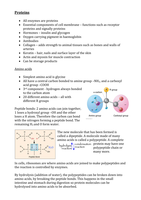
Amino acids
Simplest amino acid is glycine
All have a central carbon bonded to amine group –NH2, and a carboxyl
acid group –COOH
3rd component - hydrogen always bonded
to the carbon atom
20 different amino acids – all with
different R groups
Peptide bonds: 2 amino acids can join together,
1 loses a hydroxyl group –OH and the other
loses a H atom. Therefore the carbon can bond
with the nitrogen forming a peptide bond. The
remaining H2 and O form water.
The new molecule that has been formed is
called a dipeptide. A molecule made of many
amino acids is called a polypeptide. A complete
protein may have one
H2O polypeptide chain or
many more.
In cells, ribosomes are where amino acids are joined to make polypeptides and
the reaction is controlled by enzymes.
By hydrolysis (addition of water), the polypeptides can be broken down into
amino acids, by breaking the peptide bonds. This happens in the small
intestine and stomach during digestion so protein molecules can be
hydrolysed into amino acids to be absorbed.
All enzymes are proteins
Essential components of cell membrane – functions such as receptor
proteins and signally proteins
Hormones – insulin and glycogen
Oxygen carrying pigment in haemoglobin
Antibodies
Collagen – adds strength to animal tissues such as bones and walls of
arteries
Keratin – hair, nails and surface layer of the skin
Actin and myosin for muscle contraction
Can be storage products
Amino acids
Simplest amino acid is glycine
All have a central carbon bonded to amine group –NH2, and a carboxyl
acid group –COOH
3rd component - hydrogen always bonded
to the carbon atom
20 different amino acids – all with
different R groups
Peptide bonds: 2 amino acids can join together,
1 loses a hydroxyl group –OH and the other
loses a H atom. Therefore the carbon can bond
with the nitrogen forming a peptide bond. The
remaining H2 and O form water.
The new molecule that has been formed is
called a dipeptide. A molecule made of many
amino acids is called a polypeptide. A complete
protein may have one
H2O polypeptide chain or
many more.
In cells, ribosomes are where amino acids are joined to make polypeptides and
the reaction is controlled by enzymes.
By hydrolysis (addition of water), the polypeptides can be broken down into
amino acids, by breaking the peptide bonds. This happens in the small
intestine and stomach during digestion so protein molecules can be
hydrolysed into amino acids to be absorbed.


