Crime and Deviance
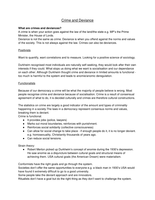
What are crimes and deviances?
A crime is when your action goes against the law of the land/the state e.g. MP’s the Prime
Minister, the House of Lords.
Deviance is not the same as crime. Deviance is when you offend against the norms and values
of the society. This is not always against the law. Crimes can also be deviances.
Positivists
Want to quantify, want correlations and to measure. Looking for a positive science of sociology.
Durkheim recognised most individuals are naturally self-seeking, they would look after their own
interests if they could. What stops us doing what we want is socialisation and our dependance
on each other. Although Durkheim thought crime and deviance in limited amounts is functional -
too much is harmful to the system and leads to anomie/anomic deregulation.
Functionalists
Because of our democracy a crime will be what the majority of people believe is wrong. Most
people recognise crime and deviance because of socialisation. Crime is a result of consensual
agreement of what to do, it is decided culturally and crimes are therefore cultural constructions.
The statistics on crime are largely a good indicator of the amount and types of criminality
happening in a society.The laws in a democracy represent consensus norms and values,
breaking them is deviant.
Crime is functional.
● It provides jobs (police, lawyers)
● Marks out moral boundaries, reinforces with punishment.
● Reinforces social solidarity (collective consciousness)
● Can allow for social change to take place - if enough people do it, it is no longer deviant.
e.g. homosexuality, Christianity thousands of years ago.
● Can reduce social tensions.
Strain theory:
● Robert Merton picked up Durkheim’s concept of anomie during the 1930’s depression.
He saw anomie as a disjuncture between cultural goals and structural means of
achieving them. USA cultural goals (the American Dream) were materialism.
Conformists have the right goals and go through the system.
Societies don’t offer the same opportunities to everyone e.g. a black man in 1930’s USA would
have found it extremely difficult to go to a good university.
Some people take the deviant approach and are innovators.
Ritualists don’t have a goal but do the right thing as they don’t want to challenge the system.
What are crimes and deviances?
A crime is when your action goes against the law of the land/the state e.g. MP’s the Prime
Minister, the House of Lords.
Deviance is not the same as crime. Deviance is when you offend against the norms and values
of the society. This is not always against the law. Crimes can also be deviances.
Positivists
Want to quantify, want correlations and to measure. Looking for a positive science of sociology.
Durkheim recognised most individuals are naturally self-seeking, they would look after their own
interests if they could. What stops us doing what we want is socialisation and our dependance
on each other. Although Durkheim thought crime and deviance in limited amounts is functional -
too much is harmful to the system and leads to anomie/anomic deregulation.
Functionalists
Because of our democracy a crime will be what the majority of people believe is wrong. Most
people recognise crime and deviance because of socialisation. Crime is a result of consensual
agreement of what to do, it is decided culturally and crimes are therefore cultural constructions.
The statistics on crime are largely a good indicator of the amount and types of criminality
happening in a society.The laws in a democracy represent consensus norms and values,
breaking them is deviant.
Crime is functional.
● It provides jobs (police, lawyers)
● Marks out moral boundaries, reinforces with punishment.
● Reinforces social solidarity (collective consciousness)
● Can allow for social change to take place - if enough people do it, it is no longer deviant.
e.g. homosexuality, Christianity thousands of years ago.
● Can reduce social tensions.
Strain theory:
● Robert Merton picked up Durkheim’s concept of anomie during the 1930’s depression.
He saw anomie as a disjuncture between cultural goals and structural means of
achieving them. USA cultural goals (the American Dream) were materialism.
Conformists have the right goals and go through the system.
Societies don’t offer the same opportunities to everyone e.g. a black man in 1930’s USA would
have found it extremely difficult to go to a good university.
Some people take the deviant approach and are innovators.
Ritualists don’t have a goal but do the right thing as they don’t want to challenge the system.