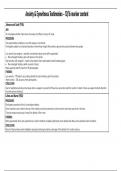
Anxiety & Eyewitness Testimonies – 12/16 marker content
Johnson and Scott (1976):
AlM:
To investigate whether high levels of anxiety will affect accuracy of recall..
PROCEDURE:
Two experimental conditions: one with weapon, one without.
Participants asked to sit outside laboratory where they thought they heard a genuine discussion between two people
Low anxiety (no weapon) - peaceful conversation about some office equipment
Man emerged holding a pen with graze on his hands
High anxiety (with weapon) - heard conversation where participants heard breaking glass
Man emerged holding a knife covered in blood.
Were asked by identify man from 50 photographs
FINDINGS:
Low anxiety - 79% able to accurately identify the man holding a pen from photos
·High anxiety - 33% accuracy from participants.
CONCLUSION
Due to heightened anxiety and arousal when a weapon is present, EW have less accurate recall for events of volent crimes as weapon distract attention
from the person holding it.
Loftus and Burns (1982):
PROCEDURE:
Participants watched a film of a simulated robbery
Some watched a non-violent version of the robbery and some watched a violent version where boy was shot in the face.
Trying to measure accuracy of recall for details of the crime.
FINDINGS:
When questioned, those who watched non-violent condition recalled significantly more details than those who watched violent condition.
CONCLUSION:
Shock of high anxiety events heightens arousal and disrupts memory storage of the details from violent scenes.
Johnson and Scott (1976):
AlM:
To investigate whether high levels of anxiety will affect accuracy of recall..
PROCEDURE:
Two experimental conditions: one with weapon, one without.
Participants asked to sit outside laboratory where they thought they heard a genuine discussion between two people
Low anxiety (no weapon) - peaceful conversation about some office equipment
Man emerged holding a pen with graze on his hands
High anxiety (with weapon) - heard conversation where participants heard breaking glass
Man emerged holding a knife covered in blood.
Were asked by identify man from 50 photographs
FINDINGS:
Low anxiety - 79% able to accurately identify the man holding a pen from photos
·High anxiety - 33% accuracy from participants.
CONCLUSION
Due to heightened anxiety and arousal when a weapon is present, EW have less accurate recall for events of volent crimes as weapon distract attention
from the person holding it.
Loftus and Burns (1982):
PROCEDURE:
Participants watched a film of a simulated robbery
Some watched a non-violent version of the robbery and some watched a violent version where boy was shot in the face.
Trying to measure accuracy of recall for details of the crime.
FINDINGS:
When questioned, those who watched non-violent condition recalled significantly more details than those who watched violent condition.
CONCLUSION:
Shock of high anxiety events heightens arousal and disrupts memory storage of the details from violent scenes.