Retrieval Failure – 12/16 marker content
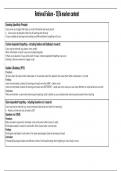
Encoding Specificity Principle:
Cues serve as a trigger that helps us recall information previously learnt.
Cues have to be present at the time of learning and retrieval
If cues available at learning and encoding are different/absent, forgetting will occur
Context-dependent forgetting – including Godden and Baddeley’s research:
Cues may be external (e.g. places, room, smell)
When information is learnt, cues are encoded alongside
If there is an absence of cues at the point of recall, context-dependent forgetting may occur
Nothing in the environment to trigger recall
Godden & Baddeley (1975):
Procedure:
18 divers learn 36 words either underwater or on land and were then asked to free recall them either underwater or on land
Findings:
when environmental contexts of learning and recall were the SAME – better recall
when environmental contexts of learning and recall were DIFFERENT – recall was much worse as cues were different so retrieval failure occurred
Conclusion:
When environment is same when learning and recalling, recall is better as cues encoded when learning were present when recalling
State-dependent forgetting – including Goodwin et al research:
Cues may also be internal (e.g., mood, emotional state of person when first learning)
Absence of internal rule can lead to SDF
Goodwin et al (1969):
Procedure:
Male volunteers required to remember a list words when either drunk or sober
Participants asked to recall list words after 24hrs (some sober, some drunk)
Findings:
Participants had higher recall when in the same physiological state at learning and recall
Conclusion:
If mental/physiological states are different at time of retrieval/encoding, then forgetting is more likely to occur
Encoding Specificity Principle:
Cues serve as a trigger that helps us recall information previously learnt.
Cues have to be present at the time of learning and retrieval
If cues available at learning and encoding are different/absent, forgetting will occur
Context-dependent forgetting – including Godden and Baddeley’s research:
Cues may be external (e.g. places, room, smell)
When information is learnt, cues are encoded alongside
If there is an absence of cues at the point of recall, context-dependent forgetting may occur
Nothing in the environment to trigger recall
Godden & Baddeley (1975):
Procedure:
18 divers learn 36 words either underwater or on land and were then asked to free recall them either underwater or on land
Findings:
when environmental contexts of learning and recall were the SAME – better recall
when environmental contexts of learning and recall were DIFFERENT – recall was much worse as cues were different so retrieval failure occurred
Conclusion:
When environment is same when learning and recalling, recall is better as cues encoded when learning were present when recalling
State-dependent forgetting – including Goodwin et al research:
Cues may also be internal (e.g., mood, emotional state of person when first learning)
Absence of internal rule can lead to SDF
Goodwin et al (1969):
Procedure:
Male volunteers required to remember a list words when either drunk or sober
Participants asked to recall list words after 24hrs (some sober, some drunk)
Findings:
Participants had higher recall when in the same physiological state at learning and recall
Conclusion:
If mental/physiological states are different at time of retrieval/encoding, then forgetting is more likely to occur