MABU - Management Accounting: Budgeting
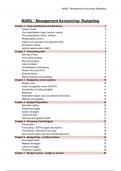
MABU - Management Accounting: Budgeting
Chapter 1 - Cost classification and behaviour 2
Types of costs 2
Cost classification (type, function, nature) 3
Cost classification (direct, indirect) 3
Responsibility centres 4
Indirect cost allocation and apportionment 4
Absorption costing 4
Activity based costing (ABC) 5
Chapter 2 - Forecasting data 5
Sources of data 5
Time series analysis 5
Moving averages 6
Index numbers 7
Uncertainties in forecasting 8
Product life cycle (PLC) 8
External factors 9
Market research and sampling 10
Chapter 3 - Budgetary control systems 10
Budget cycle 10
Uses of budgetary control (PCACP) 11
Coordination of setting budgets 11
Motivation 12
Attainable budgets and sub-optimal performance 13
Methods of budgeting 13
Chapter 4 - Budget Preparation 15
Standard costing 15
Preparing budgets 15
Types of budgets 16
Control periods 17
Planning and agreeing drafts 17
Chapter 5 - Preparing Cash Budgets 17
Presentation 17
Forecasting - SOFP budget assumptions 18
Forecasting - allowing for time lags 18
Non-current assets and cash receipts/payments 19
Chapter 6 - Budget Prep - Limiting Factors 19
Key budget factor 19
Material shortages 19
Labour shortages 19
Production capacity 20
Chapter 7 - Budget control - budget vs actuals 20
, MABU - Management Accounting: Budgeting
Budgetary control 20
Budget flexing 20
Contingency budgets 20
Variance analysis 21
Investigating variances 21
Reasons behind variances 21
Direct cost variances - materials 22
Direct cost variances - labour 22
Chapter 8 - Performance Indicators in Budgetary Control 23
Types of KPI 23
Areas of performance 23
Service Organisations 24
, MABU - Management Accounting: Budgeting
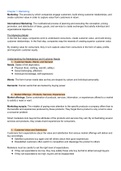
Chapter 1 - Cost classification and behaviour
Types of costs
Budget = a formalised, numerical plan of action for a business
- Represents what a business wants to achieve
- A plan and a performance measure
Creating a budget
- Costs allocated to be direct or indirect (see below)
- Direct = relating to specific units of products or services
- Indirect = costs that can’t be attributed directly to a cost unit
- Costs allocated to variable, semi-variable, fixed and stepped (cost against output)
- Variable = vary with output, e.g. product materials
- Fixed = costs that will not vary with output, e.g. fixed overheads, rent
- Stepped fixed = costs that remain fixed for a certain level of output and then
increase until a further level of output is reached, e.g. rent, supervisors costs
- Semi-variable = costs which are part fixed and part variable and are therefore
partly affected by changes in activity levels, e.g. telephones
Semi-variable costs
- Has a fixed and variable element
- Total cost = fixed element + (variable cost per unit x no. of units)
- High-low method for semi-variable costs
1. Select highest and lowest unit outputs and their costs
2. Find the difference between these figures (H - L = d)
3. Calculate variable cost per unit (VC = d units/d cost)
4. Calculate fixed cost using a precalculated figure [TC=FC + (VC x no. of units)]
Cost classification (type, function, nature)
Cost classification = arrangement of cost items into logical groups, e.g:
MABU - Management Accounting: Budgeting
Chapter 1 - Cost classification and behaviour 2
Types of costs 2
Cost classification (type, function, nature) 3
Cost classification (direct, indirect) 3
Responsibility centres 4
Indirect cost allocation and apportionment 4
Absorption costing 4
Activity based costing (ABC) 5
Chapter 2 - Forecasting data 5
Sources of data 5
Time series analysis 5
Moving averages 6
Index numbers 7
Uncertainties in forecasting 8
Product life cycle (PLC) 8
External factors 9
Market research and sampling 10
Chapter 3 - Budgetary control systems 10
Budget cycle 10
Uses of budgetary control (PCACP) 11
Coordination of setting budgets 11
Motivation 12
Attainable budgets and sub-optimal performance 13
Methods of budgeting 13
Chapter 4 - Budget Preparation 15
Standard costing 15
Preparing budgets 15
Types of budgets 16
Control periods 17
Planning and agreeing drafts 17
Chapter 5 - Preparing Cash Budgets 17
Presentation 17
Forecasting - SOFP budget assumptions 18
Forecasting - allowing for time lags 18
Non-current assets and cash receipts/payments 19
Chapter 6 - Budget Prep - Limiting Factors 19
Key budget factor 19
Material shortages 19
Labour shortages 19
Production capacity 20
Chapter 7 - Budget control - budget vs actuals 20
, MABU - Management Accounting: Budgeting
Budgetary control 20
Budget flexing 20
Contingency budgets 20
Variance analysis 21
Investigating variances 21
Reasons behind variances 21
Direct cost variances - materials 22
Direct cost variances - labour 22
Chapter 8 - Performance Indicators in Budgetary Control 23
Types of KPI 23
Areas of performance 23
Service Organisations 24
, MABU - Management Accounting: Budgeting
Chapter 1 - Cost classification and behaviour
Types of costs
Budget = a formalised, numerical plan of action for a business
- Represents what a business wants to achieve
- A plan and a performance measure
Creating a budget
- Costs allocated to be direct or indirect (see below)
- Direct = relating to specific units of products or services
- Indirect = costs that can’t be attributed directly to a cost unit
- Costs allocated to variable, semi-variable, fixed and stepped (cost against output)
- Variable = vary with output, e.g. product materials
- Fixed = costs that will not vary with output, e.g. fixed overheads, rent
- Stepped fixed = costs that remain fixed for a certain level of output and then
increase until a further level of output is reached, e.g. rent, supervisors costs
- Semi-variable = costs which are part fixed and part variable and are therefore
partly affected by changes in activity levels, e.g. telephones
Semi-variable costs
- Has a fixed and variable element
- Total cost = fixed element + (variable cost per unit x no. of units)
- High-low method for semi-variable costs
1. Select highest and lowest unit outputs and their costs
2. Find the difference between these figures (H - L = d)
3. Calculate variable cost per unit (VC = d units/d cost)
4. Calculate fixed cost using a precalculated figure [TC=FC + (VC x no. of units)]
Cost classification (type, function, nature)
Cost classification = arrangement of cost items into logical groups, e.g: