
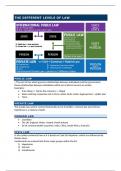
THE DIFFERENT LEVELS OF LAW
PUBLIC LAW
= The part of law which governs relationships between individuals and the government,
those relationships between individuals which are of direct concern to society.
Examples:
Price fixing => harms the economy => illegal
State ordering companies not to form cartels (state orders legal persons = public law)
Taxes
PRIVATE LAW
The private law system evolved historically out of 2 families: common law and civil law.
Hybrid law is a mixture of both.
COMMON LAW
unwritten
The UK: England, Wales, Ireland, North-Ireland
Ex UK commonwealth countries: India, China, South-Africa, Australia
CIVIL LAW
Is also called continental law as it is based on Code De Napoleon, which was influenced by
Roman Laws.
Continental Law evolved into three major groups within the EU:
1) Napoleonic
2) German
3) Scandinavian
,HYBRID LAW
= A mixture of Common Law and Civil Law
Mainly in states that during their history were ruled by both UK as another Continental
nation.
Examples:
Quebec = France and UK
South-Africa = the Netherlands and UK
Scotland was only ruled by UK, but still chose for Hybrid Law
THE MAIN DIFFERENCES BETWEEN COMMON LAW AND CIVIL LAW
CIVIL LAW COMMON LAW
Origin= Continental Europe Origin= United Kingdom
Dogmatic= everything is structured and clear Pragmatic= cross the bridge when we get there
Based on Roman Law Not based on Roman Law
Codified (= written) => covers entire areas of the Not codified= does not cover entire areas of law
law Code Civil (Burgerlijk wetboek) Cas Law (acts on certain subjects/no code)
Court don’t need to follow stare decisis Based on precedent stare decisis (previous court
(precedents) => court judgments are NOT binding decisions) => court judgements are binding (it
(not law) becomes a law)
TYPES OF PRIVATE LAWS
1) PROPERTY LAW= who is the owner of the property
2) CONTRACT LAW= agreement between private parties
3) COMPANY LAW= law on how to govern a company
4) LAW OF TORTS= law on damages
WHY IS THERE NO SUCH THING AS “AN INTERNATIONAL LAW”?
DEMOCRACY
= Division of power
In a dictatorship one person holds all powers.
THE THREE POWERS
In a perfectly safe democracy, the power is in the hands of the following 3 powers:
1) LEGISLATIVE= authority to make laws for a political entity member are called
legislators, they are always elected. They pass the laws.
2) EXECUTIVE= executing and enforcing the law.
3) JUDICIARY= interprets and applies the laws in the name of the state, courts.
In other words, you would need an international parliament that ratifies the laws manned
with internationally elected representatives. This doesn’t exist. We only elect national
representatives and parliaments. There is no international state or union.
WHAT IS INTERNATIONAL LAW
1) International Private Law
2) International Public Law
, INTERNATIONAL PRIVATE LAW
There is no “International Private Law”, it is in fact National Private Law that comes
international because two individuals (natural person or legal person/company) form two
different states are in conflict.
The local national law will then decide which of both countries’ law will be carried.
In International Private Law the only thing that has to be handled is how to decide which
kind of law applies and, in that law, look which of the 2 national laws will handle it.
LEX FORI= you apply the law where the court is.
INTERNATIONAL PRIVATE LAW= national set of rules, national law, defines which national
law is applicable in a given case if there is a foreign element.
ATTENTION: it is the (national) law that decides which (national) law will be applied.
Checking national law might lead to the conclusion that the local law is not valid and they
need to apply a foreign/other national law.
INTERNATIONAL PUBLIC LAW
International Public Law is law carried between states.
We will address 2 subjects:
1) THE UN: United Nations & Human Rights
2) THE WTO: World Trade Organization & The Trade Agreements
PUBLIC LAW
= The part of law which governs relationships between individuals and the government,
those relationships between individuals which are of direct concern to society.
Examples:
Price fixing => harms the economy => illegal
State ordering companies not to form cartels (state orders legal persons = public law)
Taxes
PRIVATE LAW
The private law system evolved historically out of 2 families: common law and civil law.
Hybrid law is a mixture of both.
COMMON LAW
unwritten
The UK: England, Wales, Ireland, North-Ireland
Ex UK commonwealth countries: India, China, South-Africa, Australia
CIVIL LAW
Is also called continental law as it is based on Code De Napoleon, which was influenced by
Roman Laws.
Continental Law evolved into three major groups within the EU:
1) Napoleonic
2) German
3) Scandinavian
,HYBRID LAW
= A mixture of Common Law and Civil Law
Mainly in states that during their history were ruled by both UK as another Continental
nation.
Examples:
Quebec = France and UK
South-Africa = the Netherlands and UK
Scotland was only ruled by UK, but still chose for Hybrid Law
THE MAIN DIFFERENCES BETWEEN COMMON LAW AND CIVIL LAW
CIVIL LAW COMMON LAW
Origin= Continental Europe Origin= United Kingdom
Dogmatic= everything is structured and clear Pragmatic= cross the bridge when we get there
Based on Roman Law Not based on Roman Law
Codified (= written) => covers entire areas of the Not codified= does not cover entire areas of law
law Code Civil (Burgerlijk wetboek) Cas Law (acts on certain subjects/no code)
Court don’t need to follow stare decisis Based on precedent stare decisis (previous court
(precedents) => court judgments are NOT binding decisions) => court judgements are binding (it
(not law) becomes a law)
TYPES OF PRIVATE LAWS
1) PROPERTY LAW= who is the owner of the property
2) CONTRACT LAW= agreement between private parties
3) COMPANY LAW= law on how to govern a company
4) LAW OF TORTS= law on damages
WHY IS THERE NO SUCH THING AS “AN INTERNATIONAL LAW”?
DEMOCRACY
= Division of power
In a dictatorship one person holds all powers.
THE THREE POWERS
In a perfectly safe democracy, the power is in the hands of the following 3 powers:
1) LEGISLATIVE= authority to make laws for a political entity member are called
legislators, they are always elected. They pass the laws.
2) EXECUTIVE= executing and enforcing the law.
3) JUDICIARY= interprets and applies the laws in the name of the state, courts.
In other words, you would need an international parliament that ratifies the laws manned
with internationally elected representatives. This doesn’t exist. We only elect national
representatives and parliaments. There is no international state or union.
WHAT IS INTERNATIONAL LAW
1) International Private Law
2) International Public Law
, INTERNATIONAL PRIVATE LAW
There is no “International Private Law”, it is in fact National Private Law that comes
international because two individuals (natural person or legal person/company) form two
different states are in conflict.
The local national law will then decide which of both countries’ law will be carried.
In International Private Law the only thing that has to be handled is how to decide which
kind of law applies and, in that law, look which of the 2 national laws will handle it.
LEX FORI= you apply the law where the court is.
INTERNATIONAL PRIVATE LAW= national set of rules, national law, defines which national
law is applicable in a given case if there is a foreign element.
ATTENTION: it is the (national) law that decides which (national) law will be applied.
Checking national law might lead to the conclusion that the local law is not valid and they
need to apply a foreign/other national law.
INTERNATIONAL PUBLIC LAW
International Public Law is law carried between states.
We will address 2 subjects:
1) THE UN: United Nations & Human Rights
2) THE WTO: World Trade Organization & The Trade Agreements


