Seminar 10- week 19. Virgo ch6 ranjohn ch 12 Hanbury ch 15
Charities I: Relief of Poverty and Advancement of Education.
1. What are the requirements for a charity for the relief of poverty? Use case law examples to
illustrate your answer.
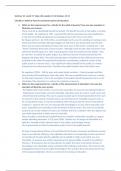
There must be an identifiable benefit or benefit. The benefit must be to the public or section
of the public. Re coulthourst 1951- evershed MR said ‘poverty does not mean destitution…
it may not be unfairly paraphrased as meaning persons who have to ‘go short’.
Re Niyazis will trust , Re 1978. Gift as a contribution to the cost of a building of working mens
hostel was held charitable although meggary VC felt that It was desperately near the line.
There was no express limitation to those who were poor as the words “working men “ and
“hostel” indicated those with a lower income. Although trusts for the relief of poverty must
satisfy the benefit aspect (i.e. their actual purposes must be beneficial to the public) , they
do not have to satisfy the public aspect. E.g. Attorney General v Charity Commission for
England and Wales 2012- The public benefit apect of charities for the relief of poverty was
provided by the either the potential beneificaries constituting a sufficient section of the
public (even in a narrow class) , or by significant indirect benefit to the public as a whole
arising from the relief of poverty. Therefore the public benefit varies from other cases.
Re segelman (1996) – Gift for poor and needy family members – listed 6 people and their
issue and had 26 beneficiaries when they died. This was accepted by the courts as a charity
for the relief of poverty. This is the exception to the public benefit requirement as It can be
charitable if the intention is to relieve the recipients of poverty.
2. What are the requirements for a charity of the advancement of education? Use case law
examples of illustrate your answer.
Re Hopkins Will Trusts (1965). A trust for the promotion of research into finding the Bacon-
Shakespeare manuscripts was held charitable. Education must be used in a wide sense and
extends beyond teaching. This case is a good example og the meaning attached to the court
to research in the context of charity law.It was held that to be charitable research must: a.
be of educational value. B. lead to something which will pass into the store of educational
material. C. improve the sum of communicable knowledge in an area which education may
cover, education here extending to the formation of literacy taste. The court has to decide
as best it can on the evidence in each case whether the test is satisfied. Here the objects was
not wholly impractical or futile and was charitable.
These are gifts to educational establishments to establish scholarships and gifts to support
people attending education. S.3(1) (post 2006) Charties act. No longer all charitable as it
adds the heading include advancement of arts culture and heritage science.
The requirements are that the education needs to be for the public benefit.
Re shaw. George Bernard Shaw in his will directed his trustee to execute and finance various
steps to provide the efficiency of an alphabet with letters corresponding to each sound and
to transliterate his play into this alphabet and to publish it .High court held it was non-
charitable- its purpose was neither educational nor general utility, instead it was political.
Harman J. The purpose was not educational. An object that aims to promote increase of
knowledge is not charitable unless combined with teaching or education. The research and
propaganda merely increases public knowledge in the saving of time and money by the use
of the proposed alphabet, there is no element of teaching or education
, The propaganda persuades the public that the alphabet is “a good thing,” but that is not
education. Neither is it of general utility. For it to be a task of general utility, it must be
generally accepted that a benefit will be conferred on the public. Whether there is a benefit
is highly controversial, the mere fact that the testator thinks so is not conclusive. And the
fact that propaganda is needed to convince the public is further evidence. It is of a political
nature .Trusts for advertisements, propaganda and research on a controversial matter were
analogous to trusts for political purposes.
3. Read R (on the application of Independent Schools Council) v Charity Commission for
England and Wales [2011] UKUT 421; [2012] Ch 214. Should private schools have charitable
status?
The charity commission published guidance concerning the public benefit requirement
under s4 of the Charities Act 2006.Principle 2 of the guidance provided that “where benefit
is to a section of the public, the opportunity to benefit must not be unreasonably restricted…
by ability to pay any fees charged” and “people in poverty must not be excluded from the
opportunity to benefit. “ The Independant schools council and association of privat schools
sought judicial review of errors of law against the charity commission. It was held that
private schools are charitable as long as they provide de minimis measures to admit non-fee
payers.
The judgment: meaning of public benefit: A purpose might fall under one of the headings
listed in the act but still fail to be a charitable purpose since it is a private purpose and not
for the public benefit
R (Independent Schools Council) v Charity Commission for England and Wales, Attorney-
General v Charity Commission and the Independent Schools Council [2012] Ch 214Public
benefit has two aspects:
Firstly, the object of the charity must be deemed socially useful, and education is so
regarded, and
Secondly, the educational charity must provide benefits to the general public. Charging fees
to attend the school does not lose charitable status, as long as the poor are not excluded.
Providing scholarships and sharing facilities and teachers with state schools are two
examples of how a fee-charging school might provide benefits to the general public.
There can be no personal benefit.
There are two senses of public benefit: The nature of the charitable purpose was a benefit to
the community. Those benefiting are sufficiently numerous and identified to constitute a
section of the public. As per s4(2) Charities Act 2006 there is no evidential presumption that
certain purposes were for the public benefit, there is merely a predisposition of judges, if a
previous case was decided based on a presumption it was not binding, such as Re
Hetherington. Whether a purpose is for the public benefit is decided on a case-by-case basis,
it may differ markedly between different types of purposes due to the incremental approach
Are private schools charitable? The benefits must be weighed against the disadvantages
The provision of mainstream education is ordinarily charitable, evidence of great weight has
to be given to prove the disadvantages. A school educating only fee payers would not be
charitable as long as it meets a de minimis requirement of provision for the poor who can’t
afford the fees, furthermore there is a wider benefit to the community through partnerships
with state schools. On the facts, the evidence is not strong enough and the issues on social
mobility are only capable of political resolution.
Sloan, ‘“Private” schools, their charitable status, and their property rights: legal barriersto
attenuation’ (2021) 137 LQR 228-253.
Charities I: Relief of Poverty and Advancement of Education.
1. What are the requirements for a charity for the relief of poverty? Use case law examples to
illustrate your answer.
There must be an identifiable benefit or benefit. The benefit must be to the public or section
of the public. Re coulthourst 1951- evershed MR said ‘poverty does not mean destitution…
it may not be unfairly paraphrased as meaning persons who have to ‘go short’.
Re Niyazis will trust , Re 1978. Gift as a contribution to the cost of a building of working mens
hostel was held charitable although meggary VC felt that It was desperately near the line.
There was no express limitation to those who were poor as the words “working men “ and
“hostel” indicated those with a lower income. Although trusts for the relief of poverty must
satisfy the benefit aspect (i.e. their actual purposes must be beneficial to the public) , they
do not have to satisfy the public aspect. E.g. Attorney General v Charity Commission for
England and Wales 2012- The public benefit apect of charities for the relief of poverty was
provided by the either the potential beneificaries constituting a sufficient section of the
public (even in a narrow class) , or by significant indirect benefit to the public as a whole
arising from the relief of poverty. Therefore the public benefit varies from other cases.
Re segelman (1996) – Gift for poor and needy family members – listed 6 people and their
issue and had 26 beneficiaries when they died. This was accepted by the courts as a charity
for the relief of poverty. This is the exception to the public benefit requirement as It can be
charitable if the intention is to relieve the recipients of poverty.
2. What are the requirements for a charity of the advancement of education? Use case law
examples of illustrate your answer.
Re Hopkins Will Trusts (1965). A trust for the promotion of research into finding the Bacon-
Shakespeare manuscripts was held charitable. Education must be used in a wide sense and
extends beyond teaching. This case is a good example og the meaning attached to the court
to research in the context of charity law.It was held that to be charitable research must: a.
be of educational value. B. lead to something which will pass into the store of educational
material. C. improve the sum of communicable knowledge in an area which education may
cover, education here extending to the formation of literacy taste. The court has to decide
as best it can on the evidence in each case whether the test is satisfied. Here the objects was
not wholly impractical or futile and was charitable.
These are gifts to educational establishments to establish scholarships and gifts to support
people attending education. S.3(1) (post 2006) Charties act. No longer all charitable as it
adds the heading include advancement of arts culture and heritage science.
The requirements are that the education needs to be for the public benefit.
Re shaw. George Bernard Shaw in his will directed his trustee to execute and finance various
steps to provide the efficiency of an alphabet with letters corresponding to each sound and
to transliterate his play into this alphabet and to publish it .High court held it was non-
charitable- its purpose was neither educational nor general utility, instead it was political.
Harman J. The purpose was not educational. An object that aims to promote increase of
knowledge is not charitable unless combined with teaching or education. The research and
propaganda merely increases public knowledge in the saving of time and money by the use
of the proposed alphabet, there is no element of teaching or education
, The propaganda persuades the public that the alphabet is “a good thing,” but that is not
education. Neither is it of general utility. For it to be a task of general utility, it must be
generally accepted that a benefit will be conferred on the public. Whether there is a benefit
is highly controversial, the mere fact that the testator thinks so is not conclusive. And the
fact that propaganda is needed to convince the public is further evidence. It is of a political
nature .Trusts for advertisements, propaganda and research on a controversial matter were
analogous to trusts for political purposes.
3. Read R (on the application of Independent Schools Council) v Charity Commission for
England and Wales [2011] UKUT 421; [2012] Ch 214. Should private schools have charitable
status?
The charity commission published guidance concerning the public benefit requirement
under s4 of the Charities Act 2006.Principle 2 of the guidance provided that “where benefit
is to a section of the public, the opportunity to benefit must not be unreasonably restricted…
by ability to pay any fees charged” and “people in poverty must not be excluded from the
opportunity to benefit. “ The Independant schools council and association of privat schools
sought judicial review of errors of law against the charity commission. It was held that
private schools are charitable as long as they provide de minimis measures to admit non-fee
payers.
The judgment: meaning of public benefit: A purpose might fall under one of the headings
listed in the act but still fail to be a charitable purpose since it is a private purpose and not
for the public benefit
R (Independent Schools Council) v Charity Commission for England and Wales, Attorney-
General v Charity Commission and the Independent Schools Council [2012] Ch 214Public
benefit has two aspects:
Firstly, the object of the charity must be deemed socially useful, and education is so
regarded, and
Secondly, the educational charity must provide benefits to the general public. Charging fees
to attend the school does not lose charitable status, as long as the poor are not excluded.
Providing scholarships and sharing facilities and teachers with state schools are two
examples of how a fee-charging school might provide benefits to the general public.
There can be no personal benefit.
There are two senses of public benefit: The nature of the charitable purpose was a benefit to
the community. Those benefiting are sufficiently numerous and identified to constitute a
section of the public. As per s4(2) Charities Act 2006 there is no evidential presumption that
certain purposes were for the public benefit, there is merely a predisposition of judges, if a
previous case was decided based on a presumption it was not binding, such as Re
Hetherington. Whether a purpose is for the public benefit is decided on a case-by-case basis,
it may differ markedly between different types of purposes due to the incremental approach
Are private schools charitable? The benefits must be weighed against the disadvantages
The provision of mainstream education is ordinarily charitable, evidence of great weight has
to be given to prove the disadvantages. A school educating only fee payers would not be
charitable as long as it meets a de minimis requirement of provision for the poor who can’t
afford the fees, furthermore there is a wider benefit to the community through partnerships
with state schools. On the facts, the evidence is not strong enough and the issues on social
mobility are only capable of political resolution.
Sloan, ‘“Private” schools, their charitable status, and their property rights: legal barriersto
attenuation’ (2021) 137 LQR 228-253.