1. What do you understand to be the main differences between equity and the common law?
Why was equity developed as a counterbalance to the common law.
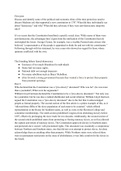
Common law based on precedent or court decisions. Equity constitutes general principles
and serve as a supplement to common law. Common law is universal as it applies to every
scenario. Common law values the concept of certainty. Common law is rigid and cannot be
changed. Equity is a form of legal relief in the even such relief cannot be found in the rules
of common law. Equity is based on judicial evaluation of fairness, reason, good faith and
justice. Common law entails applying the rules of common law to the issue before the court.
Common law operates on reasonability whilst equity operates on conscionability.
2. How does Rajah JA explain the development of equity? What principles explain how a judge
approaches equitable decision- making today?
“ the law evolved progressively to mitigate the severity sometimes occasioned by the rigid
application of the rules of the common law “.
Precedent , principle, policy and pragmatism. These are the four principles that equity is
based on. Precedent- there is case law which leaves prior decision, its used as a guidance but
they are not applied as strictly because it is so fact specific. Principles and policy- there are
no clear cut rules so the issues are much more broadly stated. Pragmatism- judgments that
work for the people involved, more tailed outcomes designed for that particular dispute.
Pragmatism gives suitable outcomes for certain situation so it is much more practical then
common law.
3. What do you understand conscience and unconscionability to mean in equity? Is it possible
to objectively determine unconscionable conduct? How do judges determine
unconscionability, especially in a globalised world with (a) litigants from a wide range of
different backgrounds and (b) the use of equity in jurisdictions around the world?
Conscience can be seen as a unified communal morality, an individual’s application of social
mores, or some argue that it is wholly personal where each person is allowed to formulate
their own sense of morality and ethics. Unconscionability is vague that it has no real
meaning and therefore no place in juridical discourse. Equity adopts the objective
conception of conscience.
There is the scholastic view of conscience which is that conscience is the process of moral
reasoning. This is based on Greek philosophy.
Why was equity developed as a counterbalance to the common law.
Common law based on precedent or court decisions. Equity constitutes general principles
and serve as a supplement to common law. Common law is universal as it applies to every
scenario. Common law values the concept of certainty. Common law is rigid and cannot be
changed. Equity is a form of legal relief in the even such relief cannot be found in the rules
of common law. Equity is based on judicial evaluation of fairness, reason, good faith and
justice. Common law entails applying the rules of common law to the issue before the court.
Common law operates on reasonability whilst equity operates on conscionability.
2. How does Rajah JA explain the development of equity? What principles explain how a judge
approaches equitable decision- making today?
“ the law evolved progressively to mitigate the severity sometimes occasioned by the rigid
application of the rules of the common law “.
Precedent , principle, policy and pragmatism. These are the four principles that equity is
based on. Precedent- there is case law which leaves prior decision, its used as a guidance but
they are not applied as strictly because it is so fact specific. Principles and policy- there are
no clear cut rules so the issues are much more broadly stated. Pragmatism- judgments that
work for the people involved, more tailed outcomes designed for that particular dispute.
Pragmatism gives suitable outcomes for certain situation so it is much more practical then
common law.
3. What do you understand conscience and unconscionability to mean in equity? Is it possible
to objectively determine unconscionable conduct? How do judges determine
unconscionability, especially in a globalised world with (a) litigants from a wide range of
different backgrounds and (b) the use of equity in jurisdictions around the world?
Conscience can be seen as a unified communal morality, an individual’s application of social
mores, or some argue that it is wholly personal where each person is allowed to formulate
their own sense of morality and ethics. Unconscionability is vague that it has no real
meaning and therefore no place in juridical discourse. Equity adopts the objective
conception of conscience.
There is the scholastic view of conscience which is that conscience is the process of moral
reasoning. This is based on Greek philosophy.