SECOND SEMESTER 2023
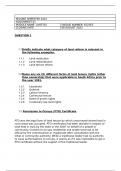
ASSIGNMENT 01
MODULE NAME: LAH3701 UNIQUE NUMBER: 652263
CLOSING DATE 08 AUGUST 2023
QUESTION 1
1.1 Briefly indicate what category of land reform is relevant in
the following examples.
1.1.1 Land restitution
1.1.2 Land redistribution
1.1.3 Land tenure reform
1.2 Name any six (6) different forms of land tenure rights (other
than ownership) that were applicable in South Africa prior to
the year 1991.
1.2.1 Leasehold
1.2.2 Quitrent
1.2.3 Labour tenancy
1.2.4 Communal tenure
1.2.5 Deed of grants rights
1.2.6 Customary law land rights
1.3 Permission to Occupy (PTO) Certificate
PTO was the legal form of land tenure by which unsurveyed shared land in
rural areas was occupied. PTO certificates had been decided in respect of
land held in trust by the state or the SADT on behalf of a people or
community. Consent to occupy residential and arable land had to be
official by the commissioner or magistrate after consultation with the
tribal or community authority. While a traditional leader had no authority
to issue authorisations to occupy, it seems as if it was impossible to get a
PTO certificate without the support of the traditional leader.
ASSIGNMENT 01
MODULE NAME: LAH3701 UNIQUE NUMBER: 652263
CLOSING DATE 08 AUGUST 2023
QUESTION 1
1.1 Briefly indicate what category of land reform is relevant in
the following examples.
1.1.1 Land restitution
1.1.2 Land redistribution
1.1.3 Land tenure reform
1.2 Name any six (6) different forms of land tenure rights (other
than ownership) that were applicable in South Africa prior to
the year 1991.
1.2.1 Leasehold
1.2.2 Quitrent
1.2.3 Labour tenancy
1.2.4 Communal tenure
1.2.5 Deed of grants rights
1.2.6 Customary law land rights
1.3 Permission to Occupy (PTO) Certificate
PTO was the legal form of land tenure by which unsurveyed shared land in
rural areas was occupied. PTO certificates had been decided in respect of
land held in trust by the state or the SADT on behalf of a people or
community. Consent to occupy residential and arable land had to be
official by the commissioner or magistrate after consultation with the
tribal or community authority. While a traditional leader had no authority
to issue authorisations to occupy, it seems as if it was impossible to get a
PTO certificate without the support of the traditional leader.