

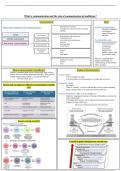
What is communication and the role of communication in healthcare?
Communication: Why?
Types and components of communication: - Disturbances to privacy Ineffective communication:
- Arrangement, colour and type of furniture - Generate complaints
- Lighting - misdiagnosis
- delayed diagnosis
Verbal Environment - fatalities
- Body position and movements
- Facial expressions
Written and pictoral Body Language As professionals’ poor
- Eye contact and eye behaviour
- Gestures communication contributes to:
Non-verbal communication - Personal space - perceived lack of
Suprasegmental
- Use of touch competence
- missed job
Paralinguistic - Volume opportunities
features - Pitch - conflict within team
- Rate/speed - legal ramifications
Effective communication
- Emphasis on words
requires knowledge, an
- Pauses
understanding of oneself and
- tone
others and skill.
What is communication in healthcare? Models of Communication:
- Effective communication occurs when people send, receive,
process and successfully understand messages. This produces Linear Model:
mutual understanding which is essential to healthcare - Like newspaper or radio
o (O’toole, 2020, p.11) - It is the giving out of information as a sender and a receiver
Interactive Model:
Factors that can impact on effective communication in health - Eg. Email
care: - There is a sender, a receiver and then the receiver sends something
back in return. There is an interaction between the two.
Transactional Model: (This is used in healthcare)
- Requires “ongoing processing of messages throughout an interaction
and a relationship.”
- Communication success can be impacted by internal and external
factors. (O’toole, 2020, p.4)
Person-centred care (PcC)
How to provide PcC: 3 steps
1. Mutual understanding
2. Building a therapeutic relationship A model to guide family/person centred care:
3. Person centred care and goals
, Learning Outcomes:
- Identify different styles of
communication
- identify the 4 domains of Johari
Window
Communication styles and Self Awareness - Demonstrate self-awareness
Communication Styles:
Determined by culture, family, life experiences, place in family, peers, etc
- Different communication styles assist working relationships and helps develop new ways of thinking and learning
- There are numerous definitions and descriptions of communications styles – vary with context
3-5 Main Styles:
- Aggressive
- Assertive
- Passive/Submissive
- Passive aggressive
- Manipulative
Communication Description Characteristics Non-Verbal Behaviour
Style
Aggressive a hostile or forceful message with an - Frightening/threatening/loud/hostile - Voice: loud volume
communication intention to hurt or pressure; - Out to “win” - Posture: “bigger” than others
expressing your feelings in a way - Demanding, abrasive - Gestures: big, fast, jerky
that is confrontational - Explosive, unpredictable - Facial: scowl, frown, glare
- Spatial Position: Invade others personal
space, try to stand over others
Assertive A direct and clear message with no - Achieving goals without hurting others - Voice: medium pitch, speed, volume
Communication intention to hurt - Protective of rights and respect of others - Posture: open posture, symmetrical,
- Expressing feelings in a - Socially and emotionally expressive balance, tall, relaxed, no fidgeting
manner that is honest, self - Making your own choices and taking - Gestures: even, rounded, expansive
confident and considerate responsibility for them - Facial expression: good eye contact
of the other persons - Accepting compliments - Spatial position: n control, respectful of
feelings others
- The healthiest style of
communication
Passive A non-direct or unclear message; not - Apologetic, inexpressive - Voice: soft volume
Communication expressing feelings at all or doing so - Avoiding any confrontation - Posture: makes themselves small, head
in a manner that is vague and makes - Finding difficulty in taking responsibility down
it seem that you could be easily or decisions - Gestures: twist and fidget
persuaded to change your mind - Yielding to someone else’s preferences - Facial expression: no eye contact
- Feeling like a victim - Spatial position: make themselves
- Refusing compliments smaller/lower than others
- Submissive behaviour
Passive - Indirectly aggressive - Sweet voice
Aggressive - Sarcastic, devious - Insincere smiling
- Unreliable, complaining, sulky, - Close touching
patronising - Pretends to be friendly
- Gossips
- Two faced
Manipulative - Controlling of others in an insidious way - Voice: patronising, envious,
- Asking indirectly for needs to be met ingratiating, often high pitch
- Making others feel obliged or sorry for - Facial:
them
- Uses fake tears
Self Awareness in Communication: The Johari Window:
What is self-awareness?
- The means by which a person gains knowledge and Domains
understanding of all aspects of self concept (i.e. interests, skills, Open self:
values, personality, occupation, roles) - Information is known to others
- The conscious use of this information to ensure equal, fair and about our attitudes, desires, ideas
unbiased health care provision (also know as our public self that
- Requires elf reflection we show to others)
Hidden Self:
Why is it necessary? - Cannot be known to others unless
- Enhance self-understanding We disclose it
- Allows acceptance of others - The degree to which we share
- Enable us to understand difficult situations we with others is the degree
- Enable self monitoring to which we can be known
- Enhance personal autonomy
Blind Self:
- Semi public
- Things we don’t know about ourselves but other people see clearly
- Things that we imagine to be true about ourselves for a variety of reasons but that
others do not see at all
Unknown self:
- Inner self
- Unconscious dimension
- From time to time something from our unconscious is revealed then we “know”
what we have never known before
Communication: Why?
Types and components of communication: - Disturbances to privacy Ineffective communication:
- Arrangement, colour and type of furniture - Generate complaints
- Lighting - misdiagnosis
- delayed diagnosis
Verbal Environment - fatalities
- Body position and movements
- Facial expressions
Written and pictoral Body Language As professionals’ poor
- Eye contact and eye behaviour
- Gestures communication contributes to:
Non-verbal communication - Personal space - perceived lack of
Suprasegmental
- Use of touch competence
- missed job
Paralinguistic - Volume opportunities
features - Pitch - conflict within team
- Rate/speed - legal ramifications
Effective communication
- Emphasis on words
requires knowledge, an
- Pauses
understanding of oneself and
- tone
others and skill.
What is communication in healthcare? Models of Communication:
- Effective communication occurs when people send, receive,
process and successfully understand messages. This produces Linear Model:
mutual understanding which is essential to healthcare - Like newspaper or radio
o (O’toole, 2020, p.11) - It is the giving out of information as a sender and a receiver
Interactive Model:
Factors that can impact on effective communication in health - Eg. Email
care: - There is a sender, a receiver and then the receiver sends something
back in return. There is an interaction between the two.
Transactional Model: (This is used in healthcare)
- Requires “ongoing processing of messages throughout an interaction
and a relationship.”
- Communication success can be impacted by internal and external
factors. (O’toole, 2020, p.4)
Person-centred care (PcC)
How to provide PcC: 3 steps
1. Mutual understanding
2. Building a therapeutic relationship A model to guide family/person centred care:
3. Person centred care and goals
, Learning Outcomes:
- Identify different styles of
communication
- identify the 4 domains of Johari
Window
Communication styles and Self Awareness - Demonstrate self-awareness
Communication Styles:
Determined by culture, family, life experiences, place in family, peers, etc
- Different communication styles assist working relationships and helps develop new ways of thinking and learning
- There are numerous definitions and descriptions of communications styles – vary with context
3-5 Main Styles:
- Aggressive
- Assertive
- Passive/Submissive
- Passive aggressive
- Manipulative
Communication Description Characteristics Non-Verbal Behaviour
Style
Aggressive a hostile or forceful message with an - Frightening/threatening/loud/hostile - Voice: loud volume
communication intention to hurt or pressure; - Out to “win” - Posture: “bigger” than others
expressing your feelings in a way - Demanding, abrasive - Gestures: big, fast, jerky
that is confrontational - Explosive, unpredictable - Facial: scowl, frown, glare
- Spatial Position: Invade others personal
space, try to stand over others
Assertive A direct and clear message with no - Achieving goals without hurting others - Voice: medium pitch, speed, volume
Communication intention to hurt - Protective of rights and respect of others - Posture: open posture, symmetrical,
- Expressing feelings in a - Socially and emotionally expressive balance, tall, relaxed, no fidgeting
manner that is honest, self - Making your own choices and taking - Gestures: even, rounded, expansive
confident and considerate responsibility for them - Facial expression: good eye contact
of the other persons - Accepting compliments - Spatial position: n control, respectful of
feelings others
- The healthiest style of
communication
Passive A non-direct or unclear message; not - Apologetic, inexpressive - Voice: soft volume
Communication expressing feelings at all or doing so - Avoiding any confrontation - Posture: makes themselves small, head
in a manner that is vague and makes - Finding difficulty in taking responsibility down
it seem that you could be easily or decisions - Gestures: twist and fidget
persuaded to change your mind - Yielding to someone else’s preferences - Facial expression: no eye contact
- Feeling like a victim - Spatial position: make themselves
- Refusing compliments smaller/lower than others
- Submissive behaviour
Passive - Indirectly aggressive - Sweet voice
Aggressive - Sarcastic, devious - Insincere smiling
- Unreliable, complaining, sulky, - Close touching
patronising - Pretends to be friendly
- Gossips
- Two faced
Manipulative - Controlling of others in an insidious way - Voice: patronising, envious,
- Asking indirectly for needs to be met ingratiating, often high pitch
- Making others feel obliged or sorry for - Facial:
them
- Uses fake tears
Self Awareness in Communication: The Johari Window:
What is self-awareness?
- The means by which a person gains knowledge and Domains
understanding of all aspects of self concept (i.e. interests, skills, Open self:
values, personality, occupation, roles) - Information is known to others
- The conscious use of this information to ensure equal, fair and about our attitudes, desires, ideas
unbiased health care provision (also know as our public self that
- Requires elf reflection we show to others)
Hidden Self:
Why is it necessary? - Cannot be known to others unless
- Enhance self-understanding We disclose it
- Allows acceptance of others - The degree to which we share
- Enable us to understand difficult situations we with others is the degree
- Enable self monitoring to which we can be known
- Enhance personal autonomy
Blind Self:
- Semi public
- Things we don’t know about ourselves but other people see clearly
- Things that we imagine to be true about ourselves for a variety of reasons but that
others do not see at all
Unknown self:
- Inner self
- Unconscious dimension
- From time to time something from our unconscious is revealed then we “know”
what we have never known before


