William Blake Context
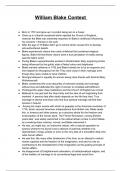
● Born in 1757 and grew up in London being son to a hosier
● Grew up in a liberal household which rejected the Church of England,,
however the Bible was extremely important in Blake’s childhood influencing
his concerts + themes in his work
● After the age of 10 Blake didn’t go to school which caused him to develop
anti-authoritarian beliefs.
● Blake experienced visions from early childhood that contained religious
figures, Blake felt that these visions were a true perception of reality seeing
past the fallen world
● During Blake’s apprenticeship worked in Westminister Abby engraving tombs
being influenced by the gothic style of faded colour and brightness
● Blake married catherine in 1782 and Blake trained her to be an engraver and
she helped him throughout her life. They were close in their marriage even
though they were unable to have children.
● Strongly believed in equality for women being close friends with feminist Mary
Wollstonecraft
● Blake condemned the cruel absurdity of enforced chastity and marriage
without love and defended the right of women to complete self-fulfilment
● Portrayed the upper class institutions and the Church of England as corrupt
● Believed in one god and the Holy trinity and the idea of evil originating from
mankind. A persons fate after death depends on the life they lived. True
marriage is eternal and those who find true spiritual marriage will find their
spouse in heaven.
● Among the major events with which he grapples is the American revolution of
1776, which secured American independence from British rule. Blake reads
this, in America and other poems, as a decisive stroke for the freedom and
emancipation of the human spirit. The French Revolution, coming thirteen
years later, was widely welcomed in the radical artisan circles in which Blake,
as a working-class cockney, moved, and Blake welcomed it
● He was, we might say, an instinctive radical, with a natural opposition to
tyranny wherever he found it and a distrust of authority whether it be
represented in kings, priests or even in the very idea of a monolithic deity who
rules human affairs
● He saw this, like many other tendencies of his time, as an attempt to restrict
human capacity and the freedom of the imagination, and saw his role as
contributing to the reinstatement of the imagination as the guiding principle of
human affairs.
● He disapproved of Enlightenment rationalism, of institutionalized religion, and
of the tradition of marriage in its conventional legal and social form
● Born in 1757 and grew up in London being son to a hosier
● Grew up in a liberal household which rejected the Church of England,,
however the Bible was extremely important in Blake’s childhood influencing
his concerts + themes in his work
● After the age of 10 Blake didn’t go to school which caused him to develop
anti-authoritarian beliefs.
● Blake experienced visions from early childhood that contained religious
figures, Blake felt that these visions were a true perception of reality seeing
past the fallen world
● During Blake’s apprenticeship worked in Westminister Abby engraving tombs
being influenced by the gothic style of faded colour and brightness
● Blake married catherine in 1782 and Blake trained her to be an engraver and
she helped him throughout her life. They were close in their marriage even
though they were unable to have children.
● Strongly believed in equality for women being close friends with feminist Mary
Wollstonecraft
● Blake condemned the cruel absurdity of enforced chastity and marriage
without love and defended the right of women to complete self-fulfilment
● Portrayed the upper class institutions and the Church of England as corrupt
● Believed in one god and the Holy trinity and the idea of evil originating from
mankind. A persons fate after death depends on the life they lived. True
marriage is eternal and those who find true spiritual marriage will find their
spouse in heaven.
● Among the major events with which he grapples is the American revolution of
1776, which secured American independence from British rule. Blake reads
this, in America and other poems, as a decisive stroke for the freedom and
emancipation of the human spirit. The French Revolution, coming thirteen
years later, was widely welcomed in the radical artisan circles in which Blake,
as a working-class cockney, moved, and Blake welcomed it
● He was, we might say, an instinctive radical, with a natural opposition to
tyranny wherever he found it and a distrust of authority whether it be
represented in kings, priests or even in the very idea of a monolithic deity who
rules human affairs
● He saw this, like many other tendencies of his time, as an attempt to restrict
human capacity and the freedom of the imagination, and saw his role as
contributing to the reinstatement of the imagination as the guiding principle of
human affairs.
● He disapproved of Enlightenment rationalism, of institutionalized religion, and
of the tradition of marriage in its conventional legal and social form