Hogeschool taaltoets Engels
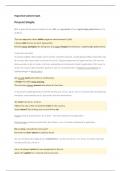
Present Simple
[B1] Je gebruikt de present simple om een feit, een gewoonte of een regelmatige gebeurtenis uit te
drukken:
This text says that clients dislike negative advertisements. (feit)
I always take the bus to work. (gewoonte)
Michael often apologises for being late, but never changes his behaviour. (regelmatige gebeurtenis)
Vaak staan woorden
als always (altijd), often (vaak), never (nooit), sometimes (soms), usually (gewoonlijk), frequently (vaa
k) en every day, every week, enzovoort in de zin. Ze geven gewoonte of regelmaat aan. Als een van
deze woorden in de zin staat, is dat een aanwijzing om de present simple te gebruiken. (Om meer te
leren over waar je deze woorden plaatst in een zin, zie bijwoorden in Adjectives and adverbs en
tijdsbepalingen in Word order.)
We usually meet each other at conferences.
I charge my tablet every evening.
The secretary always answers the phone for her boss.
In de present simple gebruik je het hele werkwoord. Let op: bij he, she en it (of woorden die daarnaar
verwijzen, zoals namen) zet je -(e)s achter het hele werkwoord.
We work from 8a.m. to 4p.m.
I live in the city, while my boyfriend lives in the country.
Susan doesn’t like writing, but Lea and Simon do.
Vragen maak je meestal door do of does + het hele werkwoord te gebruiken.
Ontkenningen maak je meestal door do of does + not + het hele werkwoord te gebruiken.
Do you buy a new phone every year?
Normally we don’t advise on political issues.
Als een werkwoord eindigt op een medeklinker + -y, dan vervalt de -y en zet je -ies achter dat hele
werkwoord bij he, she en it.
carry: He always carries his own equipment to the car.
apply: She applies for a new job every two years.
,Maar wanneer er een klinker (a, e, i, o, u) voor de -y staat, gebruik je gewoon alleen een -
s bij he, she en it.
buy: She buys a new phone every year.
stay: She stays at home most evenings.
Als een werkwoord eindigt op een sisklank (-(s)s, -sh, -ch, -x, -zz) of -o zet je -es achter het hele
werkwoord bij he, she en it. De onregelmatige werkwoorden do en go krijgen ook -es achter het
werkwoord bij he, she en it.
catch: He usually catches the first bus into town.
miss: Fatima never misses a deadline.
go: He goes to the gym every other day.
[B2] In zinnen met de constructie not only ... but also ... kun je de present simple ook gebruiken. Deze
constructie komt vooral voor in formeel taalgebruik. Als je extra nadruk wilt leggen, zet je not
only vooraan in de zin. In dat geval treedt er inversie op. Bij inversie komt het (hulp)werkwoord vóór
het onderwerp te staan. Als er geen ander hulpwerkwoord en geen vorm van to be in de zin staat,
heb je daarvoor een vorm van to do nodig.
affect, change: This process not only affects individual clients but also changes the entire market
segment.
be, forget: Not only is she often late for meetings, but she also forgets to prepare for presentations.
need, be: Not only do they need new laptops, but there is also bad Wi-Fi coverage in their room.
[C1] We also use the present simple with reporting verbs such as demonstrate, illustrate,
describe, and argue. We can use reporting verbs in academic, business, and other professional
writing contexts to convey information or arguments, or to report on research findings.
Reporting verbs can be used in numerous ways. In most cases, the standard rules for forming the
present simple apply. (Scroll up to B1 to review the rules.)
Here we provide some examples of reporting verbs and show how they are used. Note that this list is
not exhaustive and that some words may belong in several categories.
• Reporting verb + that-clause:
acknowledge, agree, argue, claim, clarify, comment, confirm, consider, demonstrate, deny,
doubt, estimate, explain, fear, feel, illustrate, insist, mention, observe, persuade, propose,
remark, repeat, reply, report, reveal, say, state, suggest, suppose, tell, think, understand,
warn
,Some researchers argue that the concept of virtual teams is inherently inferior to traditional on-site
presence.
This graph illustrates that 90% of advergames market high salt, sugar, and fat (HSSF) products.
• Reporting verb + that-clause (often with a (possessive) noun) OR the to-infinitive (verb
with to):
decide, expect, guarantee, hope, promise, swear, threaten
The research council promises that their new outreach programme will have a positive impact on
society.
Does the research council promise to implement their new funding programme next summer?
• Reporting verb + a noun/noun phrase:
analyse, applaud, assess, attack, consider, contradict, critique, debate, describe, discuss,
dismiss, evaluate, examine, explore, express, highlight, identify, ignore, illustrate, investigate,
justify, list, oppose, outline, praise, present, question, refute, reject, reveal, study, support,
underscore, use, validate, verify
This chapter analyses the effects that remote teaching has on test results.
In this proposal, we outline the advantages and disadvantages of remote teaching.
• Reporting verb + a clause starting with a question word (what, which, when, where, who,
whom, whose, why, whether, how):
decide, demonstrate, describe, discover, discuss, explain, forget, guess, imagine, know, learn,
realise, remember, reveal, say, see, show, state, suggest, teach, tell, think, understand,
wonder
Jones et al. (2019) do not discuss why there is an urgent need for additional protective gear at
construction sites.
Do the performed statistical tests reveal how demographic changes occur?
For more information about question words, see Questions. For more information about using who,
whom, whose, or which, see relative clauses.
Additionally, some reporting verbs can be used to express a (strong) suggestion or obligation. In that
case, different rules for forming the present simple apply. Some verbs that follow this pattern
are: advise, ask, command, demand, insist, order, propose, recommend, request, require, suggest,
urge
Sentences with ‘suggest-verbs’ can be confusing because the present simple forms used in them
differs according to formal vs. informal and/or British vs. American usage:
• In formal language especially in American English, we use a form called the subjunctive
mood. In this form
, o the ‘suggest-verb’ is conjugated according to the standard present simple rules (see
B1), and
o the verb in the that-clause is the bare infinitive (the verb without to) regardless of
the person it refers to. In practice, this means that the verb form only deviates from
the standard present simple rule with he/she/it, e.g. we suggest that it
remain instead of we suggest that it remains.
• In less formal British English, we take a different approach.
o The ‘suggest-verb’ AND the verb in the that-clause are conjugated following
the standard present simple rules.
o Alternatively, should + bare infinitive (verb without to) are commonly used instead of
the subjunctive.
• In both American and British English, in less formal writing and speaking, the word ‘that’ is
sometimes omitted.
AmE/formal BrE: We suggest that the distribution department remain in the same office. (NOT
remains)
Informal BrE: We suggest (that) the distribution department remains in the same office.
OR
We suggest (that) the distribution department should remain in the same office.
To form negations with a ‘suggest-verb’:
• In formal language especially in American English, place the negation (not) before the verb in
the that-clause when using the subjunctive. Note that we do not use ‘do/does’ in these
sentences.
• In less formal British English (so not using the subjunctive) either use do/does + not following
the general rules for negations OR should + not + bare infinitive (verb without to).
Although questions are uncommon with this form, they follow the same verb pattern and the general
rules to form questions.
AmE/formal BrE: We suggest that the distribution department not remain in the same office. (NOT
remains)
Informal BrE: We suggest (that) the distribution department does not remain in the same office.
OR
We suggest (that) the distribution department should not remain in the same office.
Present Simple
[B1] Je gebruikt de present simple om een feit, een gewoonte of een regelmatige gebeurtenis uit te
drukken:
This text says that clients dislike negative advertisements. (feit)
I always take the bus to work. (gewoonte)
Michael often apologises for being late, but never changes his behaviour. (regelmatige gebeurtenis)
Vaak staan woorden
als always (altijd), often (vaak), never (nooit), sometimes (soms), usually (gewoonlijk), frequently (vaa
k) en every day, every week, enzovoort in de zin. Ze geven gewoonte of regelmaat aan. Als een van
deze woorden in de zin staat, is dat een aanwijzing om de present simple te gebruiken. (Om meer te
leren over waar je deze woorden plaatst in een zin, zie bijwoorden in Adjectives and adverbs en
tijdsbepalingen in Word order.)
We usually meet each other at conferences.
I charge my tablet every evening.
The secretary always answers the phone for her boss.
In de present simple gebruik je het hele werkwoord. Let op: bij he, she en it (of woorden die daarnaar
verwijzen, zoals namen) zet je -(e)s achter het hele werkwoord.
We work from 8a.m. to 4p.m.
I live in the city, while my boyfriend lives in the country.
Susan doesn’t like writing, but Lea and Simon do.
Vragen maak je meestal door do of does + het hele werkwoord te gebruiken.
Ontkenningen maak je meestal door do of does + not + het hele werkwoord te gebruiken.
Do you buy a new phone every year?
Normally we don’t advise on political issues.
Als een werkwoord eindigt op een medeklinker + -y, dan vervalt de -y en zet je -ies achter dat hele
werkwoord bij he, she en it.
carry: He always carries his own equipment to the car.
apply: She applies for a new job every two years.
,Maar wanneer er een klinker (a, e, i, o, u) voor de -y staat, gebruik je gewoon alleen een -
s bij he, she en it.
buy: She buys a new phone every year.
stay: She stays at home most evenings.
Als een werkwoord eindigt op een sisklank (-(s)s, -sh, -ch, -x, -zz) of -o zet je -es achter het hele
werkwoord bij he, she en it. De onregelmatige werkwoorden do en go krijgen ook -es achter het
werkwoord bij he, she en it.
catch: He usually catches the first bus into town.
miss: Fatima never misses a deadline.
go: He goes to the gym every other day.
[B2] In zinnen met de constructie not only ... but also ... kun je de present simple ook gebruiken. Deze
constructie komt vooral voor in formeel taalgebruik. Als je extra nadruk wilt leggen, zet je not
only vooraan in de zin. In dat geval treedt er inversie op. Bij inversie komt het (hulp)werkwoord vóór
het onderwerp te staan. Als er geen ander hulpwerkwoord en geen vorm van to be in de zin staat,
heb je daarvoor een vorm van to do nodig.
affect, change: This process not only affects individual clients but also changes the entire market
segment.
be, forget: Not only is she often late for meetings, but she also forgets to prepare for presentations.
need, be: Not only do they need new laptops, but there is also bad Wi-Fi coverage in their room.
[C1] We also use the present simple with reporting verbs such as demonstrate, illustrate,
describe, and argue. We can use reporting verbs in academic, business, and other professional
writing contexts to convey information or arguments, or to report on research findings.
Reporting verbs can be used in numerous ways. In most cases, the standard rules for forming the
present simple apply. (Scroll up to B1 to review the rules.)
Here we provide some examples of reporting verbs and show how they are used. Note that this list is
not exhaustive and that some words may belong in several categories.
• Reporting verb + that-clause:
acknowledge, agree, argue, claim, clarify, comment, confirm, consider, demonstrate, deny,
doubt, estimate, explain, fear, feel, illustrate, insist, mention, observe, persuade, propose,
remark, repeat, reply, report, reveal, say, state, suggest, suppose, tell, think, understand,
warn
,Some researchers argue that the concept of virtual teams is inherently inferior to traditional on-site
presence.
This graph illustrates that 90% of advergames market high salt, sugar, and fat (HSSF) products.
• Reporting verb + that-clause (often with a (possessive) noun) OR the to-infinitive (verb
with to):
decide, expect, guarantee, hope, promise, swear, threaten
The research council promises that their new outreach programme will have a positive impact on
society.
Does the research council promise to implement their new funding programme next summer?
• Reporting verb + a noun/noun phrase:
analyse, applaud, assess, attack, consider, contradict, critique, debate, describe, discuss,
dismiss, evaluate, examine, explore, express, highlight, identify, ignore, illustrate, investigate,
justify, list, oppose, outline, praise, present, question, refute, reject, reveal, study, support,
underscore, use, validate, verify
This chapter analyses the effects that remote teaching has on test results.
In this proposal, we outline the advantages and disadvantages of remote teaching.
• Reporting verb + a clause starting with a question word (what, which, when, where, who,
whom, whose, why, whether, how):
decide, demonstrate, describe, discover, discuss, explain, forget, guess, imagine, know, learn,
realise, remember, reveal, say, see, show, state, suggest, teach, tell, think, understand,
wonder
Jones et al. (2019) do not discuss why there is an urgent need for additional protective gear at
construction sites.
Do the performed statistical tests reveal how demographic changes occur?
For more information about question words, see Questions. For more information about using who,
whom, whose, or which, see relative clauses.
Additionally, some reporting verbs can be used to express a (strong) suggestion or obligation. In that
case, different rules for forming the present simple apply. Some verbs that follow this pattern
are: advise, ask, command, demand, insist, order, propose, recommend, request, require, suggest,
urge
Sentences with ‘suggest-verbs’ can be confusing because the present simple forms used in them
differs according to formal vs. informal and/or British vs. American usage:
• In formal language especially in American English, we use a form called the subjunctive
mood. In this form
, o the ‘suggest-verb’ is conjugated according to the standard present simple rules (see
B1), and
o the verb in the that-clause is the bare infinitive (the verb without to) regardless of
the person it refers to. In practice, this means that the verb form only deviates from
the standard present simple rule with he/she/it, e.g. we suggest that it
remain instead of we suggest that it remains.
• In less formal British English, we take a different approach.
o The ‘suggest-verb’ AND the verb in the that-clause are conjugated following
the standard present simple rules.
o Alternatively, should + bare infinitive (verb without to) are commonly used instead of
the subjunctive.
• In both American and British English, in less formal writing and speaking, the word ‘that’ is
sometimes omitted.
AmE/formal BrE: We suggest that the distribution department remain in the same office. (NOT
remains)
Informal BrE: We suggest (that) the distribution department remains in the same office.
OR
We suggest (that) the distribution department should remain in the same office.
To form negations with a ‘suggest-verb’:
• In formal language especially in American English, place the negation (not) before the verb in
the that-clause when using the subjunctive. Note that we do not use ‘do/does’ in these
sentences.
• In less formal British English (so not using the subjunctive) either use do/does + not following
the general rules for negations OR should + not + bare infinitive (verb without to).
Although questions are uncommon with this form, they follow the same verb pattern and the general
rules to form questions.
AmE/formal BrE: We suggest that the distribution department not remain in the same office. (NOT
remains)
Informal BrE: We suggest (that) the distribution department does not remain in the same office.
OR
We suggest (that) the distribution department should not remain in the same office.