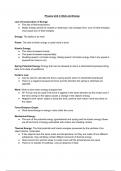
Physics Unit 3: Work and Energy
Law of Conservation of Energy:
● First law of thermodynamics
● States energy cannot be created or destroyed, only changes form, sum of initial energies
must equal sum of final energies
Energy: The ability to do work
Power: The rate at which energy is used/ work is done
Kinetic Energy:
● The mass increases linearly
● The speed increases exponentially
● Doubling speed= x4 kinetic energy, tripling speed= x9 kinetic energy (that’s why speed is
squared but mass is not)
Spring Potential Energy: Energy that can be released to return a stretched/compressed string
back to its state of equilibrium
Hooke’s Law:
● Can be used to calculate the force a spring exerts when it’s stretched/compressed
● There is a negative because the force and the direction the spring is stretched are
opposite
Work: Work is done when energy changes form
● W= Fd can only be used if the force is applied in the same direction as the motion and if
the force acting on the object causes a change in the object’s energy
● Negative work value= object is doing the work, positive work value= work was done on
the object
Force-Distance Graph:
● Work done/change in energy= area under the curve
Mechanical Energy:
● The sum of the potential energy (gravitational and spring) and the kinetic energy (these
are all the forms of energy associated with motion and creating motion)
Thermal Energy: The total potential and kinetic energies possessed by the particles of an
object (atoms, molecules)
● If two objects have the same mass and temperature, but they are made of two different
substances, they will likely contain different amounts of thermal energy
● Heat moves from warmer areas to cooler ones until the temperatures are equal
● There is no transfer of coldness- only an absence of heat
, ● The kinetic molecular theory states that as particles of matter gain kinetic energy, they
move faster and the temperature of the substance increases and vice versa
Heat: Thermal energy in transfer (between two materials of different temperatures)
Temperature: A measure of thermal energy (average kinetic energy of the particles in a
substance)
● Three commonly used scales:
○ Celsius Scale: Based on the boiling and freezing points of water
○ Fahrenheit Scale: Based on the boiling and freezing points of brine
○ Kelvin Scale: Developed using ‘absolute zero’ as the point at which there is
virtually no motion in the particles of a substance (0 K = -273 ℃)
● Conversion Equations: Celsius = Kelvin - 273, Kelvin = Celsius + 273
Vacuum: A volume empty of matter (no heat due to the absence of atoms resulting in no atomic
vibrations)
● A thermos keeps food warm by imitating a vacuum but a true vacuum has not yet been
created due to its extreme difficulty
Methods of Transferring Thermal Energy:
● Conduction: Heat transfer due to contact (fast-moving particles of a warmer material
collide with the slower-moving particles of a colder materia which causes the
slower-moving particles of the colder object to speed up and the faster-moving particles
of the warmer object to slow down)
● Convection: Heat transfer through the movement of a liquid (colder, denser fluid falls
and pushes up warmer, less dense fluid), creates convection current (rotating motion)
● Radiation: Heat transfer through electromagnetic waves emitted from sources such as
lamps, flames, the sun etc. (all particles that have kinetic energy emit some radiant
energy)
Specific Heat Capacity: The amount of energy required to increase the temperature of 1 kg of
a substance by 1 °C.
Latent Heat:
● Solid ↔ Liquid = Fusion (mLf)
● Liquid ↔ Gas = Vaporization (mLv)
Law of Conservation of Energy:
● First law of thermodynamics
● States energy cannot be created or destroyed, only changes form, sum of initial energies
must equal sum of final energies
Energy: The ability to do work
Power: The rate at which energy is used/ work is done
Kinetic Energy:
● The mass increases linearly
● The speed increases exponentially
● Doubling speed= x4 kinetic energy, tripling speed= x9 kinetic energy (that’s why speed is
squared but mass is not)
Spring Potential Energy: Energy that can be released to return a stretched/compressed string
back to its state of equilibrium
Hooke’s Law:
● Can be used to calculate the force a spring exerts when it’s stretched/compressed
● There is a negative because the force and the direction the spring is stretched are
opposite
Work: Work is done when energy changes form
● W= Fd can only be used if the force is applied in the same direction as the motion and if
the force acting on the object causes a change in the object’s energy
● Negative work value= object is doing the work, positive work value= work was done on
the object
Force-Distance Graph:
● Work done/change in energy= area under the curve
Mechanical Energy:
● The sum of the potential energy (gravitational and spring) and the kinetic energy (these
are all the forms of energy associated with motion and creating motion)
Thermal Energy: The total potential and kinetic energies possessed by the particles of an
object (atoms, molecules)
● If two objects have the same mass and temperature, but they are made of two different
substances, they will likely contain different amounts of thermal energy
● Heat moves from warmer areas to cooler ones until the temperatures are equal
● There is no transfer of coldness- only an absence of heat
, ● The kinetic molecular theory states that as particles of matter gain kinetic energy, they
move faster and the temperature of the substance increases and vice versa
Heat: Thermal energy in transfer (between two materials of different temperatures)
Temperature: A measure of thermal energy (average kinetic energy of the particles in a
substance)
● Three commonly used scales:
○ Celsius Scale: Based on the boiling and freezing points of water
○ Fahrenheit Scale: Based on the boiling and freezing points of brine
○ Kelvin Scale: Developed using ‘absolute zero’ as the point at which there is
virtually no motion in the particles of a substance (0 K = -273 ℃)
● Conversion Equations: Celsius = Kelvin - 273, Kelvin = Celsius + 273
Vacuum: A volume empty of matter (no heat due to the absence of atoms resulting in no atomic
vibrations)
● A thermos keeps food warm by imitating a vacuum but a true vacuum has not yet been
created due to its extreme difficulty
Methods of Transferring Thermal Energy:
● Conduction: Heat transfer due to contact (fast-moving particles of a warmer material
collide with the slower-moving particles of a colder materia which causes the
slower-moving particles of the colder object to speed up and the faster-moving particles
of the warmer object to slow down)
● Convection: Heat transfer through the movement of a liquid (colder, denser fluid falls
and pushes up warmer, less dense fluid), creates convection current (rotating motion)
● Radiation: Heat transfer through electromagnetic waves emitted from sources such as
lamps, flames, the sun etc. (all particles that have kinetic energy emit some radiant
energy)
Specific Heat Capacity: The amount of energy required to increase the temperature of 1 kg of
a substance by 1 °C.
Latent Heat:
● Solid ↔ Liquid = Fusion (mLf)
● Liquid ↔ Gas = Vaporization (mLv)