

AST 110 – General Astronomy # 2 (Practice)
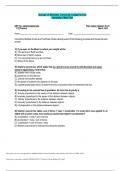
1) If you were on the Moon’s surface your weight will be A) The same as in Earth’s surface B)More than in Earth’s surface C) You cannot tell since you are not there! D) None of the above 2) Kepler's second law, which states that as a planet moves around its orbit itsweeps out equal areas in equal times, means that, A) planets have circular orbits. B) planets do not orbit the sun. C) planets orbit another planets. D) the period of a planet only depends on its mass. E) a planet travels faster when it is nearer to the Sun and slower when it is fartherfromthe Sun. 3) According to the universal law of gravitation, the force due to gravity is A) directly proportional to the square of the distance between objects. B) inversely proportional to the square of the distance between objects. C) directly proportional to the distance between objects. D) inversely proportional to the distance between objects. E) not dependent on the distance between objects. 4) Newton's second law states: sum of forces = mass × acceleration. If a known force was applied to an object with a known mass, how would you predict that object's acceleration? A) acceleration = mass × sum of forces B) acceleration = mass / sum of forces C) acceleration = sum of forces / mass D) Newton's second law is irrelevant for solving this problem. CONTINUES...
Document information
- Uploaded on
- August 1, 2023
- Number of pages
- 8
- Written in
- 2023/2024
- Type
- Exam (elaborations)
- Contains
- Questions & answers


