‘The best crime writing always involves the
unexpected.ʼ Explore the significance of the
unexpected in The Murder of Roger Ackroyd
[25 marks]
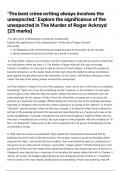
‘The best crime writing always involves the unexpected.ʼ
Explore the significance of the unexpected in The Murder of Roger Ackroyd
[25 marks]
Dr Sheppard as the criminal Being unsuspecting due to his position as the narrator.
Being unexpected due to his position as a doctor in society.
In crime fiction, authors use of mystery and the unexpected is a key feature used to create thrill
and anticipation within the story. In ‘The Murder of Roger Ackroydʼ this occurs through
Christieʼs revelation of a new clue or idea by the end of each chapter. It allows the mystery to
become interactive, so the reader takes on their own roll as the detective whose scrutinising
gaze passes through almost all of the characters. In this essay I will therefore discuss to what
extent ‘the best crime writing always involves the unexpectedʼ.
As Poirot states in Chapter 12 to all of the suspects, “every one of you in this room is concealing
something”, “each one of you has something to hide”. However, in this moment it is only upon
second read or later reflection that the reader realises that there are two characters who we
subconsciously do not suspect. Firstly, Poirot who should be a suspect yet is not due to his
position as a detective and outsider differentiating him from the rest of the ‘dramatis personaeʼ.
Secondly, Dr Sheppard who avoids the readers suspicions by acting as the “Watson” to Poirotʼs
“Sherlock” and the narrator whom we feel trust towards. It is therefore when Poirot creates the
portrait of the possible criminal in his denouement describing him as a “person who was on the
scene straightaway”, “carrying a receptacle into which the Dictaphone might be fitted” and one
who had a “mechanical turn of mind”, the clues begin to string together with the revelation of “In
fact – Dr Sheppard!” creating one of the most unexpected turn of events in all detective fiction
and Christieʼs novels.
In 1926 when the novel was published critics stated that Christie had cheated and that by
breaking Knoxʼs first law of detective fiction; ‘the narrator cannot conceal any thoughts which
may pass his mind… and cannot be the murdererʼ, the novel should be seen as a subversion of
the genre not an achievement. However, as Dorothy L Sayers stated, “Christie fooled you!”, and
by the end of the novel the reader does indeed feel fooled by the unexpected turn of events. Dr
Sheppard never directly lies or deceives in his narrative but merely elides the truth. In Chapter 4
‘Dinner at Fernleyʼ, his double-edged discourse and ambiguous lexical choices in; “I hesitated
with my hand on the door handle, looking back and wondering if there was anything I had left
unexpected.ʼ Explore the significance of the
unexpected in The Murder of Roger Ackroyd
[25 marks]
‘The best crime writing always involves the unexpected.ʼ
Explore the significance of the unexpected in The Murder of Roger Ackroyd
[25 marks]
Dr Sheppard as the criminal Being unsuspecting due to his position as the narrator.
Being unexpected due to his position as a doctor in society.
In crime fiction, authors use of mystery and the unexpected is a key feature used to create thrill
and anticipation within the story. In ‘The Murder of Roger Ackroydʼ this occurs through
Christieʼs revelation of a new clue or idea by the end of each chapter. It allows the mystery to
become interactive, so the reader takes on their own roll as the detective whose scrutinising
gaze passes through almost all of the characters. In this essay I will therefore discuss to what
extent ‘the best crime writing always involves the unexpectedʼ.
As Poirot states in Chapter 12 to all of the suspects, “every one of you in this room is concealing
something”, “each one of you has something to hide”. However, in this moment it is only upon
second read or later reflection that the reader realises that there are two characters who we
subconsciously do not suspect. Firstly, Poirot who should be a suspect yet is not due to his
position as a detective and outsider differentiating him from the rest of the ‘dramatis personaeʼ.
Secondly, Dr Sheppard who avoids the readers suspicions by acting as the “Watson” to Poirotʼs
“Sherlock” and the narrator whom we feel trust towards. It is therefore when Poirot creates the
portrait of the possible criminal in his denouement describing him as a “person who was on the
scene straightaway”, “carrying a receptacle into which the Dictaphone might be fitted” and one
who had a “mechanical turn of mind”, the clues begin to string together with the revelation of “In
fact – Dr Sheppard!” creating one of the most unexpected turn of events in all detective fiction
and Christieʼs novels.
In 1926 when the novel was published critics stated that Christie had cheated and that by
breaking Knoxʼs first law of detective fiction; ‘the narrator cannot conceal any thoughts which
may pass his mind… and cannot be the murdererʼ, the novel should be seen as a subversion of
the genre not an achievement. However, as Dorothy L Sayers stated, “Christie fooled you!”, and
by the end of the novel the reader does indeed feel fooled by the unexpected turn of events. Dr
Sheppard never directly lies or deceives in his narrative but merely elides the truth. In Chapter 4
‘Dinner at Fernleyʼ, his double-edged discourse and ambiguous lexical choices in; “I hesitated
with my hand on the door handle, looking back and wondering if there was anything I had left