NR 361 Week 4 Discussion: Your Patient Has a Personal Health
Record . . . Now What
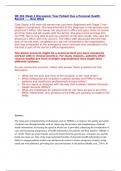
Case Study: A 65-year-old woman has just been diagnosed with Stage 3 non-
Hodgkin's lymphoma. She was informed of this diagnosis in her primary care
physician’s office. She leaves her physician's office and goes home to review
all of her tests and lab results with her family. She goes home and logs into
her PHR. She is only able to pull up a portion of her test results. She calls her
physician’s office with this concern. The office staff discussed that she had
part of her lab work completed at a lab not connected to the organization,
part was completed at the emergency room, and part was completed in the
lab that is part of the doctor's office organization.
The above scenario might be a scenario that you have commonly
worked with in clinical practice. For many reasons, patients often
receive healthcare from multiple organizations that might have
different systems.
As you review this scenario, reflect and answer these questions for this
discussion.
What are the pros and cons of the situation in the case study?
What safeguards are included in patient portals and PHRs to help
patients and healthcare professionals ensure safety?
Do you agree or disagree with the way that a patient obtains Personal
Health Records (PHRs)?
What are challenges for patients that do not have access to all of the
PHRs? Remember, only portions of the EHRs are typically included in the
PHRs.
Answer:
The main goal of implementing technologies such as EHRSs is to improve the quality and safety
of patient care through benefits such as: improving the accuracy and completeness of patient
health information; increasing the speed at which care is provided; enhancing the coordination of
care; and increasing transparency of health information for patients and their families. (Hebda et
al., 2018). There are great benefits across the board from the general use, consumer use, and the
heath care team use. One of the major potential benefits of electronic health information is the
ability to engage patients in their care and provide venues to access caregivers virtually, using
email and web platforms, providing ease and convenience to the patient (Hebda et al., 2018). In
, this case study it was no different, the client was able to go home and review with family what
was explained by her provider to then be able make an informed decision regarding her care.
This allows her to; decreased her wait time for treatment; give her access and control over health
information; she can ask informed questions from reviewing her records; and increased
medication safety when she goes for treatment.
Of course, there are some snags along the way with EMRs. In the case study the patient only had
partial information in her records with this provider. This is a common factor I have witness on
the frontline working with clients and EMR access. Patients can struggle to access their health
data because of underutilized patient portals, ambiguous security protocols, and lack of health IT
interoperability. Just to name a few changeless faced not just by the client but by the healthcare
industry: supporting communication and coordination of care among integrated teams;
exchanging information with tablet devices and other EHRSs ; While robust in volume, clinical
documentation often is highly fragmented, which makes it difficult to learn a complete story
about a patient (Effk & Weaver, 2016); Work-arounds in Accessing Information from the EHRS
are developed ; and Integration from one system to the other don’t speak.
With all the data floating in the world it is extremely important that there are safeguards to
protect PHRs. To make sure that your health information is safe from unauthorized access, EHRs
patient portal must be hosted on a secure connection and accessed via an encrypted, password-
protected login. There are three pillars to securing protected health information outlined by
HIPAA administrative safeguards, physical safeguards, and technical safeguards. These
safeguards consist of transmission security, authentication who should have access, not
excluding access control based in organization role, audit controls and integrity of the data.
Patient access to health data is an important component to empowers patients with knowledge
about their conditions. It also incorporates the patient as a partner in care. Giving patients a view
into their health records allows them to learn about their health, become more active in their care,
make health decisions, improve their care, improve engagement, empower them to be more in
control of decisions regarding their health, monitor chronic conditions, adhere to treatment, and
find and fix errors. Yes, I agree they should have access. There are cons to having access to all
records though. Patients can struggle to access their health data because of underutilized patient
portals, ambiguous security protocols, and lack of health IT interoperability. In the case study it
was IT interoperability to share data visual for client to see in one platform.
Until health care demographic data collection requirements are consistent with public health
requirements, the national goal of eliminating health disparities cannot be realized (Douglas et
al., 2015). This affects to overall why some records are visible over others. Items scanned into a
EMR cannot be seen by a client. That can be a consult report pertain to patient care, yet it is old
school fax transmission there is nowhere to data dump the information outside of a file folder in
Record . . . Now What
Case Study: A 65-year-old woman has just been diagnosed with Stage 3 non-
Hodgkin's lymphoma. She was informed of this diagnosis in her primary care
physician’s office. She leaves her physician's office and goes home to review
all of her tests and lab results with her family. She goes home and logs into
her PHR. She is only able to pull up a portion of her test results. She calls her
physician’s office with this concern. The office staff discussed that she had
part of her lab work completed at a lab not connected to the organization,
part was completed at the emergency room, and part was completed in the
lab that is part of the doctor's office organization.
The above scenario might be a scenario that you have commonly
worked with in clinical practice. For many reasons, patients often
receive healthcare from multiple organizations that might have
different systems.
As you review this scenario, reflect and answer these questions for this
discussion.
What are the pros and cons of the situation in the case study?
What safeguards are included in patient portals and PHRs to help
patients and healthcare professionals ensure safety?
Do you agree or disagree with the way that a patient obtains Personal
Health Records (PHRs)?
What are challenges for patients that do not have access to all of the
PHRs? Remember, only portions of the EHRs are typically included in the
PHRs.
Answer:
The main goal of implementing technologies such as EHRSs is to improve the quality and safety
of patient care through benefits such as: improving the accuracy and completeness of patient
health information; increasing the speed at which care is provided; enhancing the coordination of
care; and increasing transparency of health information for patients and their families. (Hebda et
al., 2018). There are great benefits across the board from the general use, consumer use, and the
heath care team use. One of the major potential benefits of electronic health information is the
ability to engage patients in their care and provide venues to access caregivers virtually, using
email and web platforms, providing ease and convenience to the patient (Hebda et al., 2018). In
, this case study it was no different, the client was able to go home and review with family what
was explained by her provider to then be able make an informed decision regarding her care.
This allows her to; decreased her wait time for treatment; give her access and control over health
information; she can ask informed questions from reviewing her records; and increased
medication safety when she goes for treatment.
Of course, there are some snags along the way with EMRs. In the case study the patient only had
partial information in her records with this provider. This is a common factor I have witness on
the frontline working with clients and EMR access. Patients can struggle to access their health
data because of underutilized patient portals, ambiguous security protocols, and lack of health IT
interoperability. Just to name a few changeless faced not just by the client but by the healthcare
industry: supporting communication and coordination of care among integrated teams;
exchanging information with tablet devices and other EHRSs ; While robust in volume, clinical
documentation often is highly fragmented, which makes it difficult to learn a complete story
about a patient (Effk & Weaver, 2016); Work-arounds in Accessing Information from the EHRS
are developed ; and Integration from one system to the other don’t speak.
With all the data floating in the world it is extremely important that there are safeguards to
protect PHRs. To make sure that your health information is safe from unauthorized access, EHRs
patient portal must be hosted on a secure connection and accessed via an encrypted, password-
protected login. There are three pillars to securing protected health information outlined by
HIPAA administrative safeguards, physical safeguards, and technical safeguards. These
safeguards consist of transmission security, authentication who should have access, not
excluding access control based in organization role, audit controls and integrity of the data.
Patient access to health data is an important component to empowers patients with knowledge
about their conditions. It also incorporates the patient as a partner in care. Giving patients a view
into their health records allows them to learn about their health, become more active in their care,
make health decisions, improve their care, improve engagement, empower them to be more in
control of decisions regarding their health, monitor chronic conditions, adhere to treatment, and
find and fix errors. Yes, I agree they should have access. There are cons to having access to all
records though. Patients can struggle to access their health data because of underutilized patient
portals, ambiguous security protocols, and lack of health IT interoperability. In the case study it
was IT interoperability to share data visual for client to see in one platform.
Until health care demographic data collection requirements are consistent with public health
requirements, the national goal of eliminating health disparities cannot be realized (Douglas et
al., 2015). This affects to overall why some records are visible over others. Items scanned into a
EMR cannot be seen by a client. That can be a consult report pertain to patient care, yet it is old
school fax transmission there is nowhere to data dump the information outside of a file folder in