Acyl Chloride and Acid Anhydride's
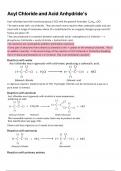
Acyl chlorides have the functional group COCl with the general formulae: CnH2n-1OCl.
The name ends with -oyl chloride. They are much more reactive than carboxylic acids and can
react with a range of molecules where Cl is substituted for an oxygen/ nitrogen group and HCl
fumes are given off.
They are produced in a reaction between carboxylic acids + phosphorus (v) chloride --->
phosphorus trichloride + acetyl chloride + hydrochloric acid.
The reactions are nucleophilic addition-elimination reactions.
A lone pair of electrons from ethanol is donated to the + carbon of the ethanoyl chloride. This is
an addition reaction. In the second step of the reaction of HCl molecule is formed by breaking
the O-H bond and formation of a C=O bond. This is an elimination reaction.
Reaction with water
A vigorous reaction, steamy fumes of HCl. Hydrogen chloride can be removed as a gas so a
pure ester is formed.
Reaction with alcohols
Slower and less vigorous so it needs to be warmed.
Reaction with ammonia
Reaction with primary amines
, Nucleophilic addition-elimination reactions have two steps:
1. Nucleophile adds onto the acetyl chloride displacing the Cl- ion.
2. The hydrogen leaves to create an acetyl chloride derivative.
The shorter/smaller chain is next to the N when naming the secondary amide. (N-methyl
ethanamide).
Acylation - replacing a H with an acetyl group (COCH3).
Made from two identical carboxylic acid molecules joined via an oxygen with carbonyl groups
on either side.
The reactions are very similar to acetyl chlorides but are less vigorous and produce a carboxylic
acid instead of HCl.
To name a carboxylic acid the acid part of the name is removed and replaced with
anhydride - ethanoic acid --> ethanoic anhydride.
Acyl chlorides have the functional group COCl with the general formulae: CnH2n-1OCl.
The name ends with -oyl chloride. They are much more reactive than carboxylic acids and can
react with a range of molecules where Cl is substituted for an oxygen/ nitrogen group and HCl
fumes are given off.
They are produced in a reaction between carboxylic acids + phosphorus (v) chloride --->
phosphorus trichloride + acetyl chloride + hydrochloric acid.
The reactions are nucleophilic addition-elimination reactions.
A lone pair of electrons from ethanol is donated to the + carbon of the ethanoyl chloride. This is
an addition reaction. In the second step of the reaction of HCl molecule is formed by breaking
the O-H bond and formation of a C=O bond. This is an elimination reaction.
Reaction with water
A vigorous reaction, steamy fumes of HCl. Hydrogen chloride can be removed as a gas so a
pure ester is formed.
Reaction with alcohols
Slower and less vigorous so it needs to be warmed.
Reaction with ammonia
Reaction with primary amines
, Nucleophilic addition-elimination reactions have two steps:
1. Nucleophile adds onto the acetyl chloride displacing the Cl- ion.
2. The hydrogen leaves to create an acetyl chloride derivative.
The shorter/smaller chain is next to the N when naming the secondary amide. (N-methyl
ethanamide).
Acylation - replacing a H with an acetyl group (COCH3).
Made from two identical carboxylic acid molecules joined via an oxygen with carbonyl groups
on either side.
The reactions are very similar to acetyl chlorides but are less vigorous and produce a carboxylic
acid instead of HCl.
To name a carboxylic acid the acid part of the name is removed and replaced with
anhydride - ethanoic acid --> ethanoic anhydride.