

UHMOSC1F/1-B/003
UH EXTENDED DEGREE IN SCIENCE
Fluid Mosaic Model Essay
Cell membrane : The basics
- Cell membrane controls movement of molecules in and out of the cell.
- The cell membrane is selectively permeable. It allows certain chemicals to flow through
quickly and others to pass through slowly, but it also prohibits other substances from
going through at all.
- Cell membrane is similar to the membrane around organelles
- This benefits the surrounding organelles by restricting the passage of proteins. Most
organelles contain a set of membrane
proteins that form a pore. This pore permits
the passage of proteins with the correct
signal sequence, which is similar to a
sequence in a lock and key process but in
the case of the access to pass through the
membrane.
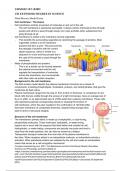
- Made of phospholipids and proteins.
- This is so a barrier can be formed between
the external environment and the cell,
regulate the transportation of molecules
across the membrane, and communicate
with other cells via protein receptors.
Background to the cell membrane
The fluid mosaic model depicts the plasma membrane's structure as a mosaic of
components, including phospholipids, cholesterol, proteins, and carbohydrates, that give the
membrane its fluid nature.
- Plasma membranes range from the size of 5nm to 8nm in thickness. In comparison to red
blood cells that are visible through the access of a light microscope, have an average size of
8 µm in width, or an approximate size of x1000 wider than a plasma membrane. These cells
also represent positively corresponding results to studying the function of
cell membrane, which has also resulted in the confirmation of 100-fold softer
than latex membrane of comparable thickness, despite being stronger than
steel in terms of structural integrity.
Structure of the cell membrane
- The membrane's primary fabric is made up of amphiphilic, or dual-loving,
phospholipid molecules. These molecules' hydrophilic, or water-loving,
regions are in touch with the aqueous fluid both within and outside the cell.
Hydrophobic, or water-hating, compounds are typically non-polar and tend to
repel from the water particles; this can also be named as a bilayer.
- Transporters transport molecules from one side of the plasma membrane to
the other. When receptors attach to an extracellular molecule, an intracellular activity is
activated. Other peripheral proteins are released by the cell and create an extracellular
matrix that serves as a cell recognition mechanism.
Courses.lumenlearning.com. 2021. Cell Membranes and the Fluid Mosaic Model | Boundless
Anatomy and Physiology. [online] Available at:
<https://courses.lumenlearning.com/boundless-ap/chapter/cell-membranes-and-the-fluid-mosaic-mod
el/#:~:text=The%20 fluid%20 mosaic%20model%20 describes%20the%20structure%20of%20the%20
plasma,to%2010%20nm%20in%20 thickness.&text=For%20example%2C%20
myelin%20contains%2018%25%20protein%20and%2076%25%20lipid.> [Accessed 29 September
2021].
UH EXTENDED DEGREE IN SCIENCE
Fluid Mosaic Model Essay
Cell membrane : The basics
- Cell membrane controls movement of molecules in and out of the cell.
- The cell membrane is selectively permeable. It allows certain chemicals to flow through
quickly and others to pass through slowly, but it also prohibits other substances from
going through at all.
- Cell membrane is similar to the membrane around organelles
- This benefits the surrounding organelles by restricting the passage of proteins. Most
organelles contain a set of membrane
proteins that form a pore. This pore permits
the passage of proteins with the correct
signal sequence, which is similar to a
sequence in a lock and key process but in
the case of the access to pass through the
membrane.
- Made of phospholipids and proteins.
- This is so a barrier can be formed between
the external environment and the cell,
regulate the transportation of molecules
across the membrane, and communicate
with other cells via protein receptors.
Background to the cell membrane
The fluid mosaic model depicts the plasma membrane's structure as a mosaic of
components, including phospholipids, cholesterol, proteins, and carbohydrates, that give the
membrane its fluid nature.
- Plasma membranes range from the size of 5nm to 8nm in thickness. In comparison to red
blood cells that are visible through the access of a light microscope, have an average size of
8 µm in width, or an approximate size of x1000 wider than a plasma membrane. These cells
also represent positively corresponding results to studying the function of
cell membrane, which has also resulted in the confirmation of 100-fold softer
than latex membrane of comparable thickness, despite being stronger than
steel in terms of structural integrity.
Structure of the cell membrane
- The membrane's primary fabric is made up of amphiphilic, or dual-loving,
phospholipid molecules. These molecules' hydrophilic, or water-loving,
regions are in touch with the aqueous fluid both within and outside the cell.
Hydrophobic, or water-hating, compounds are typically non-polar and tend to
repel from the water particles; this can also be named as a bilayer.
- Transporters transport molecules from one side of the plasma membrane to
the other. When receptors attach to an extracellular molecule, an intracellular activity is
activated. Other peripheral proteins are released by the cell and create an extracellular
matrix that serves as a cell recognition mechanism.
Courses.lumenlearning.com. 2021. Cell Membranes and the Fluid Mosaic Model | Boundless
Anatomy and Physiology. [online] Available at:
<https://courses.lumenlearning.com/boundless-ap/chapter/cell-membranes-and-the-fluid-mosaic-mod
el/#:~:text=The%20 fluid%20 mosaic%20model%20 describes%20the%20structure%20of%20the%20
plasma,to%2010%20nm%20in%20 thickness.&text=For%20example%2C%20
myelin%20contains%2018%25%20protein%20and%2076%25%20lipid.> [Accessed 29 September
2021].


