TMC Practice Exam - B Questions And Answers All Confirmed By Expert
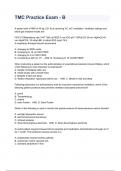
TMC Practice Exam - B Questions And Answers All Confirmed By Expert A patient with a PBW of 55 kg (121 lb) is receiving VC, A/C ventilation. Ventilator settings and blood gas analysis results are: FIO2 0.70Mandatory rate 14VT 350 mLPEEP 5 cm H2O pH 7.35PaCO2 35 mm HgPaO2 40 mm HgHCO3- 19 mEq/LBE -6 mEq/LSO2 (calc) 74% A respiratory therapist should recommend A. changing to SIMV mode. B. increasing to 10 cm H2O PEEP. C. changing to 5 cm H2O CPAP. D. increasing to 400 mL VT. - ANS B. Increasing to 10 cmH20 PEEP When instructing a patient on the administration of umeclidinium/vilanterol (Anoro Ellipta), which of the following is most important to emphasize? A. Gargle immediately after use. B. Inhale slowly with a breath hold. C. Breathe in fast and deep. D. Shake medication vigorously before use. - ANS C. Breath in fast and deep Following placement of a tracheostomy tube for long-term mechanical ventilation, which of the following patient positions best prevents ventilator-associated pneumonia? A. prone B. Trendelenburg C. supine D. semi-Fowler - ANS D. Semi-Fowler Which of the following is used to monitor the partial pressure of transcutaneous carbon dioxide? A. red-light absorption sensor B. electromechanical transducer C. infrared analyzer D. Stow-Severinghaus electrode - ANS D. Stow-Severinghaus electrode An adult patient requires frequent blood sampling and medication administrations through an IV for 1 month. The preferred vascular access is a A. peripherally inserted central catheter. B. subclavian central vascular line. C. standard peripheral IV line. D. internal jugular catheter. - ANS A. peripherally inserted central catheter A 170-cm (5-ft 7-in), 69-kg (152-lb) male with ARDS has the following ABG analysis results: pH 7.37PCO2 43 mm HgPO2 95 mm HgHCO3- 25 mEq/LBE -1 mEq/LSO2 (calc) 97% The patient is receiving VC, A/C ventilation with the following settings: FIO2 0.70Mandatory rate 12VT 450 mLPEEP 8 cm H2O Which of the following is most appropriate? A. Decrease the FIO2 to 0.60. B. Change the PEEP to 5 cm H2O. C. Increase the minute ventilation. D. Maintain the current settings. - ANS A. Decrease the FiO2 to 0.60 Which of the following techniques is preferred for a quadriplegic patient having difficulty expectorating secretions? A. pursed lip breathing B. abdominal thrust C. PEP therapy D. inspiratory muscle training - ANS B. Abdominal thrust A patient with a history of hypertension was awakened by cough and shortness of breath. He has fine inspiratory crackles bilaterally. Which of the following should a respiratory therapist recommend? A. prednisone B. albuterol C.furosemide (Lasix) D. guaifenesin (Mucinex) - ANS C. Furosemide (Lasix) The preferred suction device to remove large amounts of secretions from the oral cavity of an adult patient is a A. Yankauer device. B. DeLee suction trap. C. whistle-tip catheter. D. Coudé catheter. - ANS A. Yankauer device A respiratory therapist examines a patient and notes coarse crackles over both lung fields. Which of the following does this most likely indica
École, étude et sujet
- Établissement
- Respiratory Therapist TMC
- Cours
- Respiratory Therapist TMC
Infos sur le Document
- Publié le
- 31 juillet 2023
- Nombre de pages
- 30
- Écrit en
- 2022/2023
- Type
- Examen
- Contient
- Questions et réponses
Sujets

Document également disponible en groupe