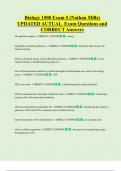
PSY 3260: Forensic Psychology (Exam 1) Questions and Answers 2023
PSY 3260: Forensic Psychology (Exam 1) Questions and Answers 2023 Forensic Psychology Any application of psychological research, methods, theory, and practice to a task faced by the legal system. (A specialty area by ABPP (American Board of Professional Psychology and the APA (American Psychology Association) Aggravating or Mitigating Factors When a jury or judge considers whether to impose the sentence of death, many states provide a consideration of the presence of any what? (Ex. did the defendant have a history of having been abused?) Amicus Brief Literally, a "friend of the court" brief, filed by an individual or organization to present arguments in addition to those presented by the immediate parties to a case. Try to get the judge to rule one way or the other. Brandeis Briefs Briefs that focus on empirical evidence and similar types of evidence rather than reviewing past cases and statutes Deduction The application of rules or a theory. (From the general to the specific) Empirical Approach An approach in which both existing standards and proposals for change would be carefully examined for their scientific merit. Standard held by the APA (American Psychiatric Association). Induction The generation of rules or a theory. (Uses several specifics to generate a general rule). Precedent A court ruling based on the outcomes of previous legal decisions in similar cases. Reliability A measure that shows consistency over time. Replicability A measure indicating that different investigators are able to produce similar results. Sex Stereotyping A form of prejudice that can be applied to employment opportunities, credit ratings, consumer behavior, and so on "Specialty" Designation A term used to indicate specific graduate-school training programs and not to credential individuals, a concern exists that such labels in the future may be applied to individual psychologists. Spousal Rape When a married man forced his wife to have sexual relations against her will. Society once looked the other way, and now is becoming increasingly aware of and concerned about this act. Current terminology refers to one spouse sexually assaulting another spouse, not just man to woman. Stare Decisis "Let the decision stand" This principle is important to many judges, as they often case follow previously set precedent. "Subjective Expectation of Privacy" A precedent set in the case of California v. Greenwood (1988) in which the U.S. Supreme Court stated that people have no expectation of privacy when they put out their garbage for collection. Trial Consultants People who asses the attitudes of people role-playing as jurors in a trial in order to identify issues perceived by the actual trial jurors; (Jurors bring prior experience, attitudes, biases, and personal characteristics into the courtroom) Values The standards for decision making, and thus laws are created, amended, or discarded because society has established standards for what is acceptable and unacceptable behavior. Society's values can change, leading to new laws, and new interpretations of existing laws. Advocates Role As far as the presiding judge is concerned, the expert witness at trial "is cast in the role of a witness, not as one of the advocates and not as a decision maker" Amicus Curiae Briefs Legal briefs submitted by a "friend of the court" for the purpose of accompanying appeals and the presentation of psychological issues to legislative committees or others with power to institute legal change. Raises additional points of view and presenting information not contained in the briefs of the formal parties. These briefs attempt to influence a court's decision. Competency Hearing A court proceeding to determine whether the defendant is mentally well enough to understand the charges filed against him or her and cooperate with a lawyer in presenting a defense. If a judge believes the defendant to be incompetent, the trial cannot take place. Does the defendant have the mental capacity to understand the implications of the act. Conduit-Educator An expert who regards his or her own field as the first priority. Confidentiality The act of holding information in confidence, not to be released to unauthorized individuals. A particular concern for trial consultants, who need to avoid unreasonable intrusion into the privacy of others, including members of focus groups or mock juries. It is essential that trial consultants recognize that all information about a particular case remains private and confidential. Death-Qualified Juries A death-qualified jury is a jury in a criminal law case in the United States in which the death penalty is a prospective sentence. Dual Relationships Example: A forensic psychologist cannot be engaged in more than one type of professional activity with the same individuals, such as a business relationship along with therapy, as they may receive additional information which was released under confidentiality. This leads to ethical problems. Evaluation The primary responsibility of many forensic psychologists with clinical psychology backgrounds, who act as evaluators and potential expert witnesses. Expert Witness A medical practitioner or other expert who, through education, training, or experience, has special knowledge about a subject and gives testimony about that subject in court, usually for a fee (Supposed to be impartial, but is paid by one side) (A witness to knowledge)(this may include a forensic psychologist) (Is not an advocate)(sworn to tell the truth). Fact Witness A witness who testified about facts based upon observation or personal knowledge about the matter before the court. (Someone with something to offer about the crime. Frye Test A test governing the admissibility of scientific evidence announced in Frye v. US, stating that such evidence must be derived from theories or procedures that are generally accepted by the relevant scientific field before it may be admitted into evidence. Hired Gun Work in the service of their employer's values rather than trying to advance their own. Junk Science Scientific results or hypothesis presented as sound science without having undergone the rigors of the peer review process. Peer Review A process by which the procedures and results of an experiment are evaluated by other scientists who are in the same field or who are conducting similar research. Philosopher-Ruler/Advocate The oath of telling "the whole truth" is of less concern. Psychopathy A set of emotional and interpersonal characteristics marked by impulsive, a lack of guilt or remorse, pathological lying and manipulativeness, and a continual willingness to violate social norms. Science-translation Brief A brief that made allegations that, in the opinion of the psychologists, drew conclusions about jury behavior that were unsupported by empirical research. Standard of Reliability Standards that psychologists should reflect "organized skepticism" Summary Judgment A judge's ruling to end a lawsuit without a trial based on a matter of law presented in pleadings. The judges ruling avoids an expensive trial. Trial Consultant Psychologists and other social scientists who aid trial attorneys in preparing for and carrying out a trial. Burnout A state of physical, emotional, and mental exhaustion created by long-term involvement in an emotionally demanding situation and accompanied by lowered performance and motivation. California Psychological Inventory (CPI) This instrument is used to investigate behavior that is interpersonal and social interaction between individuals that are 13 years and over. It provides information such as the patient's character and interpersonal values and how one behaves in social situations. Reflects an individuals personal traits such as dominance, sociability, and flexibility in contrast to the diagnostic categories. Clienteles Groups of citizens who interests are affected by an agency or a department and who work to influence its policies. Community Policing A concept developed with the goal or reuniting the police with the community. "A collaborative effort between the police and the community that identifies problems of crime and disorder and involves all elements of the community in the search for solutions to these problems." DWB ("Driving While Black") A sarcastic crime-classification reflecting the tendency of some patrol officers to concentrate on minorities as possible offenders. False Negatives Individuals who are not hired who would have displayed acceptable performance. Face-to-Face interviews have no impact on the goal or reducing _____ _______ because of the strong tendency for people to portray themselves more positively in face-to-face interviews than on personality tests. False Positives Poor risks who are hired, because of the strong tendency for people to portray themselves more positively in face-to-face interviews than on personality tests. Fitness-for-Duty Evaluation Psychological assessment of an employee conducted once on the job to determine whether that individual is mentally, emotionally, or behaviorally impaired to continue his or her workplace duties. It is often used with those in dangerous occupations, such as police, fire, military, etc.Typically occurs after an employee has engaged in some behavior or communication that has raised concern about his or her psychological suitability to perform job duties, or about risk of harm to self or others in the workplace. Hostage Taker Four different types, the political activist or terrorist,, the criminal, the mentally disturbed person, and the prisoner. Immaturity Index Consists of combination of MMPI scales Pd (Psychopathic Deviate), Ma (Hypomania), and L scale and is a strong predictor of termination. Inwald Personality Inventory (IPI) A test specifically designed for law enforcement, has 26 scales that tap past and present behaviors presumed to have special relevance for law enforcement. Measures the suitability of personality attributes and behavior patterns of law enforcement candidates. Consists of 310 true false questions measuring stress reactions and deviant behavior pattern, including absence and lateness problems, interpersonal difficulties, antisocial behavior, and alcohol and drug use. L scale Measure the examines an individual's tendency to depict himself/herself in a favorable way so that the validity of the MMPI can be determined. Minnesota Multiphasic Personality Inventory (MMPI) The most widely researched and clinically used of all personality tests. Originally developed to identify individuals with psychotic, neurotic, or other emotional disorders (still considered its most appropriate use), this test is now used for many other screening purposes. Police Corruption Deviant behavior by police which can vary along a continuum of seriousness. Police Psychologist Psychologists who serve full or part-time working with law enforcement agencies. Such psychologists formed the Law Enforcement Behavioral Sciences Association (LEBSA), a section of Division 18 or the American Psychological Association) Police Selection A set of procedures used by psychologists to either screen out undesirable candidates or select in desirable candidates, for police officers. Primary Negotiator In a hostage situation this person communicates directly with the subject. Fusiler, 1988, noted that a psychologist should not fulfill this position, but should rather be a consultant in order to maintain a more objective role in assessing the mental status and performance of the negotiator. Race-Based Profiling The discriminatory practice by law enforcement officials of targeting individuals for suspicion of crime based on the individual's race, ethnicity, religion or national origin. Ride-Alongs A ride-along is an arrangement for a civilian to spend a shift in the passenger seat of a police car, observing the work day of a police officer, firefighter, or paramedic. This should be the initial task for a police psychologist, to listen, learn, and understand the culture of law enforcement. Situational Tests Incorporate tasks that are similar to those that will actually be undertaken by officers on the job. Designed to analyze small samples of behaviors to predict performance in the training academy and on the job. Somewhat valid, but time consuming and expensive. Stakeholders Individuals who have a special knowledge and interest, or a "stake" in running the department. Team Policing The assignment of police officers to particular neighborhoods, so that they become familiar with local concerns. Wellness Training Assisting the police officer toward improving his/her lifestyle through learning new health enhancing behaviors and ideas. Wellness training is based on the concept that how an individual manages his or her life, and the accompanying stressors, will have a significant impact on job performance. Cognitive Interview A procedure used for interviewing crime scene witnesses that involves letting witnesses talk with a minimum of interruption, and before answering any questions about the crime, witnesses should be told to re-create, in their own minds, the environment that existed when the crime happened. They should focus on how things looked and sounded and smelled, what they were doing, how they felt, and what was happening around them. This technique may revel information that would have otherwise possibly not been recovered. Composite Drawing A picture of an alleged criminal created by a professional police artist using verbal descriptions giving by the victim or a witness. Confirmation Bias A tendency to search for information that supports our preconceptions and to ignore or distort contradictory evidence. Delayed Discovery States that the statutes of limitations does not begin to run until the plaintiff has discovered the facts that are essential to the cause of the action (typically used in medical malpractice) (also common in repressed memories) Demand Characteristics Elements of an experimental situation that might cause a participant to perceive the situation in a certain way or become aware of the purpose of the study and thus bias the participant to behave in a certain way, and in so doing, distort results. Double-Blind Procedure A control procedure in which neither the experimenter nor the research subjects are aware of which condition is in effect. It is used to prevent experimenters' and subjects' expectations from influencing the results of an experiment. (Used in law enforcement in lineup procedures when the administrator is unaware of the"correct" answer, neither subtle nor overt communication would be made, and a purer estimate of the accuracy of the witness's memory and his or her confidence level could be determined. Estimator Variables Variables such as characteristics of the witness, the crime, and the witness's testimony that are not under the control of the justice system but that may provide information about the likely accuracy of an eyewitness identification. (Include environmental factors such as length of time the witness saw the target, stress, weapons focus, cross-racial identification, weather, etc.) Evaluation Research Research undertaken for the purpose of determining the impact of some social intervention, such as a program aimed at solving a social problem. Foils Photographs with either partial or complete opposites in one or more characteristic ways to help a witness identify a subject. Holistic Process It has been identified that the identification of faces is a ______ process of considering multiple factors to create a more complete picture rather than an analysis of component features. Identikit a face identification system used in police work that consists of a series of plastic templates. each representing a facial characteristics such as hair, eyes, nose, chin, and mouth. (Recently computer-generated faces have replaced the Identikit) Identity Parade A row of people, including one who is suspected of a crime, who are shown to a witness to see if they can recognize the criminal. Leading Questions A question phrased in such a way as to suggest the desired answer. Lineups or Photo Arrays A police identification procedure by which an individual is asked to attempt to identify a subject from other possible alternatives through a line up or a series of photographs. Memory Testimony The witness's statement of what he or she recalls about a prior event; can be influenced by a wide variety of events and processes. Relative Judgment Process A process in which the witness selects the stimulus person who most resembles the perpetrator of the crime. If the real culprit is present, this is effective, but if the lineup only contains foils, an innocent person is likely to be chosen. Sequential Presentation A procedure in which members of a lineup are presented one at a time. This reduces or eliminates relative comparison by essentially forcing the witness to use an absolute yes or no before seeing the next one; reduces the rate of false alarms with little effect on correct identification rates. Showup An identification procedure in which the witness sees only one suspect at a time and indicates whether or not that person is the perpetrator. There are fewer identifications but also more failures to make a positive id. Social Framework Testimony The use of general conclusions from social science research in determining factual issues in a specific case. Statute of Limitations The time within a plaintiff must begin a lawsuit (in civil cases) or a prosecutor must bring charges (in criminal cases). There are different statutes of limitations at both the federal and state levels for different kinds of lawsuits or crimes. System Variables Factors that can be controlled by the legal system. Most commonly used in eyewitness identification research (e.g., the type of questioning done by the police, the nature of the lineup or photo array, and the presence or absence of videotaping procedures). Unconscious Tranference Identifying an innocent foil, who is familiar in some context, instead of the actual perpetrator. Areas of Forensic Psychology These individuals may be an educator or conduct research, work with law enforcement officials, serve as expert witnesses, act as a mediator in steeling legal disputes, consult to judges, advising legislators on public policy, etc. Cesare Lombroso Considered the father of modern criminology, because he sought to understand the cause of crime from a biological perspective. Hugo Munsterburg The founder of the field of forensic psychology. A student of Wundt, and a professor at Harvard. He published On the Witness Stand. He studied memory distortions, eyewitness accuracy, confessions, suggestibility, hypnosis, crime detection, and the prevention of crime. A strong advocate of psychology in the courtroom. Forensic Derived from the Latin word, forensis, meaning "Forum", the place where trials were conducted in Roman times. Collegial Psychology is ______, whereas the legal system is adversarial. (The law justifies the application of abstract principles to specific cases - Deduction) (Psychology derives abstract principles from specific instances - Induction) (Psychologists consider things in probabilities - A is related to B, and lawyers think in terms of right or wrong - A caused B). Pre-employment screening An assessment of an applicant's psychological suitability for prospective employment. (Psychological screening is one component) (Mandated by the Commission on Accreditation for Law Enforcement Agencies, and agencies may be held liable if employees are not properly screened.) Voir Dire "To Speak the Truth" - A process of impartiality mandated by both federal and state statues used to uncover biases. (Used in trial consulting and jury selection) Civil Civil/Criminal cases involve a (responsible party) being punished by having to (pay a monetary award) to the (injured party). (Custody Cases are classified as this type) Criminal Civil/Criminal cases involve a (perpetrator) who has to defend themselves and those found (guilty) will be (deprived of freedom). Jenkins v. United States This case involved mental illness at the time the crime was committed, judge David Bazelon stated that experts on mental disease could not be limited to physicians and that the ability to testify was based on training, skills, and knowledge. Brown v. Board of Education This case stated that school segregation was illegal. The appendix to the case was prepared by 3 psychologists and was based on social science research. APA (Americal Psychological Association) This organization evaluates specific graduate school training programs to determine if they provide a "proficiency" in the area. However, does not credential specific individuals. ABPP (American Board of Professional Psychology) This organization credentials specific individuals. Diplomate This term is awarded to specific individuals by the ABPP (American Board of Professional Psychology) and indicates that the recipient is at the highest level of excellence in his or her field. Clinical (Psychologist) The role of a _____ psychologist is to help the client, and then what is learned about the client is used to help them (the client is the client) ( research and findings are published and others are encouraged to replicate results).
Geschreven voor
- Instelling
- ABPP
- Vak
- ABPP
Documentinformatie
- Geüpload op
- 31 juli 2023
- Aantal pagina's
- 12
- Geschreven in
- 2022/2023
- Type
- Tentamen (uitwerkingen)
- Bevat
- Vragen en antwoorden
Onderwerpen
-
psy 3260 forensic psychology exam 1 questions a
-
forensic psychology any application of psychologic
-
aggravating or mitigating factors when a jury or j
-
precedent a court ruling based on the outcomes

Ook beschikbaar in voordeelbundel