Frankenstein Key Language Terminology
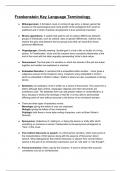
● Bildungsroman: A formation novel or coming of age story; a literary genre that
focuses on the psychological and moral growth of the protagonist from youth to
adulthood and in which character development is thus extremely important.
● Binary oppositions: A system that authors use to explore differences between
groups of individuals, such as cultural, class or gender differences. Authors may
explore the grey area between the two groups and what can result from those
perceived differences.
● Doppelganger: (literally meaning “double-goer”) a look a like or double of a living
person. In Frankenstein, Victor and the creature have a symbolic relationship at the
end of the novel with the latter arguably representing Victor’s dark nature.
● Denouement: The final part of a narrative in which the strands of the plot are drawn
together and matters are explained or resolved.
● Embedded Narrative: A narrative that is embedded within another – Victor gives a
subjective account of the Creature’s story. Creature’s story embedded in Victor’s
which is embedded in Walton’s letters. Walton’s letters are also considered a framing
device.
● Epistolary: An epistolary novel is written as a series of documents. The usual form is
letters although diary entries, newspaper clippings and other documents are
sometimes used. The epistolary form can add greater realism or verisimilitude to a
story, because it mimics the workings of real life. It is thus able to demonstrate
differing points of view without recourse to the device of an omniscient narrator.
● There are three types of epistolary novels:
Monologic (giving the letters of only one character)
Dialogic (giving the letters of two characters)
Polylogic (with three or more letter writing characters, such as Bram Stoker’s
Dracula)
● Eponymous: (Adjective) of, relating to, or being the person or entity after which
something or someone is named. Frankenstein is the eponymous protagonist or
“hero” of the novel.
● Free indirect discourse or speech: Is a third person narrative, which uses some of
the characteristics of third person along with the essence of first person direct
speech. What distinguishes free indirect discourse or speech from normal indirect
speech is the lack of an introductory expression such as “she said” or “she thought”.
● Formal archaisms: Often used by the Creature. A word or phrase that would be
considered very old or old-fashioned.
● Bildungsroman: A formation novel or coming of age story; a literary genre that
focuses on the psychological and moral growth of the protagonist from youth to
adulthood and in which character development is thus extremely important.
● Binary oppositions: A system that authors use to explore differences between
groups of individuals, such as cultural, class or gender differences. Authors may
explore the grey area between the two groups and what can result from those
perceived differences.
● Doppelganger: (literally meaning “double-goer”) a look a like or double of a living
person. In Frankenstein, Victor and the creature have a symbolic relationship at the
end of the novel with the latter arguably representing Victor’s dark nature.
● Denouement: The final part of a narrative in which the strands of the plot are drawn
together and matters are explained or resolved.
● Embedded Narrative: A narrative that is embedded within another – Victor gives a
subjective account of the Creature’s story. Creature’s story embedded in Victor’s
which is embedded in Walton’s letters. Walton’s letters are also considered a framing
device.
● Epistolary: An epistolary novel is written as a series of documents. The usual form is
letters although diary entries, newspaper clippings and other documents are
sometimes used. The epistolary form can add greater realism or verisimilitude to a
story, because it mimics the workings of real life. It is thus able to demonstrate
differing points of view without recourse to the device of an omniscient narrator.
● There are three types of epistolary novels:
Monologic (giving the letters of only one character)
Dialogic (giving the letters of two characters)
Polylogic (with three or more letter writing characters, such as Bram Stoker’s
Dracula)
● Eponymous: (Adjective) of, relating to, or being the person or entity after which
something or someone is named. Frankenstein is the eponymous protagonist or
“hero” of the novel.
● Free indirect discourse or speech: Is a third person narrative, which uses some of
the characteristics of third person along with the essence of first person direct
speech. What distinguishes free indirect discourse or speech from normal indirect
speech is the lack of an introductory expression such as “she said” or “she thought”.
● Formal archaisms: Often used by the Creature. A word or phrase that would be
considered very old or old-fashioned.