

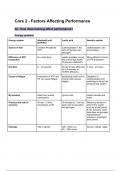
Core 2 - Factors Affecting Performance
IQ : How does training affect performance?
Energy systems:
Energy system Alactacid acid Lactic acid Aerobic system
(ATP/PC)
Source of fuel Creatine Phosphate Carbohydrates in the carbohydrates, fats
(CP) form of glucose and and proteins
glycogen
Efficiency of ATP for a brief time. rapidly available, but at More efficient in terms
production the cost of high levels of ATP production.
of glucose catabolism.
Duration 8 - 12 seconds 30 sec at max effort and 3 mins - 24 hours
for 3-4 minutes at
70-80% efficiency.
Cause of fatigue Exhaustion of ATP and Building up lactic acid in Depletion of
CP can cause fatigue muscle cells causes carbohydrates and
fatigue. switching to fat as fuel
exhausts the system
By-product Heat from muscle pyruvic acid carbon dioxide and
contractions water
Process and rate of 30 sec - 2 mins, 30 minutes to 1 hour as Recovery window is
recovery resynthesis of CP lactic acid is converted short if the system
into glycogen. runs for a brief period.
If not, recovery could
take days as glycogen
replenishment
requires a prolonged
time period.
Example 100 m sprints 200 - 400m run Soccer, netball, rugby
50 - 100m swim
, Types of training and training methods:
Aerobic training - Low intensity, long time. Enhances cardiovascular and muscle endurance
Continuous Same activity, same intensity, for min 20 mins
Fartlek Same activity, different intensity, for 20 mins
Interval Switching between periods of intense work and rest in 3:1 ratio
Circuit Range of aerobic activities, completed one after another
Strength training - Increase muscular strength, power and endurance.
It works by tearing the muscle then forming it to build stronger.
Weights Applying resistance to muscles, can perform isometric and isotonic
contractions.
Elastic
Hydraulic Perform isokinetic contractions
Flexibility training - Increases range of motion around joints through exercises targeted at
specific muscles and joints.
Static Muscles are stretched and held still
Ballistic Muscles stretched even further with a bouncing motion
PNF Start with static stretch, contract the muscles being stretched to switch off
the stretch reflex, then stretch the muscle further.
Dynamic Muscles stretched through continuous movements through full range of
motion at the targeted joint.
IQ : How does training affect performance?
Energy systems:
Energy system Alactacid acid Lactic acid Aerobic system
(ATP/PC)
Source of fuel Creatine Phosphate Carbohydrates in the carbohydrates, fats
(CP) form of glucose and and proteins
glycogen
Efficiency of ATP for a brief time. rapidly available, but at More efficient in terms
production the cost of high levels of ATP production.
of glucose catabolism.
Duration 8 - 12 seconds 30 sec at max effort and 3 mins - 24 hours
for 3-4 minutes at
70-80% efficiency.
Cause of fatigue Exhaustion of ATP and Building up lactic acid in Depletion of
CP can cause fatigue muscle cells causes carbohydrates and
fatigue. switching to fat as fuel
exhausts the system
By-product Heat from muscle pyruvic acid carbon dioxide and
contractions water
Process and rate of 30 sec - 2 mins, 30 minutes to 1 hour as Recovery window is
recovery resynthesis of CP lactic acid is converted short if the system
into glycogen. runs for a brief period.
If not, recovery could
take days as glycogen
replenishment
requires a prolonged
time period.
Example 100 m sprints 200 - 400m run Soccer, netball, rugby
50 - 100m swim
, Types of training and training methods:
Aerobic training - Low intensity, long time. Enhances cardiovascular and muscle endurance
Continuous Same activity, same intensity, for min 20 mins
Fartlek Same activity, different intensity, for 20 mins
Interval Switching between periods of intense work and rest in 3:1 ratio
Circuit Range of aerobic activities, completed one after another
Strength training - Increase muscular strength, power and endurance.
It works by tearing the muscle then forming it to build stronger.
Weights Applying resistance to muscles, can perform isometric and isotonic
contractions.
Elastic
Hydraulic Perform isokinetic contractions
Flexibility training - Increases range of motion around joints through exercises targeted at
specific muscles and joints.
Static Muscles are stretched and held still
Ballistic Muscles stretched even further with a bouncing motion
PNF Start with static stretch, contract the muscles being stretched to switch off
the stretch reflex, then stretch the muscle further.
Dynamic Muscles stretched through continuous movements through full range of
motion at the targeted joint.


