Summary International Strategy & Leadership
Chapter 7 – Strategy Formation
The main question is how a successful course of action be realized in practice. In order to answer
this question, we first need to know what type of activities are involved with strategy formation
(what) and who executes each type of activity (who).
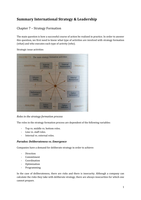
Strategic issue activities
Roles in the strategy formation process
The roles in the strategy formation process are dependent of the following variables:
- Top vs. middle vs. bottom roles.
- Line vs. staff roles.
- Internal vs. external roles.
Paradox: Deliberateness vs. Emergence
Companies have a demand for deliberate strategy in order to achieve:
- Direction
- Commitment
- Coordination
- Optimization
- Programming
In the case of deliberateness, there are risks and there is insecurity. Although a company can
calculate the risks they take with deliberate strategy, there are always insecurities for which one
cannot prepare.
1
,Companies also have a demand for emergence in strategy, in order to obtain:
- Opportunism
- Flexibility
- Learning
- Entrepreneurship
- Support
In the case of emergent strategy, there is a risk that a company divides its resources too much in
order to be present in many sectors
In academic literature, the concepts of deliberateness and emergence are reflected in two strategies,
namely in the strategic planning perspective and the strategic incrementalism perspective.
Managing the paradox
1. Balancing: opposing demands are traded off to find the most appropriate balance.
2. Juxtaposing: managing opposites or different blends simultaneously, often between
business units.
2
, Chapter 8 – Strategy Change
The question is not whether firms should change, but in what direction. Not all change is strategic.
Most is operational, which is meant to maintain efficiency in everyday tasks.
The issue of strategic alignment
There is an always ongoing renewal process, for example when a firm undergoes a strategic drift or
when the environment changes, a strategic misfit is created and the need for strategic renewal
comes up.
Areas of strategic alignment
- Business model
- Organizational system
The organizational system consists of three parts:
1. Organizational structure (formal hierarchy)
Structuring criteria:
- output based
- throughput based
- input based
2. Organizational processes (how it really plays out)
3. Organizational culture (customs within the firm)
3
Chapter 7 – Strategy Formation
The main question is how a successful course of action be realized in practice. In order to answer
this question, we first need to know what type of activities are involved with strategy formation
(what) and who executes each type of activity (who).
Strategic issue activities
Roles in the strategy formation process
The roles in the strategy formation process are dependent of the following variables:
- Top vs. middle vs. bottom roles.
- Line vs. staff roles.
- Internal vs. external roles.
Paradox: Deliberateness vs. Emergence
Companies have a demand for deliberate strategy in order to achieve:
- Direction
- Commitment
- Coordination
- Optimization
- Programming
In the case of deliberateness, there are risks and there is insecurity. Although a company can
calculate the risks they take with deliberate strategy, there are always insecurities for which one
cannot prepare.
1
,Companies also have a demand for emergence in strategy, in order to obtain:
- Opportunism
- Flexibility
- Learning
- Entrepreneurship
- Support
In the case of emergent strategy, there is a risk that a company divides its resources too much in
order to be present in many sectors
In academic literature, the concepts of deliberateness and emergence are reflected in two strategies,
namely in the strategic planning perspective and the strategic incrementalism perspective.
Managing the paradox
1. Balancing: opposing demands are traded off to find the most appropriate balance.
2. Juxtaposing: managing opposites or different blends simultaneously, often between
business units.
2
, Chapter 8 – Strategy Change
The question is not whether firms should change, but in what direction. Not all change is strategic.
Most is operational, which is meant to maintain efficiency in everyday tasks.
The issue of strategic alignment
There is an always ongoing renewal process, for example when a firm undergoes a strategic drift or
when the environment changes, a strategic misfit is created and the need for strategic renewal
comes up.
Areas of strategic alignment
- Business model
- Organizational system
The organizational system consists of three parts:
1. Organizational structure (formal hierarchy)
Structuring criteria:
- output based
- throughput based
- input based
2. Organizational processes (how it really plays out)
3. Organizational culture (customs within the firm)
3