- The molar gas volume of a substance at room temperature and pressure is always 24dm3
(24000cm3)
Relative atomic mass (Ar): the average mass of naturally occurring atoms of an element
on a scale where the 12C atom has a mass of exactly 12 units
Relative molecular mass (Mr): the sum of the relative atomic masses (Mr will be used for
ionic compounds)
Calculating stoichiometric reacting masses:
- In all chemical reactions, the total mass of reactants used is equal to the total mass of
the products made
- Step one: Write out the equation for the reaction. Make sure it is balanced.
- Step two: Work out the relative masses of the substances needed in the calculation.
Remember to multiply by the number of molecules that are present.
- Step three: Convert the relative masses into the units in the question.
- Step four: Find the ratio by dividing both numbers by the smallest relative mass.
- Step five: Find the mass of the unknown by multiplying the mass of the known by the
ratio of the unknown.
E.g. What mass of carbon dioxide is formed when 12 g of carbon is burned in air?
1. Write out the equation for the reaction. Make sure it is balanced
C + O2 -> CO2 (Carbon is the known, carbon dioxide is the unknown)
2. Work out the relative masses of the substances needed in the calculation.
Mass of carbon = 12, mass of carbon dioxide = 44
3. Convert the relative masses into the units in the question.
Mass of carbon = 12 g, mass of carbon dioxide is 44 g
4. Find the ratio by dividing both numbers by the smallest number.
For carbon 12 ÷ 12 = 1, for carbon dioxide 44 ÷ 12 = 3.67
5. Find the mass of the unknown by multiplying the mass of the known by the ratio of
the unknown.
3.67 × 12 = 44 g
Empirical formula: gives the simplest whole number ratio of atoms in the molecule
Calculation:
- Step one: Find masses
- Step two: Look up given Ar values
- Step three: Divide masses by Ar
- Step four: Find the ratio
E.g. Suppose 3.2 g of sulfur reacts with oxygen to produce 6.4 g of sulfur oxide. What is the
formula of the oxide?
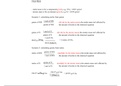
Step Action Sulfur Oxygen
(24000cm3)
Relative atomic mass (Ar): the average mass of naturally occurring atoms of an element
on a scale where the 12C atom has a mass of exactly 12 units
Relative molecular mass (Mr): the sum of the relative atomic masses (Mr will be used for
ionic compounds)
Calculating stoichiometric reacting masses:
- In all chemical reactions, the total mass of reactants used is equal to the total mass of
the products made
- Step one: Write out the equation for the reaction. Make sure it is balanced.
- Step two: Work out the relative masses of the substances needed in the calculation.
Remember to multiply by the number of molecules that are present.
- Step three: Convert the relative masses into the units in the question.
- Step four: Find the ratio by dividing both numbers by the smallest relative mass.
- Step five: Find the mass of the unknown by multiplying the mass of the known by the
ratio of the unknown.
E.g. What mass of carbon dioxide is formed when 12 g of carbon is burned in air?
1. Write out the equation for the reaction. Make sure it is balanced
C + O2 -> CO2 (Carbon is the known, carbon dioxide is the unknown)
2. Work out the relative masses of the substances needed in the calculation.
Mass of carbon = 12, mass of carbon dioxide = 44
3. Convert the relative masses into the units in the question.
Mass of carbon = 12 g, mass of carbon dioxide is 44 g
4. Find the ratio by dividing both numbers by the smallest number.
For carbon 12 ÷ 12 = 1, for carbon dioxide 44 ÷ 12 = 3.67
5. Find the mass of the unknown by multiplying the mass of the known by the ratio of
the unknown.
3.67 × 12 = 44 g
Empirical formula: gives the simplest whole number ratio of atoms in the molecule
Calculation:
- Step one: Find masses
- Step two: Look up given Ar values
- Step three: Divide masses by Ar
- Step four: Find the ratio
E.g. Suppose 3.2 g of sulfur reacts with oxygen to produce 6.4 g of sulfur oxide. What is the
formula of the oxide?
Step Action Sulfur Oxygen