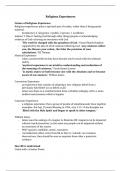
Religious Experiences
Nature of Religious Experience
Religious experiences point a spiritual part of reality, rather than it being purely
material.
- Swinburne’s 5 categories: 2 public, 2 private, 1 worldview
Indirect V Direct: feeling God through other things/people or acknowledging
evidence of God vs having an encounter with God
- ‘The world is charged with the grandeur of God.’ Gerard Manly Hopkins
- supported by the idea of all of creation reflecting God. ‘any creatures reflect
you, the flowers your colour, the tides the precision of your
calculations.’ RS Thomas
Mystical Experience
- when a person believes they have become one/in touch with the ultimate
reality
- ‘mystical experience is an intuitive understanding and realisation of
the meaning of existence.’ Gerald James Larson
- ‘in mystic states we both become one with the Absolute and we become
aware of our oneness.’ William James
Conversion Experience
- an experience that consists of adopting a new religious belief from a
previously held belief (or no belief at all)
- James saw these as a transformation from a divided, unhappy self to a more
unified consciousness which is happier
Corporate Experience
- a religious experience that a group of people all simultaneously have together
- examples: the hajj, Toronto Blessing in 1994, Acts 2:13-15 the disciples are
‘filled with the Holy Spirit and began to speak in other tongues.’
William James
- James uses the analogy of a magnet to illustrate RE: magnets can be impacted
without touch/awareness, in the same way people can be impacted without
an awareness of the source
- PINT (passive, ineffable, noetic, transient)
- contradictions often arrive from RE as they’re ‘outside’ our common
observations, they should be seen as separate from other a posteriori
evidence
How RE is understood
Union with a Greater Power
Nature of Religious Experience
Religious experiences point a spiritual part of reality, rather than it being purely
material.
- Swinburne’s 5 categories: 2 public, 2 private, 1 worldview
Indirect V Direct: feeling God through other things/people or acknowledging
evidence of God vs having an encounter with God
- ‘The world is charged with the grandeur of God.’ Gerard Manly Hopkins
- supported by the idea of all of creation reflecting God. ‘any creatures reflect
you, the flowers your colour, the tides the precision of your
calculations.’ RS Thomas
Mystical Experience
- when a person believes they have become one/in touch with the ultimate
reality
- ‘mystical experience is an intuitive understanding and realisation of
the meaning of existence.’ Gerald James Larson
- ‘in mystic states we both become one with the Absolute and we become
aware of our oneness.’ William James
Conversion Experience
- an experience that consists of adopting a new religious belief from a
previously held belief (or no belief at all)
- James saw these as a transformation from a divided, unhappy self to a more
unified consciousness which is happier
Corporate Experience
- a religious experience that a group of people all simultaneously have together
- examples: the hajj, Toronto Blessing in 1994, Acts 2:13-15 the disciples are
‘filled with the Holy Spirit and began to speak in other tongues.’
William James
- James uses the analogy of a magnet to illustrate RE: magnets can be impacted
without touch/awareness, in the same way people can be impacted without
an awareness of the source
- PINT (passive, ineffable, noetic, transient)
- contradictions often arrive from RE as they’re ‘outside’ our common
observations, they should be seen as separate from other a posteriori
evidence
How RE is understood
Union with a Greater Power