1.3 Fundamental Theorem of Calculus
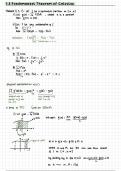
Theorem. (1.3.1):letto be a continuous function on [a,b]
i) Let
g(x) St fdt,
=
where a is a constant
then f(x)
g'(x) is
ii) Let I
be any antiderivative of of
e. FP-dx
↓
F(b)
=
-
F()
b
Notation:F(x) F(b)
=
-
F(a)
a "evaluated from a to-b
(ii)
eg. of
(Xdx
①
iff(x) x,F(X) x-
=
=
F(b) F(a)
b2 1az
- =
-
② SoexdX
F(X) 2x =
F(0) e 10
F(X)/: F(1) e 1
= - =
-
-
=
physical interpretation of(ii)
(bg'(X)dX g(x)p g(b) =
= -
g(a)
m a
m
integral rate of total change ing
change of 'g' over over [a,b]
[a,b]
a proofofFTC:(just for f(x)20)
i) set
g(x) Sof(t)dt=
img(x+h)- ga
11 we want:
g.(x) = e
,,,iy
=
yy
*
a i
-
A g(4)
=
vonisNcglyta
#
e M.h
m.n g(x
=
+
1) -
g(x) =
where m and M are the min and max values
of on
f
[x,x+h]
(for his)
by dividing by h m
=g(x h) g(x) M
+ -
=
as h ->0 m,M f(x) =
Theorem. (1.3.1):letto be a continuous function on [a,b]
i) Let
g(x) St fdt,
=
where a is a constant
then f(x)
g'(x) is
ii) Let I
be any antiderivative of of
e. FP-dx
↓
F(b)
=
-
F()
b
Notation:F(x) F(b)
=
-
F(a)
a "evaluated from a to-b
(ii)
eg. of
(Xdx
①
iff(x) x,F(X) x-
=
=
F(b) F(a)
b2 1az
- =
-
② SoexdX
F(X) 2x =
F(0) e 10
F(X)/: F(1) e 1
= - =
-
-
=
physical interpretation of(ii)
(bg'(X)dX g(x)p g(b) =
= -
g(a)
m a
m
integral rate of total change ing
change of 'g' over over [a,b]
[a,b]
a proofofFTC:(just for f(x)20)
i) set
g(x) Sof(t)dt=
img(x+h)- ga
11 we want:
g.(x) = e
,,,iy
=
yy
*
a i
-
A g(4)
=
vonisNcglyta
#
e M.h
m.n g(x
=
+
1) -
g(x) =
where m and M are the min and max values
of on
f
[x,x+h]
(for his)
by dividing by h m
=g(x h) g(x) M
+ -
=
as h ->0 m,M f(x) =