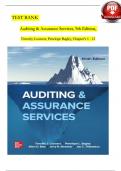
,Accounting Information Systems: Basic Concepts and Current Issues (4th edition)
Dr. Bob Hurt, C.F.E.
End-of-chapter solutions
Chapter 1: Role and purpose of AIS
1. Reading review questions
a. What is an accounting information system? An accounting information system,
like all systems, is a collection of inter-related parts designed to achieve a specific goal.
In the case of AIS, that goal is to prepare information for decision making.
b. Explain three reasons AIS is an important area of study for future accountants.
(1) Developing a strong AIS helps achieve some of the components of the FASB
Conceptual Framework of Accounting. (2) Studying AIS helps students develop many
of the core competencies suggested by the AICPA. (3) Acquiring knowledge about AIS
helps students learn more about common business processes.
c. List and discuss the five parts of a generic accounting information system.
The five generic parts of the AIS are: inputs (such as source documents), processing
(such as with general ledger software), outputs (such as the general purpose financial
statements), storage (such as in master and transaction files) and internal control (such
as separation of duties).
d. Identify five broad criteria you can use to evaluate information on the Internet
and in other sources. The University of Maryland University College offered five
criteria for information evaluation. They are: authority, accuracy, objectivity, currency
and coverage.
e. In a manner specified by your instructor (e.g., individually or with a group, as a
written paper or as an oral presentation), prepare an original response to one or
more of the questions for this chapter’s “AIS in the Business World.” As in
previous editions, I’ve posted responses to each chapter’s AIS in the Business World on
my accounting information systems blog (www.bobhurtais.blogspot.com). Look for the
4th edition’s responses in the 15 December 2014 post.
2. Multiple choice review questions. Answers to all of these questions appear at the
end of the textbook itself.
Copyright © 2016 McGraw-Hill Education. All rights reserved. No reproduction or distribution without the prior written consent of
McGraw-Hill Education
1-1
,Accounting Information Systems: Basic Concepts and Current Issues (4th edition)
Dr. Bob Hurt, C.F.E.
End-of-chapter solutions
Chapter 1: Role and purpose of AIS
3. Reading review problem
a. Consider the five business processes described in the chapter. Which one
best applies to the activities described? Why? The activities described are most
closely aligned with the sales / collection process, since they involve selling goods to a
customer and collecting payment. In addition, preparing the food (Step 4) is an
example of a conversion process.
b. Does Richie’s need an accounting information system? Why, or why not?
Richie’s, like all organizations, needs an AIS. If properly designed and implemented,
the AIS can produce general purpose financial statements and other outputs which will
serve as a basis for decision making.
c. If you were an accountant for Richie’s, how might you demonstrate the AICPA
core competencies discussed in the chapter in your interaction with
management? The chapter discussed six elements of the AICPA core competencies
framework. The broad business perspective competencies included strategic / critical
thinking and resource management; functional competencies were risk analysis and
research. Personal competencies discussed in the chapter were problem solving and
decision making and communication. An accountant could demonstrate strategic /
critical thinking by focusing on what accounting (and other) data tell management about
how to compete more effectively in their markets; resource management competencies
come into play, for example, by understanding human motivation and applying theories
like Vroom’s expectancy theory. All organizations face risk; an accountant could point
out risks in interacting with management. Research would be required as part of
strategic thinking, since knowing what competitors are doing can inform what Richie’s
does. Both personal competencies are an integral part of the others.
d. Suggest one example of each generic AIS element within the context of
Richie’s. Input, customer order. Process, collecting payment. Output, customer bill.
Storage, electronic files with accounting data. Internal control, Developing standard
procedures for taking orders, preparing and delivering food.
e. Do a Google search on “operating a successful restaurant.” Pick one of the
articles it produces and evaluate it using the UMUC criteria. One such article is
“Start A Killer Restaurant: 6 Tips” by Jeff Haden. It appeared in the 23 January 2012
issue of Inc. magazine. Here is a sample evaluation using the UMUC criteria.
• Authority. The author is a professional journalist; his contact information is
provided at the end of the article.
• Accuracy. The article explains that the source of the information is an interview
with a successful restaurant owner. It does not appear to have erroneous
information.
Copyright © 2016 McGraw-Hill Education. All rights reserved. No reproduction or distribution without the prior written consent of
McGraw-Hill Education
1-2
, Accounting Information Systems: Basic Concepts and Current Issues (4th edition)
Dr. Bob Hurt, C.F.E.
End-of-chapter solutions
Chapter 1: Role and purpose of AIS
• Objectivity. The article is not primarily advertising oriented, but it does have
some information about the restaurant owner’s businesses. The article is
available freely.
• Currency. The article is about two years old, which means it could be a bit dated
in the fast-paced restaurant industry. But, its advice seems as applicable today
as they were in 2012.
• Coverage. The article is completed; it is not particularly deep, but its length
seems tailored to both the venue and its audience.
4. Making choices and exercising judgment
Students’ answers may vary significantly since the point of these exercises is for them
to think critically. Nevertheless, here are a few elements they might include in a
discussion of Sebastian and Viola’s IT needs.
• Spreadsheets. Commonly available and widely used, but they are not
specifically designed for accounting tasks and can be cumbersome.
• General ledger software. Several choices are available and most accountants
know how to use at least one or two. Choosing can be challenging.
• Tax preparation software. This tool can make the process of filing tax returns
simpler, but it still requires significant recordkeeping.
Copyright © 2016 McGraw-Hill Education. All rights reserved. No reproduction or distribution without the prior written consent of
McGraw-Hill Education
1-3
Dr. Bob Hurt, C.F.E.
End-of-chapter solutions
Chapter 1: Role and purpose of AIS
1. Reading review questions
a. What is an accounting information system? An accounting information system,
like all systems, is a collection of inter-related parts designed to achieve a specific goal.
In the case of AIS, that goal is to prepare information for decision making.
b. Explain three reasons AIS is an important area of study for future accountants.
(1) Developing a strong AIS helps achieve some of the components of the FASB
Conceptual Framework of Accounting. (2) Studying AIS helps students develop many
of the core competencies suggested by the AICPA. (3) Acquiring knowledge about AIS
helps students learn more about common business processes.
c. List and discuss the five parts of a generic accounting information system.
The five generic parts of the AIS are: inputs (such as source documents), processing
(such as with general ledger software), outputs (such as the general purpose financial
statements), storage (such as in master and transaction files) and internal control (such
as separation of duties).
d. Identify five broad criteria you can use to evaluate information on the Internet
and in other sources. The University of Maryland University College offered five
criteria for information evaluation. They are: authority, accuracy, objectivity, currency
and coverage.
e. In a manner specified by your instructor (e.g., individually or with a group, as a
written paper or as an oral presentation), prepare an original response to one or
more of the questions for this chapter’s “AIS in the Business World.” As in
previous editions, I’ve posted responses to each chapter’s AIS in the Business World on
my accounting information systems blog (www.bobhurtais.blogspot.com). Look for the
4th edition’s responses in the 15 December 2014 post.
2. Multiple choice review questions. Answers to all of these questions appear at the
end of the textbook itself.
Copyright © 2016 McGraw-Hill Education. All rights reserved. No reproduction or distribution without the prior written consent of
McGraw-Hill Education
1-1
,Accounting Information Systems: Basic Concepts and Current Issues (4th edition)
Dr. Bob Hurt, C.F.E.
End-of-chapter solutions
Chapter 1: Role and purpose of AIS
3. Reading review problem
a. Consider the five business processes described in the chapter. Which one
best applies to the activities described? Why? The activities described are most
closely aligned with the sales / collection process, since they involve selling goods to a
customer and collecting payment. In addition, preparing the food (Step 4) is an
example of a conversion process.
b. Does Richie’s need an accounting information system? Why, or why not?
Richie’s, like all organizations, needs an AIS. If properly designed and implemented,
the AIS can produce general purpose financial statements and other outputs which will
serve as a basis for decision making.
c. If you were an accountant for Richie’s, how might you demonstrate the AICPA
core competencies discussed in the chapter in your interaction with
management? The chapter discussed six elements of the AICPA core competencies
framework. The broad business perspective competencies included strategic / critical
thinking and resource management; functional competencies were risk analysis and
research. Personal competencies discussed in the chapter were problem solving and
decision making and communication. An accountant could demonstrate strategic /
critical thinking by focusing on what accounting (and other) data tell management about
how to compete more effectively in their markets; resource management competencies
come into play, for example, by understanding human motivation and applying theories
like Vroom’s expectancy theory. All organizations face risk; an accountant could point
out risks in interacting with management. Research would be required as part of
strategic thinking, since knowing what competitors are doing can inform what Richie’s
does. Both personal competencies are an integral part of the others.
d. Suggest one example of each generic AIS element within the context of
Richie’s. Input, customer order. Process, collecting payment. Output, customer bill.
Storage, electronic files with accounting data. Internal control, Developing standard
procedures for taking orders, preparing and delivering food.
e. Do a Google search on “operating a successful restaurant.” Pick one of the
articles it produces and evaluate it using the UMUC criteria. One such article is
“Start A Killer Restaurant: 6 Tips” by Jeff Haden. It appeared in the 23 January 2012
issue of Inc. magazine. Here is a sample evaluation using the UMUC criteria.
• Authority. The author is a professional journalist; his contact information is
provided at the end of the article.
• Accuracy. The article explains that the source of the information is an interview
with a successful restaurant owner. It does not appear to have erroneous
information.
Copyright © 2016 McGraw-Hill Education. All rights reserved. No reproduction or distribution without the prior written consent of
McGraw-Hill Education
1-2
, Accounting Information Systems: Basic Concepts and Current Issues (4th edition)
Dr. Bob Hurt, C.F.E.
End-of-chapter solutions
Chapter 1: Role and purpose of AIS
• Objectivity. The article is not primarily advertising oriented, but it does have
some information about the restaurant owner’s businesses. The article is
available freely.
• Currency. The article is about two years old, which means it could be a bit dated
in the fast-paced restaurant industry. But, its advice seems as applicable today
as they were in 2012.
• Coverage. The article is completed; it is not particularly deep, but its length
seems tailored to both the venue and its audience.
4. Making choices and exercising judgment
Students’ answers may vary significantly since the point of these exercises is for them
to think critically. Nevertheless, here are a few elements they might include in a
discussion of Sebastian and Viola’s IT needs.
• Spreadsheets. Commonly available and widely used, but they are not
specifically designed for accounting tasks and can be cumbersome.
• General ledger software. Several choices are available and most accountants
know how to use at least one or two. Choosing can be challenging.
• Tax preparation software. This tool can make the process of filing tax returns
simpler, but it still requires significant recordkeeping.
Copyright © 2016 McGraw-Hill Education. All rights reserved. No reproduction or distribution without the prior written consent of
McGraw-Hill Education
1-3