PYC1512
BIOLOGICAL ASPECTS OF PSYCHOLOGY
UNIT 1
Knowledge of the Human Nervous System
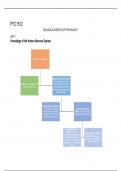
Human Nervous System
Peripheral Nervous System:
All the nerves that exit the
Central Nervous System: The brain and spinal cord, and
brain and spinal cord. carry sensory and motor
messages to and from other
parts of the body.
Somatic Nervous System:
All the axons conveying Autonomic Nervous
messages from the sense System: Controls the heart,
organs to the CNS, and from intestines and other organs.
the CNS to the muscles.
Sympathetic Nervous
System: Acts as an
Parasympathetic Nervous
integrated whole in affecting
System: Controls rest,
smooth muscle systems to
enjoyment, eating, sleeping
enable a "fight or flight"
and sexual activity.
response when we perceive
danger.
, Neurons: Info processing and transmitting element of the CNS and PNS.
Glia: Serves support functions for neurons.
Macroglia Large
Microglia Small
Sensory Neuron is sensitive to:
Light
Sounds
Touch
Dendrites
Lined with Synaptic Receptors
Enables them to receive info from other neurons.
Dendritic spines: Increase surface area available for synapse.
Synaptic cleft: Space separating pre- synaptic and post- synaptic membranes.
Contains cellular fluid containing neurochemicals through which the transmitter
substance diffuses.
Soma
Contains:
Nucleus
Ribosomes
Mitochondria
Where neurons metabolism takes place.
Covered by synapses.
Axon
Thin fibre that conveys impulses towards other neurons, an organ or a muscle.
Covered in insulating material called myelin sheath, with interruptions known as
nodes or Ranvier.
Invertebrate axons do not have myelin sheaths.
Afferent Axon: Brings info into structure. (arrives)
Efferent Axon: Carries info away from structure. (exits)
Sensory neurons Afferent to nervous system.
Motor neurons Efferent to nervous system.
Cell’s dendrites and axons are contained within a single structure cell is an intrinsic
neuron/interneuron.
Macroglia
Four types of macroglia:
Astrocytes
BIOLOGICAL ASPECTS OF PSYCHOLOGY
UNIT 1
Knowledge of the Human Nervous System
Human Nervous System
Peripheral Nervous System:
All the nerves that exit the
Central Nervous System: The brain and spinal cord, and
brain and spinal cord. carry sensory and motor
messages to and from other
parts of the body.
Somatic Nervous System:
All the axons conveying Autonomic Nervous
messages from the sense System: Controls the heart,
organs to the CNS, and from intestines and other organs.
the CNS to the muscles.
Sympathetic Nervous
System: Acts as an
Parasympathetic Nervous
integrated whole in affecting
System: Controls rest,
smooth muscle systems to
enjoyment, eating, sleeping
enable a "fight or flight"
and sexual activity.
response when we perceive
danger.
, Neurons: Info processing and transmitting element of the CNS and PNS.
Glia: Serves support functions for neurons.
Macroglia Large
Microglia Small
Sensory Neuron is sensitive to:
Light
Sounds
Touch
Dendrites
Lined with Synaptic Receptors
Enables them to receive info from other neurons.
Dendritic spines: Increase surface area available for synapse.
Synaptic cleft: Space separating pre- synaptic and post- synaptic membranes.
Contains cellular fluid containing neurochemicals through which the transmitter
substance diffuses.
Soma
Contains:
Nucleus
Ribosomes
Mitochondria
Where neurons metabolism takes place.
Covered by synapses.
Axon
Thin fibre that conveys impulses towards other neurons, an organ or a muscle.
Covered in insulating material called myelin sheath, with interruptions known as
nodes or Ranvier.
Invertebrate axons do not have myelin sheaths.
Afferent Axon: Brings info into structure. (arrives)
Efferent Axon: Carries info away from structure. (exits)
Sensory neurons Afferent to nervous system.
Motor neurons Efferent to nervous system.
Cell’s dendrites and axons are contained within a single structure cell is an intrinsic
neuron/interneuron.
Macroglia
Four types of macroglia:
Astrocytes