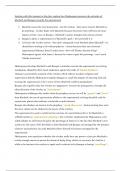
Starting with this moment in the play, explore how Shakespeare presents the attitudes of
Macbeth and Banquo towards the supernatural
1. Macbeth causes his own destruction - not the witches - they never instruct Macbeth to
do anything - witches begin with Macbeth because they know they will have the most
impact on him + less on Banquo - Macbeth’s satanic thoughts have always existed
2. Banquo’s ghost is representative of Macbeth’s guilt + how powerful it is
3. Criticises the witches' power - they don’t adequately warn Macbeth about Macduff - we
should have nothing to do with prophecies + charm because their anti-christian -
supernatural influence doesn’t make sense - how will Fleance become King? -
Shakespeare agrees with James 1 because he wants to gain his patronage - can’t teach
‘bloody instruction’
Shakespeare develops Macbeth’s and Banquo’s attitudes towards the supernatural as evolving
standpoints shaped by their moral endurance against the trials of “human kindness”.
Banquo is particularly sceptical of the witches which reflects Jacobean religious and
superstitious beliefs; Shakespeare employs Banquo to recall the dangers of rejecting God and
trusting the supernatural, as he’s aware of how Macbeth could be manipulated.
Banquo also signifies that the witches are ‘puppeteers’ towards the protagonists, through the
objectification of the witches as “instruments”.
Shakespeare challenges this earlier when the prophecy occurs, he will be “greater” and “lesser’”
than Macbeth, the use of equivocation alludes to the supernatural as being deceitful, and the
oxymoronic phrase also indicates witchcraft as multi-faceted.
Banquo also displays an interest in the prophecy, “speak then to me”, demonstrating how even
the most valiant can be shaken by the power of the witches.
The supernatural is used to reinforce how extreme of a moral failure this is for Macbeth to
willfully incline to “supernatural soliciting”; this is further emphasised by Shakespeare as he
subtly alludes (to still ensure he gains the patronage of James 1) to the fact that Macbeth’s own
actions are the cause of his downfall, as both Macbeth and Banquo are intrigued by the prospect
of power and authority, but only Macbeth allows himself to become entrapped by the
supernatural.
Shakespeare, even questions whether the witches really have any power or just give Macbeth a
worthy enough reason to pursue his dream of being King, which we are aware he’s had for a
while as he instructs the witches to speak and is referred to by Banquo as having “royal hope”;
Macbeth and Banquo towards the supernatural
1. Macbeth causes his own destruction - not the witches - they never instruct Macbeth to
do anything - witches begin with Macbeth because they know they will have the most
impact on him + less on Banquo - Macbeth’s satanic thoughts have always existed
2. Banquo’s ghost is representative of Macbeth’s guilt + how powerful it is
3. Criticises the witches' power - they don’t adequately warn Macbeth about Macduff - we
should have nothing to do with prophecies + charm because their anti-christian -
supernatural influence doesn’t make sense - how will Fleance become King? -
Shakespeare agrees with James 1 because he wants to gain his patronage - can’t teach
‘bloody instruction’
Shakespeare develops Macbeth’s and Banquo’s attitudes towards the supernatural as evolving
standpoints shaped by their moral endurance against the trials of “human kindness”.
Banquo is particularly sceptical of the witches which reflects Jacobean religious and
superstitious beliefs; Shakespeare employs Banquo to recall the dangers of rejecting God and
trusting the supernatural, as he’s aware of how Macbeth could be manipulated.
Banquo also signifies that the witches are ‘puppeteers’ towards the protagonists, through the
objectification of the witches as “instruments”.
Shakespeare challenges this earlier when the prophecy occurs, he will be “greater” and “lesser’”
than Macbeth, the use of equivocation alludes to the supernatural as being deceitful, and the
oxymoronic phrase also indicates witchcraft as multi-faceted.
Banquo also displays an interest in the prophecy, “speak then to me”, demonstrating how even
the most valiant can be shaken by the power of the witches.
The supernatural is used to reinforce how extreme of a moral failure this is for Macbeth to
willfully incline to “supernatural soliciting”; this is further emphasised by Shakespeare as he
subtly alludes (to still ensure he gains the patronage of James 1) to the fact that Macbeth’s own
actions are the cause of his downfall, as both Macbeth and Banquo are intrigued by the prospect
of power and authority, but only Macbeth allows himself to become entrapped by the
supernatural.
Shakespeare, even questions whether the witches really have any power or just give Macbeth a
worthy enough reason to pursue his dream of being King, which we are aware he’s had for a
while as he instructs the witches to speak and is referred to by Banquo as having “royal hope”;