3.5 Power Series
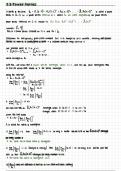
series of the form
A Ao+A,(X-C) Az(X-c) +Az(x-C)3+... An(x-C)"
+ =
is called a power
series in (x-c) or a power series centered on c where An are called coefficients ofthe power series
power series centered on C0 =
reduce to Ao+A,x+AcX +AgX+... cAnX" -
example: n!
so
this is a power series centered on c0=
and An= I!
CoefficientAn are
typically given fixed numbers butX is thoughtof as a variable, meaning each power
series is more ofa family/groupofseries, a differentseries for every value of X
one possible value of XisX c =
·An(X-C)" x c =
noAn(-c)"
=
=
Ho 0 + 0+Ot... +
which As
converges to
with this, we know that a power series converges when x c, and
=
can use other convergence tests
to find for which other values of X the series converges
using the ratio test
can An(X-c)
=
eim Ant1=lim Anti(X-C)n+1
n D
- n 0
=
an An(X-C)"
=ein Ant. X-C
n 0 -
An
=X- C line An+ 1
n 0
=
An
Art=
if im Ao
n N
=
tells
the ratio test us noAn(X-c)" converges when A.x-CC1 <IX-C 'A
A.x-C>1 A
diverges when x-C
When the limitexists
-
I
:R A lim
= =
Anti
n 0 =
An
R is called the radius ofconvergence
ratiotest tells neoAn(X-c" converges
Ant andthe
Anti us that
ifhim 0 then
in 1x-C 0 for every
=
=
n =0 An
for every number x
series has an infinite radius
the of convergence
if m Anti +00
=
(diverges to infinity) then him
n D +
Anti x -c
+
=
20 for every x/C and the ratio test
An An
tells us that An(X-C)" diverges for every number x =c
the series has radius convergence zero
of
if
Ant
does not approach a limit as, then we learn
nothing
series of the form
A Ao+A,(X-C) Az(X-c) +Az(x-C)3+... An(x-C)"
+ =
is called a power
series in (x-c) or a power series centered on c where An are called coefficients ofthe power series
power series centered on C0 =
reduce to Ao+A,x+AcX +AgX+... cAnX" -
example: n!
so
this is a power series centered on c0=
and An= I!
CoefficientAn are
typically given fixed numbers butX is thoughtof as a variable, meaning each power
series is more ofa family/groupofseries, a differentseries for every value of X
one possible value of XisX c =
·An(X-C)" x c =
noAn(-c)"
=
=
Ho 0 + 0+Ot... +
which As
converges to
with this, we know that a power series converges when x c, and
=
can use other convergence tests
to find for which other values of X the series converges
using the ratio test
can An(X-c)
=
eim Ant1=lim Anti(X-C)n+1
n D
- n 0
=
an An(X-C)"
=ein Ant. X-C
n 0 -
An
=X- C line An+ 1
n 0
=
An
Art=
if im Ao
n N
=
tells
the ratio test us noAn(X-c)" converges when A.x-CC1 <IX-C 'A
A.x-C>1 A
diverges when x-C
When the limitexists
-
I
:R A lim
= =
Anti
n 0 =
An
R is called the radius ofconvergence
ratiotest tells neoAn(X-c" converges
Ant andthe
Anti us that
ifhim 0 then
in 1x-C 0 for every
=
=
n =0 An
for every number x
series has an infinite radius
the of convergence
if m Anti +00
=
(diverges to infinity) then him
n D +
Anti x -c
+
=
20 for every x/C and the ratio test
An An
tells us that An(X-C)" diverges for every number x =c
the series has radius convergence zero
of
if
Ant
does not approach a limit as, then we learn
nothing