

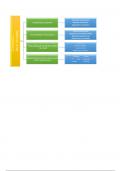
Description and elements
Unpacking economics Branches of Economics
Approaches to Economics
Positive and normative
Basic concepts
statements The Scientific method
The methods of economics
Economics:
Difficulties faced by Social
Sciences The use of models
Accounting
The setting of economics within Business Studies
the field Commercial law
Mathematics of finance
- Statistics - Maths
Relationships with other sciences and - IT - Law - Geography
career opportunities
- Politics - Sociology
, UNIT 1 – Unpacking economics
1.1 DESCRIPTION AND ELEMENTS
An economy is a place where ….
Economics is a social science that ….
Activity 2 page 5
Assignment – Term 1 (Pg 75) This is due on Friday 8 February 2019
Represents
demand side
Can you explain the relationship between scarcity and opportunity
cost?
When resources are scarce, consumers must choose to satisfy Represents supply
certain needs/wants over others, in the process giving up their side
satisfaction of other needs.
, TYPES OF ECONOMIC SYSTEMS
Types of economies
Traditional image1
Command
Market
Mixed
1.2 Branches of economics (including macroeconomics and micro economics)
Monetary; (Money and banking industry)
There are FOUR factors of production that must be remunerated (rewarded)
International; (International trade and finance)
Public Sector; (Decisions and policies made by a country’s government)
Development; (Strategies and policies that help countries to develop and grow)
Labour; (Demand and supply of labour and factors affecting productivity) Environmental;
(Environmental issues and implications of certain environmental decisions on society)
Regional; (Specific geographical regions responsible for the production of certain
goods/services) +others
Deals with the
exchange of
ECONOMIC QUESTIONS AND DECISIONS goods/services
, 1.3 Approaches to economics
Macroeconomics Macroeconomics studies the sum total of economic activity. It includes regional,
Macroeconomics Microeconomics
national and international study fields. So, macroeconomics studies aggregated or total indicators
such as statistics, the total income of the nation, inflation and unemployment rates.
Is the study of the economy as aIs the study of individual consumer,
whole. household, firms and other organisations.
It focuses on the economic Focuses on the supply and demand
behavior of a society. decisions of individuals.
E. G. Study of inflation, Consider the individuals demand for a
unemployment , or a country's certain product at a certain price, oh how
economic performance. individuals decide what to buy and when to
buy it.
Discuss activity 5 Q1. (Pg 11)
Unpacking economics Branches of Economics
Approaches to Economics
Positive and normative
Basic concepts
statements The Scientific method
The methods of economics
Economics:
Difficulties faced by Social
Sciences The use of models
Accounting
The setting of economics within Business Studies
the field Commercial law
Mathematics of finance
- Statistics - Maths
Relationships with other sciences and - IT - Law - Geography
career opportunities
- Politics - Sociology
, UNIT 1 – Unpacking economics
1.1 DESCRIPTION AND ELEMENTS
An economy is a place where ….
Economics is a social science that ….
Activity 2 page 5
Assignment – Term 1 (Pg 75) This is due on Friday 8 February 2019
Represents
demand side
Can you explain the relationship between scarcity and opportunity
cost?
When resources are scarce, consumers must choose to satisfy Represents supply
certain needs/wants over others, in the process giving up their side
satisfaction of other needs.
, TYPES OF ECONOMIC SYSTEMS
Types of economies
Traditional image1
Command
Market
Mixed
1.2 Branches of economics (including macroeconomics and micro economics)
Monetary; (Money and banking industry)
There are FOUR factors of production that must be remunerated (rewarded)
International; (International trade and finance)
Public Sector; (Decisions and policies made by a country’s government)
Development; (Strategies and policies that help countries to develop and grow)
Labour; (Demand and supply of labour and factors affecting productivity) Environmental;
(Environmental issues and implications of certain environmental decisions on society)
Regional; (Specific geographical regions responsible for the production of certain
goods/services) +others
Deals with the
exchange of
ECONOMIC QUESTIONS AND DECISIONS goods/services
, 1.3 Approaches to economics
Macroeconomics Macroeconomics studies the sum total of economic activity. It includes regional,
Macroeconomics Microeconomics
national and international study fields. So, macroeconomics studies aggregated or total indicators
such as statistics, the total income of the nation, inflation and unemployment rates.
Is the study of the economy as aIs the study of individual consumer,
whole. household, firms and other organisations.
It focuses on the economic Focuses on the supply and demand
behavior of a society. decisions of individuals.
E. G. Study of inflation, Consider the individuals demand for a
unemployment , or a country's certain product at a certain price, oh how
economic performance. individuals decide what to buy and when to
buy it.
Discuss activity 5 Q1. (Pg 11)


