OCS Military History Exam 2023 with 100% correct answers
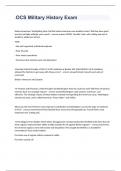
Native-Americans' Warfighting Style. Did the Native-Americans use stealthy tactics? Did they have good security and fight willingly year-round? -GOOD: 'Guerilla' style, with raiding and use of stealth in wilderness terrain. -BAD: --Not well organized; individual emphasis --Poor Security --Poor winter operations --Ferocious (but colonists were not blameless) -Describe Patriot Principle of War (P of W) violations at Bunker Hill. What British P of W violations allowed the Patriots to get away with those errors? Patriots: Security and unity of command British: Maneuver and Surprise -At Trenton and Princeton, what Principles did Washington show he could use well? Did these US tactical victories have any strategic impact? Washington used surprise, maneuver, and offensive. The strategic impact of these battles included reinvigorating the American cause, Washington retained an army, and it rallied American "fence-sitters" and militia. What was the French fleet's most important contribution to Washington's successful siege at Yorktown (1761)? French fleet blocked Navy access into Chesapeake bay. French fleet's most important role: Cutting LOC. -In the Niagara Front battles (), did aggressive combat leaders like Winfield Scott show that US Army regulars improved their ability to fight outside the US against British regulars? Yes, the US Army regulars were well trained and disciplined. They fought the British to a standstill in conventional, linear tactics battles. First time use of regular military instead of militia First time outside US -Describe Scott's conduct of administrative and diplomatic affairs after he took Mexico City. Did he receive Mexican support and avert a wider war? Scott created administrative conditions and exploited diplomatic opportunities, which led the Mexicans to accept money in return for ceding the land the US desired. This treaty averted a wider war. -Was the Anaconda Plan strategy increasingly effective in the Civil War? Was its blockade was effective early in the war? Why? Did the Union Navy implement it quickly The Anaconda plan was increasingly effective throughout the war and it was set up quickly. Initially wasn't very effective but over time the union added about 670 ships to the blockade and it became very effective over time. --Did Grant violate Security at Shiloh? Did he still win? High or low casualties? Did his advance into the South accelerate or decelerate? Grant and his army became overconfident, led to poor union security, and enabled a rebel surprise attack. Grant Won, but his losses were high and his advance into the south stalled. The union offensive slowed for the rest of the year. --So then when Bragg went north into Kentucky, did he have the Legitimacy to secure Kentuckians support? Did that issue help end his campaign? No, Bragg could not maintain confederate legal, political, and moral authority in Kentucky. He felt compelled to retreat due to weaker than expected local support, poor supplies, and a costly stalemated battle at perryville with a bigger union army.
Geschreven voor
- Instelling
- OCS Military History
- Vak
- OCS Military History
Documentinformatie
- Geüpload op
- 6 juli 2023
- Aantal pagina's
- 6
- Geschreven in
- 2022/2023
- Type
- Tentamen (uitwerkingen)
- Bevat
- Vragen en antwoorden
Onderwerpen

Ook beschikbaar in voordeelbundel