Design Considerations for additive manufacturing processes in
Industry
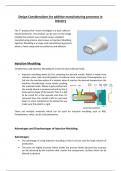
The 1st product that I must investigate is a dust collector
head transformer. The product can be seen on the image.
Initially this product was created using a standard
manufacturing process also known as Injection Moulding.
Injection Moulding is a Large scale manufacturing process
which is fairly cheap and very effective and efficient.
Injection Moulding:
Initially they used Injection Moulding to create the dust collector head.
• Injection moulding works by first selecting the desired mould. Which is made from
stainless steel, then the bits/pellets of material most commonly Thermoplastics are
fed into the machine where it is heated, when it reaches the desired temperature the
machine threads/lead screw rotate pushing
the material inside. Where it gets pushed into
the mould where is compressed and by this it
picks up the shape of the mould. Then it is left
to be cured for a few seconds and then it’s
removed from the mould a left to cool back
down to room temperature by doing this you
make sure the plastic is rigid.
There are multiple materials which can be used for injection moulding such as ABS,
Polyethylene, nylon, acrylic and polystyrene.
Advantages and Disadvantages of Injection Moulding:
Advantages:
• The advantage of using injection moulding is that it can be used for large volume of
production.
• The parts are highly accurate which makes the process faster because the accuracy
can be achieved by the machine that creates the components. Surface finish can be
altered as desired.
, • There is a large variety of material choice for injection moulding.
• There is barely any material waste produced with injection moulding.
Disadvantages:
• One of the disadvantages of injection moulding is that the initial machinery cost a lot
(up to £80,000) and not many companies can afford it which makes the market more
competitive which decreases the profit because each company is trying to create the
cheapest products.
• The dyes/moulds used cost a lot of money (up to £12,000), each injection moulding
machine requires two mould for the two sides .
• The machine cleaning and preparation is a lengthy process which makes it unsuitable
for smaller scale of production or small-scale part production.
The additive manufacturing process that is more suitable than Injection Moulding is
Material Jetting due to the fact material jetting allows you much more design changes and
design flexibility with minimal effort and cost.
Material Jetting:
Material jetting is a DOD which stands for drop on demand which means material is only used
when required to apply the next layer. The material is jetted onto the machine bed or a
specialist base through the small nozzles. The materials that can be used for material jetting
are: Polypropylene, PS, PMMA, PC, ABS, HIPS, EDP
How the process works:
First of all, the print head aligns over the build platform or also known as the machine bed.
Then small droplets of material are jetted out of the nozzles onto the surface of the platform
which are already melted by the time they
high the platform. The material droplets are
in a near liquid and near solid state before
they are jetted onto the build platform.
After the droplets land into their required
place, they will quickly solidify and bond
with the other material blobs around it by
the use of UV light and by this their
polycrystalline grains bond. This process can
be repeated to achieve the desired size and
thickness of the part.
The thickness of one layer is 16 microns and the machine bed is 490 mm x 390 mm x 200mm
Industry
The 1st product that I must investigate is a dust collector
head transformer. The product can be seen on the image.
Initially this product was created using a standard
manufacturing process also known as Injection Moulding.
Injection Moulding is a Large scale manufacturing process
which is fairly cheap and very effective and efficient.
Injection Moulding:
Initially they used Injection Moulding to create the dust collector head.
• Injection moulding works by first selecting the desired mould. Which is made from
stainless steel, then the bits/pellets of material most commonly Thermoplastics are
fed into the machine where it is heated, when it reaches the desired temperature the
machine threads/lead screw rotate pushing
the material inside. Where it gets pushed into
the mould where is compressed and by this it
picks up the shape of the mould. Then it is left
to be cured for a few seconds and then it’s
removed from the mould a left to cool back
down to room temperature by doing this you
make sure the plastic is rigid.
There are multiple materials which can be used for injection moulding such as ABS,
Polyethylene, nylon, acrylic and polystyrene.
Advantages and Disadvantages of Injection Moulding:
Advantages:
• The advantage of using injection moulding is that it can be used for large volume of
production.
• The parts are highly accurate which makes the process faster because the accuracy
can be achieved by the machine that creates the components. Surface finish can be
altered as desired.
, • There is a large variety of material choice for injection moulding.
• There is barely any material waste produced with injection moulding.
Disadvantages:
• One of the disadvantages of injection moulding is that the initial machinery cost a lot
(up to £80,000) and not many companies can afford it which makes the market more
competitive which decreases the profit because each company is trying to create the
cheapest products.
• The dyes/moulds used cost a lot of money (up to £12,000), each injection moulding
machine requires two mould for the two sides .
• The machine cleaning and preparation is a lengthy process which makes it unsuitable
for smaller scale of production or small-scale part production.
The additive manufacturing process that is more suitable than Injection Moulding is
Material Jetting due to the fact material jetting allows you much more design changes and
design flexibility with minimal effort and cost.
Material Jetting:
Material jetting is a DOD which stands for drop on demand which means material is only used
when required to apply the next layer. The material is jetted onto the machine bed or a
specialist base through the small nozzles. The materials that can be used for material jetting
are: Polypropylene, PS, PMMA, PC, ABS, HIPS, EDP
How the process works:
First of all, the print head aligns over the build platform or also known as the machine bed.
Then small droplets of material are jetted out of the nozzles onto the surface of the platform
which are already melted by the time they
high the platform. The material droplets are
in a near liquid and near solid state before
they are jetted onto the build platform.
After the droplets land into their required
place, they will quickly solidify and bond
with the other material blobs around it by
the use of UV light and by this their
polycrystalline grains bond. This process can
be repeated to achieve the desired size and
thickness of the part.
The thickness of one layer is 16 microns and the machine bed is 490 mm x 390 mm x 200mm