Boating License Exam with complete solutions
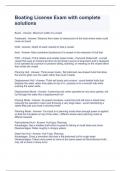
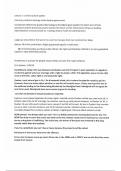
Beam - Answer- Maximum width of a vessel Freeboard - Answer- Distance from water to lowest point of the boat where water could come on board Draft - Answer- Depth of water needed to float a vessel Keel - Answer- Main centerline (backbone) of a vessel or the extension of hull that PWC - Answer- Think Jetskis and smaller power boats - Personal Watercraft - a small vessel that uses an inboard jet drive as its primary source of propulsion and is designed to be operated by a person or persons sitting, standing, or kneeling on the vessel rather than inside the vessel Planning Hull - Answer- Think power boats - flat bottomed vee-shaped hulls that allow the boat to glide over the water rather than push it aside Displacement Hull - Answer- Think sail boats and cruisers - round bodied hulls that displace the water rather than glide on top of it - purpose is for a smooth ride while pushing the water aside Displacement Mode - Answer- A planning hull, when operated at very slow speeds, will cut through the water like a displacement hull Plowing Mode - Answer- As speed increases, a planning hull will have a raised bow, reducing the operator's vision and throwing a very large wake - avoid maintaining a speed that puts your boat in plowing mode Planning Mode - Answer- Your boat is in planning mode when enough power is applied so that the hull glides on top of the water - different boats reach planning mode at different speeds Flat-bottomed Hull - Answer- Hull type: Planning Advantages: Has a shallow draft which is good for fishing in small lakes and rivers Disadvantages: Rides roughly in choppy waters Deep-Vee Hull - Answer- Hull Type: Planning Advantages: Gives a smoother ride than a flat-bottomed hull in rough water Disadvantages: Takes more power to move at the same speed as flat-bottomed hulls - may roll or bank in sharp turns Round Bottomed Hull - Answer- Hull Type: Displacement Advantages: Moves easily through the water even at slower speeds Disadvantages: Has a tendency to roll unless it has a deep keel or stabilizers Multi-Hull - Answer- Hull Type: Displacement Advantages: Has greater stability because of its wide beam Disadvantages: Needs a large area when turning Rudder - Answer- Steering device, usually a vertical blade attached to a post at, or near, the stern of the boat Class A - Answer- Less than 16 feet Class 1 - Answer- 16 feet to less than 26 feet Class 2 - Answer- 26 feet to less than 40 feet Class 3 - Answer- 40 feet to less than 65 feet Tiller - Answer- Lever used to turn a rudder to steer a boat Transom - Answer- Vertical surface at the back of the hull Impeller - Answer- Device used to pump and force water under pressure through a steering nozzle at the rear of the vessel Intake - Answer- Opening in the hull that draws water toward the impeller Intake grate - Answer- Screening cover over the intake, which prevents large debris from entering Drive Shaft - Answer- The long stem connection between the motor and the impeller Steering Nozzle - Answer- Device used for directing the stream of water to the left or right Capacity Plate - Answer- Near or under the operator's position or on the transom of the boat - plate indicates the max weight capacity and/or the maximum number of people that the boat can carry safely in good weather Calculating Boat Capacity - Answer- Capacity = (boat length (ft.) x boat width (ft.))/15 15 suggests the average weight of a person (150 lbs) Float Plan - Answer- Essentially a fail safe if you are going on a boat trip and something goes wrong - the float plan maps out where you were going and what time you planned on hitting a destination Bilge - Answer- Interior of the hull below the floor boards; lowest part of a vessel's interior where the sides of the vessel curve in to form the bottom Coupler - Answer- Coupler on a trailer connects to a ball hitch on a towing vehicle (frame mounted hitch is stronger than a bumper mounted hitch) Tongue Wieght - Answer- Amount of the loaded trailer's weight that presses down on the towing hitch - tongue weight should be about 10% of the combined weight of the vessel and trailer Trailer Safety Chains - Answer- Should be crisscrossed from trailer towing vehicle to trailer Bunks - Answer- Wooden supports on which the vessel rests while on the trailer Figure Eight Bend - Answer- Has several uses including connecting two ropes to make a longer line or making a stopper knot in a single line to prevent the line from slipping through a hole or a gap in a block or cleat Bowline Knot - Answer- The bowline is a multi-purpose knot that is essential for boat operators to know. Forming the knot creates a fixed loop on the end of the rope or line—a loop that can be used for hitching, mooring, or lifting. Anchor Bend Knot - Answer- A type of hitching knot, the anchor bend is used to secure a rope to an anchor or a ring. If additional security is needed, a half hitch can be tied at the end. clove hitch knot - Answer- The clove hitch is handy for temporary hastening, such as when tying up to a piling - it is particularly usefull because, with experience, it can be tied with only one hand Round Turn and Two Half Hitches - Answer- Handy for tying down a bulky load or tying a boat to a mooring post, the round turn and two half hitches is versatile. It is a secure knot that does not jam and is easy to undo. 3 Major Responsibilities of every boatter - Answer- 1: Practice Good Spacemanship 2: Keep a proper look out 3: Maintain a safe speed Give-way Vessel - Answer- The vessel that is required to take early and substantial action to keep well away from other vessels by stopping, slowing down or changing course Stand-on Vessel - Answer- The vessel that must maintain its course and speed unless it becomes apparent that the give-way vessel is not taking appropriate action Underway - Answer- A vessel not anchored, tied to shore or aground Where should a boat turn if meeting head on (2 power boats)? - Answer- Neither vessel, in the instance of 2 boats heading head on, is the stand on vessel - both vessels should turn starboard or right Paths that cross - Answer- The vessel on the operator's port (left) is the give-way vessel. The vessel on the operator's starboard (right) is the stand-on vessel. Overtaking - Answer- The vessel that is overtaking another vessel is the give-way vessel. The vessel being overtaken is the stand-on vessel. When two sailing vessels approach one another with wind on the same side, which vessel is the stand-on? - Answer- The leeward sailing vessel is the stand-on Leeward - Answer- Direction toward which the wind is blowing or downwind - leeward vessel refers to the vessel that is downwind of the other Windward - Answer- Direction from which the wind is blowing, or upwind - Windward vessel refers to the vessel that is upwind of the other When two sailing vessels are approaching one another with wind on different sides, which vessel is the stand-on vessel? - Answer- The vessel with the wind on its starboard is the stand on vessel
Written for
- Institution
- Boating License
- Course
- Boating License
Document information
- Uploaded on
- July 4, 2023
- Number of pages
- 14
- Written in
- 2022/2023
- Type
- Exam (elaborations)
- Contains
- Questions & answers
Subjects
-
boating license exam with complete solutions

Also available in package deal