Immunology Final Exam Questions
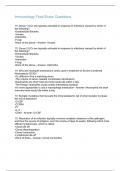
11) Group 1 ILCs are typically activated in response to infections caused by which of the following? -Extracellular Bacteria -Viruses -Helminths -Fungi -None of the above - Answer- Viruses 11) Group 2 ILCs are typically activated in response to infections caused by which of the following? -Extracellular Bacteria -Viruses -Helminths -Fungi -None of the above - Answer- Helminths 11) Why are neutrophil transfusions rarely used in treatment of Severe Combined Neutropenia (SCN)? -It's difficult to find a matching donor -The volume of serum needed complicates transfusions -Neutrophils are short lived and most would die within a day -The foreign neutrophils could contain intracellular bacteria -It's more appropriate to use a macrophage transfusion - Answer- Neutrophils are short lived and most would die within a day 11) Somatic mutations that truncate the intracytoplasmic tail of what receptor increase the risk of leukemia? -G-CSF -CCFR4 -Fc -IL-4 -CD40 - Answer- G-CSF 11) Resolution of an infection typically involves complete clearance of the pathogen, and thus the source of antigens, over the course of days to weeks, following which most effector lymphocytes, which is called: -Clonal die off -Clonal disambiguation -Clonal contraction -Lymphocyte die off -None of these - Answer- Clonal contraction
Geschreven voor
- Instelling
- Immunology
- Vak
- Immunology
Documentinformatie
- Geüpload op
- 3 juli 2023
- Aantal pagina's
- 13
- Geschreven in
- 2022/2023
- Type
- Tentamen (uitwerkingen)
- Bevat
- Vragen en antwoorden
Onderwerpen
-
immunology final exam questions
-
11 group 1 ilcs are typically activated in respon
-
11 group 2 ilcs are typically activated in respon
-
11 why are neutrophil transfusions rarely used in

Ook beschikbaar in voordeelbundel