EDF Exam 1 Questions with correct Answers
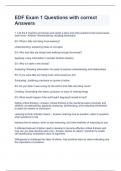
1. List the 6 cognitive processes and select a story and write questions that would asses each level - Answer- Remembering: recalling information EX: What is little red riding hood wearing? Understanding: explaining ideas or concepts EX: Why was little red riding hood walking through the woods? Applying: using information in another familiar situation EX: Why is it dark in the woods? Analyzing: Breaking information into parts to explore understanding and relationships EX: If you were little red riding hood, what would you do? Evaluating: Justifying a decision or course of action EX: Do you think it was wrong for the wolf to trick little red riding hood? Creating: Generating new ideas, products, or ways of viewing things EX: What would happen if the wolf hadn't disguised himself in bed? Define critical thinking - Answer- critical thinking is the mental process of actively and skillfully conceptualizing, applying, analyzing, synthesizing, and evaluating information to reach an answer or conclusion Learning to think critically means: - Answer- learning how to question, when to question, what questions to ask learning how to reason, when to use reasoning, and what methods of reasoning to use 3 attitudes believed children need to develop to become effective critical thinkers and how can you help develop each one - Answer- Desire to reason: important to model self-questioning, emphasize value of argument Willingness to challenge the ideas of others: help students learn to value evaluating and the importance of evidence Desire for truth: value of doubt Describe 3 types of questions that would help increase critical thinking and give an example - Answer- Questions that focus attention EX: Did you notice the 2 trains in the story? Questions that focus comparison EX: How are they different? How are they the same? Questions that seek clarification EX: can you explain further...? Examples of 3 reasoning skills and explain how you would help students develop them - Answer- Giving reasons: Identifying purposes : Evaluating outcomes explain wait time and why it is important - Answer- periods of silence that follow teachers' questions and students responses gives students time to think increases length of response decreases inappropriate responses Name three types of reinforcement from least to most intrusive. Give an example - Answer- social: positive, non-verbal behaviors activity: being a classroom helper tangible: stickers and prizes according to Duncan, what are the characteristics of effective praise. Give an example - Answer- Effective praise is specific: Jane, great job you did cleaning up the coloring center! Effective praise is generally private: think about what you need to do to be ready to listen Effective praise emphasizes improvement of process rather than the finished product: Ashlee you are remembering more names. Today you remembered Tom and Jim! What did Wolfgang recommend is a better way of changing their behavior? - Answer- Trying to understand their developmental needs and whether his situation is developmentally appropriate 3 basic psychological needs - Answer- Competence: ability to complete a task Relatedness: sense of control and personal choice Autonomy: Sense of belonging and security how might you recognize that a child's basic needs are not met and how can you help - Answer- A child's basic needs are not met when a child rejects growth and responsibility or tend to isolate themselves from society. For example, students who stare blankly from the back of the classroom As a teacher I can help by increasing a students intrinsic motivation (competence +autonomy + relatedness) - Give students feedback on their work, do not give out so many deadlines or threats as that that might come off as controlling to a student, instead acknowledge a students feelings and provide opportunity for choice, and make them feel like they belong in the classroom What is necessary for healthy psychologic
Written for
- Institution
- EDF
- Course
- EDF
Document information
- Uploaded on
- July 3, 2023
- Number of pages
- 9
- Written in
- 2022/2023
- Type
- Exam (elaborations)
- Contains
- Questions & answers
Subjects
-
edf exam 1 questions with correct answers

Also available in package deal