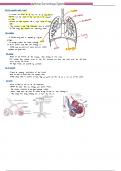
Human Gas-exchange System
do mammals ?
Why need lungs
mammals volume of
In the
02
Bronchus
÷ , that has to be absorbed for
respiration and the volume of CO2 that has to be removed
:
;;÷ &
large
Bronchioles
are .
÷ " " " " " "
µTh§
. .
" " "
cells .
related
They maintain high body temperature which
•
: a is
to them
having high metabolic and
respiratory rates .
The trachea
:*
•
A flexible airway that is supported by rings of ,
cartilage
ribs
.
The
cartilage prevents the trachea
collapsing
'
as the air
pressure inside falls when
breathing in .
Tracheal made of lined with ciliated
alveoli
walls are muscle,
up
-
epithelium and
goblet cells .
Diaphragm
The bronchi
Bronchi divisions of
are two the trachea each
leading to
lung
-
one .
,
Like dirt have dirt
they
•
trachea trap and that
, produce mucus to
particles cilia move the -
laden
mucus towards the throat .
The
larger bronchi supported by cartilage
'
are .
The bronchioles
'
A of subdivisions of the bronchi
series
branching .
Walls made of muscle lined with epithelial
•
are cells .
Muscle allows them to constrict flow of of alveoli
that
they the
'
so can control the air in and out .
the alveoli
-
Minute air -
sacs at the end of the bronchioles .
Between the alveoli and elastic fibres
there
collagen
-
are .
The alveolar membrane is the exchange surface
gas
. - .
Elastic fibres fill in
allow the alveoli to stretch as
they with air when
breathing
-
.
back
They spring during breathing out to
expel CO2 rich air
-
.
I
do mammals ?
Why need lungs
mammals volume of
In the
02
Bronchus
÷ , that has to be absorbed for
respiration and the volume of CO2 that has to be removed
:
;;÷ &
large
Bronchioles
are .
÷ " " " " " "
µTh§
. .
" " "
cells .
related
They maintain high body temperature which
•
: a is
to them
having high metabolic and
respiratory rates .
The trachea
:*
•
A flexible airway that is supported by rings of ,
cartilage
ribs
.
The
cartilage prevents the trachea
collapsing
'
as the air
pressure inside falls when
breathing in .
Tracheal made of lined with ciliated
alveoli
walls are muscle,
up
-
epithelium and
goblet cells .
Diaphragm
The bronchi
Bronchi divisions of
are two the trachea each
leading to
lung
-
one .
,
Like dirt have dirt
they
•
trachea trap and that
, produce mucus to
particles cilia move the -
laden
mucus towards the throat .
The
larger bronchi supported by cartilage
'
are .
The bronchioles
'
A of subdivisions of the bronchi
series
branching .
Walls made of muscle lined with epithelial
•
are cells .
Muscle allows them to constrict flow of of alveoli
that
they the
'
so can control the air in and out .
the alveoli
-
Minute air -
sacs at the end of the bronchioles .
Between the alveoli and elastic fibres
there
collagen
-
are .
The alveolar membrane is the exchange surface
gas
. - .
Elastic fibres fill in
allow the alveoli to stretch as
they with air when
breathing
-
.
back
They spring during breathing out to
expel CO2 rich air
-
.
I