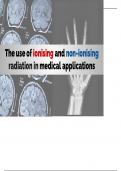
The use of ionising and non-ionising
radiation in medical applications
, What is ionising radiation?
Ionising radiation (IR) is a type of radiation that is able to
penetrate biological tissues.
When tissues are exposed to the radiation, enough
energy is deposited to break chemical bonds and remove
electrons from the orbit of atoms.
This process is also known as ionisation
, Examples of ionising radiation
Medical procedures that use IR: Non-medical examples:
- X-rays - Alpha particles
- Gamma ray imaging - Beta particles,
- CT and CAT scans - Neutrons
- Radiotherapy - High-speed electrons
- Proton beam therapy - High-speed protons
- Gamma knife surgery - Other ion-producing particles.
, What is non-ionising radiation?
Non-ionising radiation (NIR) is a type of radiation
that has less energy than ionising radiation.
Unlike IR, non-ionising radiation is non-invasive.
This means that it cannot pass through biological
tissues so chemical bonds can’t be broken.
, Examples of non-ionising radiation
Medical procedures that use NIR: Non-medical examples:
- MRI - Radiofrequency
- Lasers - Microwaves
- Infrared thermography (IRT) - Infrared radiation
- Ultrasound
- Ultraviolet light (UV)
, Properties of IR and NIR
Ionising radiation Non-ionising radiation
High energy Low energy
High frequency Low frequency
Short wavelength Long wavelength
, Production of IR and NIR
Ionising radiation Non-ionising radiation
Ionizing radiation is released by atoms that travels Non-ionising radiation is produced by
in the form of electromagnetic waves or particles electromagnetic fields
, Uses of IR and NIR
Ionising radiation Non-ionising radiation
● Energy production ● Electrical appliances in the kitchen
● Manufacturing ● Work processes such as radiofrequency
● Medicine heating and drying
● Research ● Radio
● TV
● Telecoms broadcasting masts
● Security detection devices
radiation in medical applications
, What is ionising radiation?
Ionising radiation (IR) is a type of radiation that is able to
penetrate biological tissues.
When tissues are exposed to the radiation, enough
energy is deposited to break chemical bonds and remove
electrons from the orbit of atoms.
This process is also known as ionisation
, Examples of ionising radiation
Medical procedures that use IR: Non-medical examples:
- X-rays - Alpha particles
- Gamma ray imaging - Beta particles,
- CT and CAT scans - Neutrons
- Radiotherapy - High-speed electrons
- Proton beam therapy - High-speed protons
- Gamma knife surgery - Other ion-producing particles.
, What is non-ionising radiation?
Non-ionising radiation (NIR) is a type of radiation
that has less energy than ionising radiation.
Unlike IR, non-ionising radiation is non-invasive.
This means that it cannot pass through biological
tissues so chemical bonds can’t be broken.
, Examples of non-ionising radiation
Medical procedures that use NIR: Non-medical examples:
- MRI - Radiofrequency
- Lasers - Microwaves
- Infrared thermography (IRT) - Infrared radiation
- Ultrasound
- Ultraviolet light (UV)
, Properties of IR and NIR
Ionising radiation Non-ionising radiation
High energy Low energy
High frequency Low frequency
Short wavelength Long wavelength
, Production of IR and NIR
Ionising radiation Non-ionising radiation
Ionizing radiation is released by atoms that travels Non-ionising radiation is produced by
in the form of electromagnetic waves or particles electromagnetic fields
, Uses of IR and NIR
Ionising radiation Non-ionising radiation
● Energy production ● Electrical appliances in the kitchen
● Manufacturing ● Work processes such as radiofrequency
● Medicine heating and drying
● Research ● Radio
● TV
● Telecoms broadcasting masts
● Security detection devices