

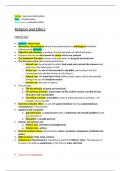
Yellow = key term/information
Blue = scholar/quote
Green/red = evaluation (AO2)
Religion and Ethics
Natural Law
Aquinas: Natural Law
Normative, deontological ethical theory derived from a teleological worldview
(influenced by Aristotle)
Objective and absolute, providing universal principles of ethical behaviour
Assumes that we are duty-bound to nature and to our purpose
The Synderesis Principle: humans naturally desire to do good and avoid evil
The four tiers of law (decreasing importance):
o Eternal Law: the principles by which God made and controls the universe and
which are only fully known to God
o Divine Law: the law of God revealed in the Bible, particularly in the Ten
Commandments and the Sermon on the Mount
o Natural Law: the moral law of God within human nature that is discoverable
through the use of God-given reason
o Human Law: the laws of nations
The precepts:
o The key precept: do good and avoid evil
o Five primary precepts: preservation of life, orderly society, worship of God,
education and reproduction
o Secondary precepts: prescriptive, ways of achieving primary precepts – for
example, do not murder
Doctrine of double effect: an act with good intentions that has unintended bad
consequences is not immoral
Apparent and real goods:
o Apparent good: an immoral act which is believed to be morally justified by the
one who does it
o Real good: a morally good act
Interior and exterior acts
o Interior acts: intentions and judgements
o Exterior acts: actions
Natural/cardinal virtues, discovered by reason: prudence, temperance, fortitude and
justice
Biblical virtues: faith, hope and love
Eudaimonia (‘flourishment’): something is good if it fulfils its ‘telos’. The purpose of
humans is to achieve eudaimonia, in the form of unity with God
Synderesis is incoherent
, o There is plenty of historical evidence that human nature is not naturally good,
such as atrocities like the Holocaust
o Augustine: human nature is fundamentally bad because of the infection of
Original Sin that occurred as a result of the Fall
o Human nature is diverse
o Aquinas acknowledges that there are many reasons why we might fail to do
good, such as original sin, misusing our reason, lacking virtue and a corrupt
culture
Fletcher: if all humans were born with an innate ability to know the primary precepts,
why do we not have more cross-cultural moral agreement?
o There does seem to be some core similarities between moralities of different
cultures eg not killing for no reason
o Ancient Chinese philosophy, Hinduism, Judaism and Christianity all agree on the
golden rule of treating others as you wish to be treated
o This agreement might not be because of innate moral law but because its simply
necessary for a society to function
Natural Law is outdated. In ancient history, society was more chaotic so it made sense to
create strict absolutist principles.
o It was more functional for a medieval society to be told to reproduce and have
lots of children, because sadly most children died
o Society has now changed, so Natural Law is irrelevant
o Just because society has moved on from Natural Law does not mean it was right
to. If the Nazis had won WW2 and enslaved humanity then by the same logic you
would then call democracy ‘outdated’ but that does not make it wrong. Calling an
ethical theory outdated is not a valid argument.
o Nonetheless, the socio-economic conditions have changed and thus that
changes how relevant Natural Law is
o Furthermore, perhaps Aquinas was not discovering an innate moral law but
simply creating a good system for the people in his society
What happens when primary precepts conflict with each other?
Naturalistic fallacy: Aquinas assumes that just because something happens naturally
that it is a morally desirable thing
Assumes that the universe and life have a purpose
o Modern science indicates that the universe has no purpose but is driven by
chance
o Science cannot rule out something like a prime mover or God which could
provide an external telos
Gives clear principles to follow (primary precepts)
A universal moral law is appealing and helpful for making moral decisions
Doesn’t necessarily require belief in God – Catholic Church changed ‘worship God’ to
‘appreciate beauty’
Emphasis on using your reasoning
o Barth: ‘the finite has no capacity for the infinite’
o Original sin means natural theology is incoherent
o Original sin did not destroy our rationality or our inclination towards good, just
our perfect rational control over the soul. Only rational beings can sin.
, Takes intentions into account (doctrine of double effect)
Optimistic view of humanity means it is more motivating
Blue = scholar/quote
Green/red = evaluation (AO2)
Religion and Ethics
Natural Law
Aquinas: Natural Law
Normative, deontological ethical theory derived from a teleological worldview
(influenced by Aristotle)
Objective and absolute, providing universal principles of ethical behaviour
Assumes that we are duty-bound to nature and to our purpose
The Synderesis Principle: humans naturally desire to do good and avoid evil
The four tiers of law (decreasing importance):
o Eternal Law: the principles by which God made and controls the universe and
which are only fully known to God
o Divine Law: the law of God revealed in the Bible, particularly in the Ten
Commandments and the Sermon on the Mount
o Natural Law: the moral law of God within human nature that is discoverable
through the use of God-given reason
o Human Law: the laws of nations
The precepts:
o The key precept: do good and avoid evil
o Five primary precepts: preservation of life, orderly society, worship of God,
education and reproduction
o Secondary precepts: prescriptive, ways of achieving primary precepts – for
example, do not murder
Doctrine of double effect: an act with good intentions that has unintended bad
consequences is not immoral
Apparent and real goods:
o Apparent good: an immoral act which is believed to be morally justified by the
one who does it
o Real good: a morally good act
Interior and exterior acts
o Interior acts: intentions and judgements
o Exterior acts: actions
Natural/cardinal virtues, discovered by reason: prudence, temperance, fortitude and
justice
Biblical virtues: faith, hope and love
Eudaimonia (‘flourishment’): something is good if it fulfils its ‘telos’. The purpose of
humans is to achieve eudaimonia, in the form of unity with God
Synderesis is incoherent
, o There is plenty of historical evidence that human nature is not naturally good,
such as atrocities like the Holocaust
o Augustine: human nature is fundamentally bad because of the infection of
Original Sin that occurred as a result of the Fall
o Human nature is diverse
o Aquinas acknowledges that there are many reasons why we might fail to do
good, such as original sin, misusing our reason, lacking virtue and a corrupt
culture
Fletcher: if all humans were born with an innate ability to know the primary precepts,
why do we not have more cross-cultural moral agreement?
o There does seem to be some core similarities between moralities of different
cultures eg not killing for no reason
o Ancient Chinese philosophy, Hinduism, Judaism and Christianity all agree on the
golden rule of treating others as you wish to be treated
o This agreement might not be because of innate moral law but because its simply
necessary for a society to function
Natural Law is outdated. In ancient history, society was more chaotic so it made sense to
create strict absolutist principles.
o It was more functional for a medieval society to be told to reproduce and have
lots of children, because sadly most children died
o Society has now changed, so Natural Law is irrelevant
o Just because society has moved on from Natural Law does not mean it was right
to. If the Nazis had won WW2 and enslaved humanity then by the same logic you
would then call democracy ‘outdated’ but that does not make it wrong. Calling an
ethical theory outdated is not a valid argument.
o Nonetheless, the socio-economic conditions have changed and thus that
changes how relevant Natural Law is
o Furthermore, perhaps Aquinas was not discovering an innate moral law but
simply creating a good system for the people in his society
What happens when primary precepts conflict with each other?
Naturalistic fallacy: Aquinas assumes that just because something happens naturally
that it is a morally desirable thing
Assumes that the universe and life have a purpose
o Modern science indicates that the universe has no purpose but is driven by
chance
o Science cannot rule out something like a prime mover or God which could
provide an external telos
Gives clear principles to follow (primary precepts)
A universal moral law is appealing and helpful for making moral decisions
Doesn’t necessarily require belief in God – Catholic Church changed ‘worship God’ to
‘appreciate beauty’
Emphasis on using your reasoning
o Barth: ‘the finite has no capacity for the infinite’
o Original sin means natural theology is incoherent
o Original sin did not destroy our rationality or our inclination towards good, just
our perfect rational control over the soul. Only rational beings can sin.
, Takes intentions into account (doctrine of double effect)
Optimistic view of humanity means it is more motivating


