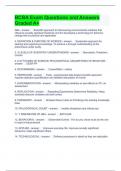
BCBA Exam Questions and Answers Graded A+
BCBA Exam Questions and Answers Graded A+ ABA Scientific approach for discovering environmental variables that influence socially significant behavior and for developing a technology for behavior change that is practical and applicable 2. DEFINITION & PURPOSE OF SCIENCE Systematic approach for seeking and organizing knowledge. To achieve a through understanding of the phenomena under study. 3. 3 LEVELS OF SCIENTIFIC UNDERSTANDING Description, Prediction , Control 4. 6 ATTITUDES OF SCIENCE/ PHILOSOPHICAL ASSUMPTIONS OF BEHAVIOR DEER PP 5. DETERMINISM Cause/Effect - orderly 6. EMPIRICISM Facts - experimental data based scientific approach, requires objective quantification and detailed description of events 7. EXPERIMENTATION Manipulating variables so see effects on DV, an assessment 8. REPLICATION Repeating Experiments Determines Reliability, Helps scientists discover mistakes and self correct 9. PARSIMONY Simplest theory helps to fit findings into existing knowledge base 10. PHILOSOPHICAL DOUBT healthy skepticism and critical eye. 11. 7 DIMENSIONS OF ABA BATCAGE 12. BEHAVIORAL Observable Events - The bx you chose must be the one in need of improvement 13. APPLIED Improves everyday life, improves socially significant behaviors, helps significant others 14. TECHNOLOGICAL Defines procedures in detail so they are replicable 15. CONCEPTUALLY SYSTEMATIC Procedures should be tied to basic principles 16. ANALYTIC Functional Relation/experimentation/control/causation A functional relationship is demonstrated. BELIEVABILITY 17. GENERALITY Extends bx change across time, settings, or other bx 18. EFFECTIVE Improves behavior in a practical manner, not simply making a change that is statistically significant 19. MENTALISM Explaining behavior that assumes an inner dimension exists and causes it. 20. HYPOTHETICAL CONSTRUCTS ex: Free Will - Presumed, but unobserved entities 21. EXPLANATORY FICTIONS Fictitious variables that are another name for observed bx. contributes nothing to what is maintaining bx. ex: knows, wants, figures out 22. CIRCULAR REASONING cause and effect are inferred from the same place. ex. he cried because he felt sad. 23. BEHAVIORISM The philosophy of the science of bx. Environmental not mentalistic explanation of bx 24. 4 BRANCHES OF BEHAVIOR ANALYSIS CASE 25. IVAN PETROVICH PAVLOV 26. JOHN BROADUS WATSON 1913 - methodological behaviorism - looks at only publicly observable events, not private events 27. BURRHUS FREDERIC SKINNER ... 28. DARWINIAN SELECTIONISM & PRAGMATISM Selection by consequences / probabilistic AB because of C. How do things come to be and how can they be changed. 29. RESPONDENT BEHAVIOR/RESPONDENTCONDITIONING Elicited, involuntary, Habituation, Pavlov US = UR = NS = CR= CS 30. REFLEX Eliciting stimulus (US) and the behavior it produces (UR) that is part of the genetic makeup of the individual 31. HABITUATION When the eliciting stimuli is presented repeatedly - the strength of the respondent bx diminishes 32. PHYLOGENY Behavior that is inherited 33. OPERANT BEHAVIOR/OPERANT CONTINGENCY Emit/Evoke - Any behavior whose probability of occurrence is determined by its history of consequences. Voluntary action. SRS model (stimulus response-stimulus model) 3 term contingency ABC. Defined by controlling variables (function) not topography. Encompasses rx and punishment 34. ADAPTATION Reductions in responding evoked by an antecedent stimulus over repeated or prolonged presentations 35. ONTOGENY learning that results from interaction with the environment 36. CONTIGUITY when 2 stimuli occur close together in TIME resulting in association of the 2 stimuli - Respondent how close together in time affects the pairing of the CS & US. Operant how close together in time affects the paining of the behavior and consequence 37. RESPONDENT-OPERANTINTERACTIONS ... 38. 3 PRINCIPLES OF BEHAVIOR Scientifically derived rules of nature that describe the predictable relation between a biological organism's responses and objects and events that influence bx. PER - Punishment, Extinction, Reinforcement SECTION 2 ... 39. RESPONSEVS.BEHAVIOR Single Instance vs larger set or class of responses that share a physical demension 40. RESPONSE CLASS A group of bx that comprise an operant and have the same function. Operant - Response/consequence relationship. Similar bx that are strengthened or weakened collectively a a result of operant conditioning ... ... 41. REPERTOIRE Collection of behaviors the individual can do 42. ENVIRONMENT Complex, dynamic universe of events that differs from instance to instance 43. STIMULI Physical events that affect bx. Internal or External. An energy change that affects an organism through receptor cells. 44. 3 TYPES OF NERVOUS SYSTEMS PER P - Balance/movement, E - Senses, I = internal organs 45. STIMULUSCLASS A group of antecedent stimuli that has a common effect on on an operant class. Tend to evoke or abate the same bx or response class. Can vary across physical dimensions 46. 3 TYPES OF STIMULUS CLASSES FTF = 1) Formal Physical Features (topography), size, color, intensity, weight, spatial positions (on top of). 2) Temporal (time) occurs prior or after bx. 3) Functional stimulus changes that are understood based on their function analysis of their effects on bx. 47. 2 TYPES OF STIMULUS CLASSES 1) Feature = common topographies, common relative relations (spatial relations) ex. dog, house, tree. 2) Arbitrary = evoke the same response, but do not share a common feature. Don't look the same. ex. fruit 48. CONSEQUENCE Selects response classes, not individual responses. ex. How you open a bag of peanuts - all different but the result is the same. 49. AUTOMATICITY(OFREINFORCEMENT/PUNISHMENT) 50. AUTOMATICREINFORCEMENT A person does not have to know what a consequence means for it to work. Operant conditioning occurs automatically. 51. AUTOMATICPUNISHMENT ... 52. REINFORCEMENT&POSSIBLEUNWANTEDEFFECTS 53. POSITIVEREINFORCEMENT ... 54. 5TYPESOFPOSITIVEREINFORCERS ... 55. NEGATIVEREINFORCEMENT ... 56. ESCAPE ... 57. AVOIDANCE -2 TYPES ... 58. UNCONDITIONEDREINFORCER ... 59. CONDITIONEDREINFORCER ... 60. GENERALIZEDCONDITIONEDREINFORCER ... 61. PUNISHMENT&POSSIBLEUNWANTEDEFFECTS ... 62. RECOVERYFROMPUNISHMENT ... 63. BEHAVIORALCONTRAST ... 64. POSITIVEPUNISHMENT ... 65. 5TYPESOFPOSITIVEPUNISHMENTINTERVENTIONS 66. NEGATIVEPUNISHMENT ... 67. RESPONSECOST ... 68. TIME-OUT ... 69. 4TYPESOFNON-EXCLUSIONARYTIME-OUT ... 70. 3TYPESOFEXCLUSIONARYTIME-OUT ... 71. UNCONDITIONEDPUNISHERS ... 72. CONDITIONEDPUNISHERS ... 73. GENERALIZEDCONDITIONEDPUNISHERS ... 74. VERBALANALOGCONDITIONING ... 75. EXTINCTION&POSSIBLEUNWANTEDEFFECTS ... 76. 3TYPESOFEXTINCTION ... 77. EXTINCTIONBURST&SPONTANEOUSRECOVERY ... 78. STIMULUSCONTROL ... 79. MASKING/OVERSHADOWING ... 80. DISCRIMINATIVESTIMULUS ... 81. STIMULUSDELTA ... 82. STIMULUSGENERALIZATION ... 83. STIMULUSDISCRIMINATION ... 84. CONCEPT ... 85. SIMPLEVS.CONDITIONALDISCRIMINATION ... 86. MATCHING-TO-SAMPLE ... 87. STIMULUSEQUIVALENCE ... 88. REFLEXIVITY,SYMMETRY,&TRANSITIVITY ...
Written for
- Institution
- BCBA
- Course
- BCBA
Document information
- Uploaded on
- July 2, 2023
- Number of pages
- 18
- Written in
- 2022/2023
- Type
- Exam (elaborations)
- Contains
- Questions & answers
Subjects
-
bcba exam questions and answers graded a
-
aba scientific approach for discovering environmen
-
2 definition amp purpose of science systematic appr
-
3 3 levels of scientific understanding descriptio
-
4

Also available in package deal