Section 3 : Organic Chemistry
Polymers
Polymer: a long chain of repeating units joined together. It is saturated.
• Monomer: unit which breaks its double bond. It is a small unsaturated molecule.
Condensation Polymers
Condensation polymer: a polymer that is formed when monomers join together from condensation
reactions + eliminate a small molecule such as water (or HCl).
• Condensation polymers are formed by reactions between:
- Dicarboxylic acids + diols, which forms a polyester.
- Dicarboxylic acids + diamines, which forms a polyamide.
Polyesters
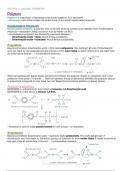
Reactions between dicarboxylic acids + diols make polyesters. The carboxyl groups of dicarboxylic
acid can react w/ the hydroxyl groups of diols to form ester links. A water molecule is lost each time
an ester link is formed ∴ = condensation reaction.
There are permanent dipole-dipole attractions between the polymer chains in polyesters due to the
presence of the polar C=O bonds. ∴ there are greater forces of attraction between the polymer chains
in polyesters compared to only weak van der Waals forces between addition polymer chains.
Terylene (a polyester)
MONOMER 1: a dicarboxylic acid which is benzene-1,4-dicarboxylic acid.
MONOMER 2: a diol which is ethane-1,2-diol.
• Terylene is used to make plastic bottles for soft drinks + is recyclable.
Polyamides
Reactions between dicarboxylic acids + diamines make polyamides. The carboxyl groups of
dicarboxylic acid can react w/ the amino groups of diamines to from amide links. A water molecule is
lost each time an amide link is formed ∴ = condensation reaction.
Polymers
Polymer: a long chain of repeating units joined together. It is saturated.
• Monomer: unit which breaks its double bond. It is a small unsaturated molecule.
Condensation Polymers
Condensation polymer: a polymer that is formed when monomers join together from condensation
reactions + eliminate a small molecule such as water (or HCl).
• Condensation polymers are formed by reactions between:
- Dicarboxylic acids + diols, which forms a polyester.
- Dicarboxylic acids + diamines, which forms a polyamide.
Polyesters
Reactions between dicarboxylic acids + diols make polyesters. The carboxyl groups of dicarboxylic
acid can react w/ the hydroxyl groups of diols to form ester links. A water molecule is lost each time
an ester link is formed ∴ = condensation reaction.
There are permanent dipole-dipole attractions between the polymer chains in polyesters due to the
presence of the polar C=O bonds. ∴ there are greater forces of attraction between the polymer chains
in polyesters compared to only weak van der Waals forces between addition polymer chains.
Terylene (a polyester)
MONOMER 1: a dicarboxylic acid which is benzene-1,4-dicarboxylic acid.
MONOMER 2: a diol which is ethane-1,2-diol.
• Terylene is used to make plastic bottles for soft drinks + is recyclable.
Polyamides
Reactions between dicarboxylic acids + diamines make polyamides. The carboxyl groups of
dicarboxylic acid can react w/ the amino groups of diamines to from amide links. A water molecule is
lost each time an amide link is formed ∴ = condensation reaction.