Section 3: Organic Chemistry
Halogenoalkanes
Halogenoalkane: an alkane w/ at least one halogen atom in place of a hydrogen atom.
• ∴ functional group is a halogen atom attached to a carbon atom, w/ general formula R-X where R is
the alkyl chain + X the halogen atom (F, Cl, Br or I). They are named after the original alkane w/ a
pre x indicating the halogen present: F = Fluoro-; Cl = Chloro-; Br = Bromo-; I = Iodo-
• Haloalkanes can also be classi ed as primary, secondary or tertiary:
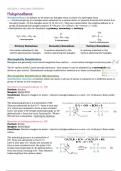
Primary Haloalkane Secondary Haloalkane Tertiary Haloalkane
One carbon attached to the 2 carbons attached to the 3 carbons attached to the
carbon adjoining the halogen. carbon adjoining the halogen. carbon adjoining the halogen.
Nucleophilic Substitution
Halogens are generally more electronegative than carbon ∴ most carbon-halogen bonds are polar.
The δ+ carbon doesn’t have enough electrons - this means it can be attacked by a nucleophile (an
electron-pair donor). Haloalkanes undergo substitution reactions w/ these nucleophiles: Cyanide
Hydroxide
Nucleophilic Substitution Mechanisms Ammonia
Substitution reaction: a reaction where an atom or group of atoms is replaced w/ a different atom or
group of atoms in the compound.
Reaction of halogenoalkane w/ OH-
Product: Alcohol
Reagent: NaOH/KOH
Conditions: Dissolve reagent in water + dissolve halogenoalkane in a min. vol. of ethanol. Heat under
re ux.
The attacking group is a nucleophile of OH-. Bromoethane + Sodium Hydroxide(aq) → Ethanol + Sodium Bromide
They are attracted to the δ+ C + have a lone pair
of e- which are donated to form a new covalent
bond. the polar C-Br breaks heterolytically, w/ Br
getting both e- from the bond, forming Br-. Where
OH- are the nucleophile = hydrolysis reaction.
Reaction of halogenoalkane w/ CN-
Product: Nitrile
Reagent: NaCN/KCN
Conditions: Dissolve reagent in water + dissolve halogenoalkane in a min. vol. of ethanol. Heat under
re ux. LENGTHENED CHAIN
The attacking group is a nucleophile of Bromoethane + Potassium Cyanide (aq) → Propanenitrile + Potassium Bromide
CN-. They are attracted to the δ+ C +
have a lone pair of e- which are donated to
form a new covalent bond. the polar C-Br
breaks heterolytically w/ Br getting both e-
from the bond, forming a Br-. This reaction
helps lengthen the carbon chain.
flfi
fi
Halogenoalkanes
Halogenoalkane: an alkane w/ at least one halogen atom in place of a hydrogen atom.
• ∴ functional group is a halogen atom attached to a carbon atom, w/ general formula R-X where R is
the alkyl chain + X the halogen atom (F, Cl, Br or I). They are named after the original alkane w/ a
pre x indicating the halogen present: F = Fluoro-; Cl = Chloro-; Br = Bromo-; I = Iodo-
• Haloalkanes can also be classi ed as primary, secondary or tertiary:
Primary Haloalkane Secondary Haloalkane Tertiary Haloalkane
One carbon attached to the 2 carbons attached to the 3 carbons attached to the
carbon adjoining the halogen. carbon adjoining the halogen. carbon adjoining the halogen.
Nucleophilic Substitution
Halogens are generally more electronegative than carbon ∴ most carbon-halogen bonds are polar.
The δ+ carbon doesn’t have enough electrons - this means it can be attacked by a nucleophile (an
electron-pair donor). Haloalkanes undergo substitution reactions w/ these nucleophiles: Cyanide
Hydroxide
Nucleophilic Substitution Mechanisms Ammonia
Substitution reaction: a reaction where an atom or group of atoms is replaced w/ a different atom or
group of atoms in the compound.
Reaction of halogenoalkane w/ OH-
Product: Alcohol
Reagent: NaOH/KOH
Conditions: Dissolve reagent in water + dissolve halogenoalkane in a min. vol. of ethanol. Heat under
re ux.
The attacking group is a nucleophile of OH-. Bromoethane + Sodium Hydroxide(aq) → Ethanol + Sodium Bromide
They are attracted to the δ+ C + have a lone pair
of e- which are donated to form a new covalent
bond. the polar C-Br breaks heterolytically, w/ Br
getting both e- from the bond, forming Br-. Where
OH- are the nucleophile = hydrolysis reaction.
Reaction of halogenoalkane w/ CN-
Product: Nitrile
Reagent: NaCN/KCN
Conditions: Dissolve reagent in water + dissolve halogenoalkane in a min. vol. of ethanol. Heat under
re ux. LENGTHENED CHAIN
The attacking group is a nucleophile of Bromoethane + Potassium Cyanide (aq) → Propanenitrile + Potassium Bromide
CN-. They are attracted to the δ+ C +
have a lone pair of e- which are donated to
form a new covalent bond. the polar C-Br
breaks heterolytically w/ Br getting both e-
from the bond, forming a Br-. This reaction
helps lengthen the carbon chain.
flfi
fi