[Your Name]
[Address, City, ST ZIP Code] | Unit 6 | Software design and development
Part one
Procedural
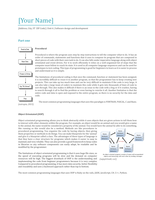
Procedural is where the program uses step by step instructions to tell the computer what to do. It has an
order of commands, statements and functions that it uses to compose its program that are composed in
short pieces of code with their own task to do. It can also falls under imperative language along with object
orientated and event driven. For it to work efficiently it relies on a well-organized list of steps that the
computer must follow to reach its state. It is used in all computer language sequences and can be used for
prototypes to test coding. This type of programming is good for beginners to learn as it is easier to process
and understand as it is simple.
The limitations of procedural coding is that once the command, function or statement has been assigned,
it is incredibly difficult to reuse it in another program, so that the programmer has to keep creating new
projects. This can take up too much time and can be very difficult to maintain if the code is very large, it
can also take a large team of coders to maintain this code while it gets into thousands of lines of code to
sort through. This also makes it difficult if there is an issue in the code with a bug or if it crashes, having
to search through it all to find the problem or even having to rewrite it all. Another limitation is that the
entire code and data is open and exposed to the entire program, so there is no security for the data and
code.
The most common programming languages that uses this paradigm is FORTRAN, PASCAL, C and Basic.
(extropia, 2015)
Object Orientated (OOP)
Object orientated programming allows you to think abstractly while it uses objects that are given actions to tell them how
to interact with other elements within the program. For example, an object would be an animal and you would give a name
to the animal, the name would be considered a property of the animal. You would have the animal be able to do something,
like running so this would also be a method. Methods are like procedures in
procedural programming. You organize the code by having objects, then giving
them properties or methods to do things. You can make blueprints for the ‘animal’
and give it a blueprint called a class. The advantages of these types of language is
that they have a clear structure for programs which makes it easier to easy to
maintain and very reliable. They can also provide a good framework to keep codes
in libraries so any software components can easily adapt, be readable and be
modified by the programmer.
The limitations of object orientated programming is that it uses huge file sizes, so
the speed of executing programs will be slow and the demand on computer
resources will be high. The biggest drawback of OOP is the understanding and (sujaytrivedi, n.d.)
implementing the code from beginner programmers because it is very complex.
Compared to procedural programming, it has more data security, better flexibility
and reusability and uses a backward approach rather than top to bottom.
The most common programming languages that uses OOP is Ruby on the rails, JADE, JavaScript, C#, C++, Python.
[Address, City, ST ZIP Code] | Unit 6 | Software design and development
Part one
Procedural
Procedural is where the program uses step by step instructions to tell the computer what to do. It has an
order of commands, statements and functions that it uses to compose its program that are composed in
short pieces of code with their own task to do. It can also falls under imperative language along with object
orientated and event driven. For it to work efficiently it relies on a well-organized list of steps that the
computer must follow to reach its state. It is used in all computer language sequences and can be used for
prototypes to test coding. This type of programming is good for beginners to learn as it is easier to process
and understand as it is simple.
The limitations of procedural coding is that once the command, function or statement has been assigned,
it is incredibly difficult to reuse it in another program, so that the programmer has to keep creating new
projects. This can take up too much time and can be very difficult to maintain if the code is very large, it
can also take a large team of coders to maintain this code while it gets into thousands of lines of code to
sort through. This also makes it difficult if there is an issue in the code with a bug or if it crashes, having
to search through it all to find the problem or even having to rewrite it all. Another limitation is that the
entire code and data is open and exposed to the entire program, so there is no security for the data and
code.
The most common programming languages that uses this paradigm is FORTRAN, PASCAL, C and Basic.
(extropia, 2015)
Object Orientated (OOP)
Object orientated programming allows you to think abstractly while it uses objects that are given actions to tell them how
to interact with other elements within the program. For example, an object would be an animal and you would give a name
to the animal, the name would be considered a property of the animal. You would have the animal be able to do something,
like running so this would also be a method. Methods are like procedures in
procedural programming. You organize the code by having objects, then giving
them properties or methods to do things. You can make blueprints for the ‘animal’
and give it a blueprint called a class. The advantages of these types of language is
that they have a clear structure for programs which makes it easier to easy to
maintain and very reliable. They can also provide a good framework to keep codes
in libraries so any software components can easily adapt, be readable and be
modified by the programmer.
The limitations of object orientated programming is that it uses huge file sizes, so
the speed of executing programs will be slow and the demand on computer
resources will be high. The biggest drawback of OOP is the understanding and (sujaytrivedi, n.d.)
implementing the code from beginner programmers because it is very complex.
Compared to procedural programming, it has more data security, better flexibility
and reusability and uses a backward approach rather than top to bottom.
The most common programming languages that uses OOP is Ruby on the rails, JADE, JavaScript, C#, C++, Python.