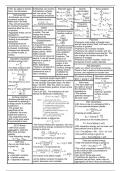
V:SA: As object is broken Surfactants can reverse Diameter types Gravity Sieve analysis
down, SA decreases. hydrophobic surfaces sedimentation
SA:
and vice versa. They
Self-assembly also stabilize emulsions. V:
-Surfactants are at least
somewhat soluble in Surface tension Sauter:
water due to its head.
-They will self assemble Surface pressure Frequency
to increase favourable Sphericity: distributions
reactions after the c.m.c. Solids
is reached. Surfactants can adsorb
Interfacial tension
-Aggregate shape can be to solids. This can Capillary method:
changed by: change the surface
*Changing concentration, hydrophobicity.
*Adding a solubilisable Fully wetted: Polymers
compound, (De)stabilisation
Flocculation: -Polymers rarely adopt a straight chain,
*Changing structure. and will wrap around itself, and hence has
-Commonly, as conc. is -Long polymers adsorb
to multiple particles, a radius of gyration.
increased, morphology Surface excess
effectively creating a -Polymers can increase viscosity.
changes from spherical -Surfactant conc.
larger particle, which -Polymers can adsorb to solids, and will
to rod-like micelle, to has a gradient
settles quickly. effectively be adsorbed permanently. This
vesicle. around the
-If the polymer does not can change the surface charge if the
interface. The
adsorb, it can still cause polymer is charged.
Adsorption equations amount of
particles to settle at -Polymers can form micelles, which can
-Surface excess conc.: surfactant in this
large conc.’s. be layered to form useful materials.
region is the
Steric stabilisation: surface excess. Salt adsorption:
-For dilute solutions with -Polymers will adsorb to -Surface energy is -Salts can adsorb at surface boundaries.
a non-ionic surfactant: particles, preventing surface tension There is then a positive surface excess for
coalescence due to multiplied by co-ions, and negative for counter ions.
steric crowding. surface area.
For planar surfaces: Adsorption isotherm
Electrical double layers (EDL) -Henry isotherm:
-When charged particles adsorb at a surface
-The tangent of a a very strongly associated layer, the stern Stern layer -Langmuir isotherm:
curve is . layer, will form. After this, there is a layer -The stern plate has
with a concentration gradient, known as the the width of around
For a 1:1 ionic surfactant: diffuse layer. the diameter of the where
-This is an EDL. The distribution of ions hydrated ion. maximum possible
follows the Boltzmann distribution: -The surface surface excess,
potential changes in
Surface potential the stern layer.
-Surface potential may be
measured by applying a EDL interactions
voltage across a colloidal -EDL force is due to overlapping EDL’s.
suspension. -For low potential between planes:
-The greater the
magnitude of the
-potential, the more -Potential at middle plane is:
stable the system is.
-The isoelectric point
(IEP) is the point where -Charge density is defined as:
-EDL pressure at the middle plane is:
the -potential is zero.
DLVO theory -The Poisson-Boltzmann equation, with very
small electrical energy compared to thermal -EDL interaction energy per unit area, and
-vdW force causes inter-particle force is given by:
aggregation, while the energy is given as:
EDL force provides
stability. -Inter-particle energy is given by:
-Total interaction energy:
-The Debye constant, , is given by:
Total inter-particle energy
vdW force -Total inter-particle energy is given by:
-the van der Walls force
is given by: -Commonly, it is expressed as:
-The critical coagulation constant (CCC)
is the minimum salt concentration to
Where: induce coagulation.
Hamaker constant, -Its inverse is the Debye length. -Non DLVO forces also exist.
Particle radius, -If particles are repulsive, a dense
Separation distance. -As the Debye constant increases, the sediment bed will form, while a bed of
system becomes more unstable aggregates will form if they are attractive.
down, SA decreases. hydrophobic surfaces sedimentation
SA:
and vice versa. They
Self-assembly also stabilize emulsions. V:
-Surfactants are at least
somewhat soluble in Surface tension Sauter:
water due to its head.
-They will self assemble Surface pressure Frequency
to increase favourable Sphericity: distributions
reactions after the c.m.c. Solids
is reached. Surfactants can adsorb
Interfacial tension
-Aggregate shape can be to solids. This can Capillary method:
changed by: change the surface
*Changing concentration, hydrophobicity.
*Adding a solubilisable Fully wetted: Polymers
compound, (De)stabilisation
Flocculation: -Polymers rarely adopt a straight chain,
*Changing structure. and will wrap around itself, and hence has
-Commonly, as conc. is -Long polymers adsorb
to multiple particles, a radius of gyration.
increased, morphology Surface excess
effectively creating a -Polymers can increase viscosity.
changes from spherical -Surfactant conc.
larger particle, which -Polymers can adsorb to solids, and will
to rod-like micelle, to has a gradient
settles quickly. effectively be adsorbed permanently. This
vesicle. around the
-If the polymer does not can change the surface charge if the
interface. The
adsorb, it can still cause polymer is charged.
Adsorption equations amount of
particles to settle at -Polymers can form micelles, which can
-Surface excess conc.: surfactant in this
large conc.’s. be layered to form useful materials.
region is the
Steric stabilisation: surface excess. Salt adsorption:
-For dilute solutions with -Polymers will adsorb to -Surface energy is -Salts can adsorb at surface boundaries.
a non-ionic surfactant: particles, preventing surface tension There is then a positive surface excess for
coalescence due to multiplied by co-ions, and negative for counter ions.
steric crowding. surface area.
For planar surfaces: Adsorption isotherm
Electrical double layers (EDL) -Henry isotherm:
-When charged particles adsorb at a surface
-The tangent of a a very strongly associated layer, the stern Stern layer -Langmuir isotherm:
curve is . layer, will form. After this, there is a layer -The stern plate has
with a concentration gradient, known as the the width of around
For a 1:1 ionic surfactant: diffuse layer. the diameter of the where
-This is an EDL. The distribution of ions hydrated ion. maximum possible
follows the Boltzmann distribution: -The surface surface excess,
potential changes in
Surface potential the stern layer.
-Surface potential may be
measured by applying a EDL interactions
voltage across a colloidal -EDL force is due to overlapping EDL’s.
suspension. -For low potential between planes:
-The greater the
magnitude of the
-potential, the more -Potential at middle plane is:
stable the system is.
-The isoelectric point
(IEP) is the point where -Charge density is defined as:
-EDL pressure at the middle plane is:
the -potential is zero.
DLVO theory -The Poisson-Boltzmann equation, with very
small electrical energy compared to thermal -EDL interaction energy per unit area, and
-vdW force causes inter-particle force is given by:
aggregation, while the energy is given as:
EDL force provides
stability. -Inter-particle energy is given by:
-Total interaction energy:
-The Debye constant, , is given by:
Total inter-particle energy
vdW force -Total inter-particle energy is given by:
-the van der Walls force
is given by: -Commonly, it is expressed as:
-The critical coagulation constant (CCC)
is the minimum salt concentration to
Where: induce coagulation.
Hamaker constant, -Its inverse is the Debye length. -Non DLVO forces also exist.
Particle radius, -If particles are repulsive, a dense
Separation distance. -As the Debye constant increases, the sediment bed will form, while a bed of
system becomes more unstable aggregates will form if they are attractive.