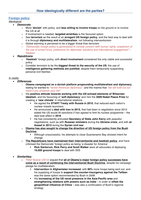
How ideologically different are the parties?
Foreign policy
Ideological:
• Democrats
o More ‘dovish’ with policy, and less willing to involve troops on the ground or to involve
the US at all
o If involvement is needed, targeted airstrikes is the favoured option
o See terrorism as the result of an arrogant US foreign policy, and the best way to deal with
it is through diplomacy and multilateralism, not following interventionism
o Global warming is perceived to be a bigger threat than terrorism
o “Democratic foreign policy is generalized to include concern with human rights, scepticism of
the use of armed force, preference for diplomatic solutions and international engagement” –
Nadeau
• Republicans
o ‘Hawkish’ foreign policy, with direct involvement considered the only viable and successful
policy
o Consider terrorism to be the biggest threat to the security of the US; the use of
intelligence gathering methods are justified, despite them temporarily suspending
personal civil liberties
In reality:
• Differences
o Obama campaigned on a dovish platform propounding multilateralism and diplomacy,
stating he wanted to “renew American diplomacy”, and the mantra that “we will hold out our
hand if you unclench your fist”
o His positive attitude towards working with the UN echoed elements of Wilsonian
idealism, and his favouring of ‘soft diplomacy’ won him the 2009 Nobel Peace Prize for
creating a ‘new climate’ in international relations
§ He signed the START Treaty with Russia in 2010, that reduced each nation’s
nuclear missile launchers
§ He announced a deal with Iran in 2015, that had been in negotiation since 2012
stated the US would lift sanctions if Iran agreed to limit its nuclear programme – the
deal took effect in 2016
§ He has consistently entrusted Secretary of State John Kerry with peaceful
negotiations, such as with Russian ministers during the Ukraine crisis, and with al-
Assad in 2013 during the Syrian civil war
o Obama has also sought to change the direction of US foreign policy from the Bush
Doctrine:
§ Although unsuccessful, his attempts to close Guantanamo Bay showed intent for
change
o The Republicans have maintained their interventionist and hawkish policy, and have
criticised the Democrats’ foreign policy as being ‘a disaster for America’
§ Rick Santorum, Rick Perry and Scott Walker were all advocates of deploying
10,000 ground troops to deal with ISIS
• Similarities:
o Peter Keaver (2012) argued that all of Obama’s major foreign policy successes have
come as a result of continuing the interventionist Bush Doctrine, despite his campaign
pledge for multilateralism
§ Intervention in Afghanistan increased, with 80% more troops being sent out, and
his supplying of troops to support the counter-insurgency against the Taliban
was the same option recommended by Bush in 2008
§ His increasing of the US naval presence in the Asia-Pacific area and
strengthening relations with powers such as India – in order to offset the
geopolitical influence of China – was also a continuation of Bush’s regional
strategy
Foreign policy
Ideological:
• Democrats
o More ‘dovish’ with policy, and less willing to involve troops on the ground or to involve
the US at all
o If involvement is needed, targeted airstrikes is the favoured option
o See terrorism as the result of an arrogant US foreign policy, and the best way to deal with
it is through diplomacy and multilateralism, not following interventionism
o Global warming is perceived to be a bigger threat than terrorism
o “Democratic foreign policy is generalized to include concern with human rights, scepticism of
the use of armed force, preference for diplomatic solutions and international engagement” –
Nadeau
• Republicans
o ‘Hawkish’ foreign policy, with direct involvement considered the only viable and successful
policy
o Consider terrorism to be the biggest threat to the security of the US; the use of
intelligence gathering methods are justified, despite them temporarily suspending
personal civil liberties
In reality:
• Differences
o Obama campaigned on a dovish platform propounding multilateralism and diplomacy,
stating he wanted to “renew American diplomacy”, and the mantra that “we will hold out our
hand if you unclench your fist”
o His positive attitude towards working with the UN echoed elements of Wilsonian
idealism, and his favouring of ‘soft diplomacy’ won him the 2009 Nobel Peace Prize for
creating a ‘new climate’ in international relations
§ He signed the START Treaty with Russia in 2010, that reduced each nation’s
nuclear missile launchers
§ He announced a deal with Iran in 2015, that had been in negotiation since 2012
stated the US would lift sanctions if Iran agreed to limit its nuclear programme – the
deal took effect in 2016
§ He has consistently entrusted Secretary of State John Kerry with peaceful
negotiations, such as with Russian ministers during the Ukraine crisis, and with al-
Assad in 2013 during the Syrian civil war
o Obama has also sought to change the direction of US foreign policy from the Bush
Doctrine:
§ Although unsuccessful, his attempts to close Guantanamo Bay showed intent for
change
o The Republicans have maintained their interventionist and hawkish policy, and have
criticised the Democrats’ foreign policy as being ‘a disaster for America’
§ Rick Santorum, Rick Perry and Scott Walker were all advocates of deploying
10,000 ground troops to deal with ISIS
• Similarities:
o Peter Keaver (2012) argued that all of Obama’s major foreign policy successes have
come as a result of continuing the interventionist Bush Doctrine, despite his campaign
pledge for multilateralism
§ Intervention in Afghanistan increased, with 80% more troops being sent out, and
his supplying of troops to support the counter-insurgency against the Taliban
was the same option recommended by Bush in 2008
§ His increasing of the US naval presence in the Asia-Pacific area and
strengthening relations with powers such as India – in order to offset the
geopolitical influence of China – was also a continuation of Bush’s regional
strategy