
GCSE Biology- DIges1on
Structure Function
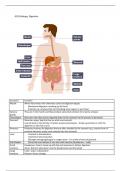
Mouth Where food enters the alimentary canal and digestion begins
- Mechanical digestion: breaking up the food
- Enzymes e.g. amylase that start breaking some sugars in your food
Salivary They are in the mouth and they produce saliva that contains the enzyme amylase
glands
Oesophagus Muscular tube that pushes ingested down to the stomach via the process of peristalsis
Stomach Muscular organ/ bag that has an acidic environment
Low pH favours the activity of certain enzymes (proteases – break up protein) in order for
digestion to take full course
Pancreas Produces enzymes for digestion that are often shuttled to the stomach (e.g. inactive form of
protease becomes active once released into the stomach)
Liver - Involved in detoxification
- Involved in bile production
- Glycogen storage (glycogen is a sugar store – it is a way of store of glucose)
Gall bladder - Stores bile and releases it into the small intestine (duodenum – tube)
Small Duodenum: Food is mixed up with bile and enzymes to further digestion
intestine Ileum: Nutrient absorption into the bloodstream and the lymph
Large Colon: water reabsorption
intestine Rectum: faeces storage
Structure Function
Mouth Where food enters the alimentary canal and digestion begins
- Mechanical digestion: breaking up the food
- Enzymes e.g. amylase that start breaking some sugars in your food
Salivary They are in the mouth and they produce saliva that contains the enzyme amylase
glands
Oesophagus Muscular tube that pushes ingested down to the stomach via the process of peristalsis
Stomach Muscular organ/ bag that has an acidic environment
Low pH favours the activity of certain enzymes (proteases – break up protein) in order for
digestion to take full course
Pancreas Produces enzymes for digestion that are often shuttled to the stomach (e.g. inactive form of
protease becomes active once released into the stomach)
Liver - Involved in detoxification
- Involved in bile production
- Glycogen storage (glycogen is a sugar store – it is a way of store of glucose)
Gall bladder - Stores bile and releases it into the small intestine (duodenum – tube)
Small Duodenum: Food is mixed up with bile and enzymes to further digestion
intestine Ileum: Nutrient absorption into the bloodstream and the lymph
Large Colon: water reabsorption
intestine Rectum: faeces storage


