
Transpiration 14/09/2019
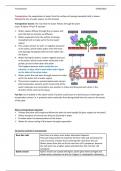
Transpiration: the evaporation of water from the surfaces of spongy mesophyll cells in leaves,
followed by loss of water vapour via the stomata
Transpiration stream: the root that the water follows through the plant
roots à xylem à leaf à stomata
1. Water vapour diffuses through the air spaces and
exits the leaf via stomata via diffusion
2. Water evaporates from the surface of spongy
mesophyll cells to make up for the lost water
vapour
3. This creates tension (a “pull” or negative pressure)
in the xylem, which makes water enter the leave
cells (spongy mesophyll cells) from the xylem into
the leaves
4. Water leaving the xylem, creates negative pressure
in the xylem, which causes water molecules to be
pulled up from further down the xylem
This happens because water molecules are
cohesive, so they stick to each other and to lignin
on the sides of the xylem tubes
5. Water enters the root hairs through osmosis to make
up for the water lost as water vapour
6. This process creates an uninterrupted water stream
(the transpiration stream), which means that all the
water molecules are connected to one another in chains and they pull each other in the
direction of the roots to the leaves
Fun fact: An air bubble in the xylem vessel of a plant could cause it to die because it interrupts the
transpiration stream i.e. it prevents water molecules from being pulled from the roots to the leaves
of the plant
Why is transpiration important
ü It keeps the plant cells turgid and allows the plant to stand upright (it gives support to the plant)
ü Allows transport of mineral ions that are dissolved in water
ü Provides water for photosynthesis at the leaves
ü Allows for some cooling of the leaves through evaporation
Structures involved in transpiration
Root hair cells Root hairs are where most water absorption happens
They are long and thin to maximise the SA:V ratio and accelerate the
rate of osmosis of water that is entering the roots from the soil
Water passes from the soil to the root hair cell’s cytoplasm, because
the soil water has a higher water potential than the root hair cell
cytoplasm
Xylem vessels Xylem vessels are coated with lignin, which gives them strength and
allows water molecules to stick to it (lignin is a hydrophilic substance),
Transpiration: the evaporation of water from the surfaces of spongy mesophyll cells in leaves,
followed by loss of water vapour via the stomata
Transpiration stream: the root that the water follows through the plant
roots à xylem à leaf à stomata
1. Water vapour diffuses through the air spaces and
exits the leaf via stomata via diffusion
2. Water evaporates from the surface of spongy
mesophyll cells to make up for the lost water
vapour
3. This creates tension (a “pull” or negative pressure)
in the xylem, which makes water enter the leave
cells (spongy mesophyll cells) from the xylem into
the leaves
4. Water leaving the xylem, creates negative pressure
in the xylem, which causes water molecules to be
pulled up from further down the xylem
This happens because water molecules are
cohesive, so they stick to each other and to lignin
on the sides of the xylem tubes
5. Water enters the root hairs through osmosis to make
up for the water lost as water vapour
6. This process creates an uninterrupted water stream
(the transpiration stream), which means that all the
water molecules are connected to one another in chains and they pull each other in the
direction of the roots to the leaves
Fun fact: An air bubble in the xylem vessel of a plant could cause it to die because it interrupts the
transpiration stream i.e. it prevents water molecules from being pulled from the roots to the leaves
of the plant
Why is transpiration important
ü It keeps the plant cells turgid and allows the plant to stand upright (it gives support to the plant)
ü Allows transport of mineral ions that are dissolved in water
ü Provides water for photosynthesis at the leaves
ü Allows for some cooling of the leaves through evaporation
Structures involved in transpiration
Root hair cells Root hairs are where most water absorption happens
They are long and thin to maximise the SA:V ratio and accelerate the
rate of osmosis of water that is entering the roots from the soil
Water passes from the soil to the root hair cell’s cytoplasm, because
the soil water has a higher water potential than the root hair cell
cytoplasm
Xylem vessels Xylem vessels are coated with lignin, which gives them strength and
allows water molecules to stick to it (lignin is a hydrophilic substance),


