
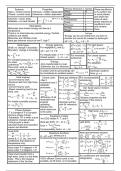
Systems: Properties: Primary Dimension Symbol Phase equilibrium
Open—control volume Intensive—matter independent Mass M is if a system two
Closed—control mass Extensive—matter dependent Length L or more phases
Time t and where the
Isochoric—const. temp. Temperature T mass of each
Adiabatic—no heat transfer Force F phase reaches an
Pressure P equilibrium level
Ideal gases: and remains
Molecules have kinetic energy and hence a Energy E
there.
temperature. Power P
There is no intermolecular potential energy. Particle 1st law:
collisions are elastic. ‘Energy can be converted from one form to
Molecules are infinitely small. another but cannot be created or destroyed.’
Ideal gas behavior occurs at low P, high T.
Work types: Energy balances: For ideal gases:
Shaft: no change in boundary For negligible EK and EP:
Boundary: change in boundary
For steady state: For reversible, For closed system:
Closed system: isothermal:
For constant pressure:
For ideal Entropy: For adiabatic:
isothermal: -Only transferrable by heat.
Flow work: work on open -Extensive, but is intensive.
system to push flow.
A system and its surroundings can Isentropic systems
be considered an isolated system. have
Heat engines: Carnot cycle: Ideal gas relations: For incompressible
-Convert heat to work. -Has 2 substances:
-Receive heat from high temp. isothermal and 2
source. adiabatic
-Convert heat to work. processes. Sat. liquid-vapour mixture:
-Reject remaining heat to low For constant C: System quality:
temp. sink.
-Efficiency of all -System properties are the
reversible heat average of the mixture
For totally reversible process: engines Absolute entropy properties.
operating with 0K reference:
between the
Phase changes: same reservoirs
is the same. High temp. is
-T is constant if P is constant Low pressure
during a phase change. is
Equations of state:
-Saturation T/P is when a pure -An EOS relates P, T, and .
substance changes phase.
-Critical point is when Ideal gas EOS: vdW EOS:
saturated liquid and saturated Error =
vapour are identical.
Compressibility factor:
Virial EOS:
Departure functions: Ideal gas isentropic process:
where is a
where B, C, D, etc. are virial fundamental thermodynamic property.
coefficients that depend on
temperature only.
Area under P-V diagram = W
Area under T-S diagram = Q
‘Heat must transfer from a
high temp. body to a low temp. Air conditioners are essentially
body’. This is the Clausius 100% efficient Carnot cycle is not refrigerators.
statement of the 2nd law. possible, as 0K temp. is not possible.
Open—control volume Intensive—matter independent Mass M is if a system two
Closed—control mass Extensive—matter dependent Length L or more phases
Time t and where the
Isochoric—const. temp. Temperature T mass of each
Adiabatic—no heat transfer Force F phase reaches an
Pressure P equilibrium level
Ideal gases: and remains
Molecules have kinetic energy and hence a Energy E
there.
temperature. Power P
There is no intermolecular potential energy. Particle 1st law:
collisions are elastic. ‘Energy can be converted from one form to
Molecules are infinitely small. another but cannot be created or destroyed.’
Ideal gas behavior occurs at low P, high T.
Work types: Energy balances: For ideal gases:
Shaft: no change in boundary For negligible EK and EP:
Boundary: change in boundary
For steady state: For reversible, For closed system:
Closed system: isothermal:
For constant pressure:
For ideal Entropy: For adiabatic:
isothermal: -Only transferrable by heat.
Flow work: work on open -Extensive, but is intensive.
system to push flow.
A system and its surroundings can Isentropic systems
be considered an isolated system. have
Heat engines: Carnot cycle: Ideal gas relations: For incompressible
-Convert heat to work. -Has 2 substances:
-Receive heat from high temp. isothermal and 2
source. adiabatic
-Convert heat to work. processes. Sat. liquid-vapour mixture:
-Reject remaining heat to low For constant C: System quality:
temp. sink.
-Efficiency of all -System properties are the
reversible heat average of the mixture
For totally reversible process: engines Absolute entropy properties.
operating with 0K reference:
between the
Phase changes: same reservoirs
is the same. High temp. is
-T is constant if P is constant Low pressure
during a phase change. is
Equations of state:
-Saturation T/P is when a pure -An EOS relates P, T, and .
substance changes phase.
-Critical point is when Ideal gas EOS: vdW EOS:
saturated liquid and saturated Error =
vapour are identical.
Compressibility factor:
Virial EOS:
Departure functions: Ideal gas isentropic process:
where is a
where B, C, D, etc. are virial fundamental thermodynamic property.
coefficients that depend on
temperature only.
Area under P-V diagram = W
Area under T-S diagram = Q
‘Heat must transfer from a
high temp. body to a low temp. Air conditioners are essentially
body’. This is the Clausius 100% efficient Carnot cycle is not refrigerators.
statement of the 2nd law. possible, as 0K temp. is not possible.


