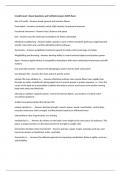
WGU D080 Objective Assessment 2023 Questions and Answers (Verified Answers) What is globalization? - ANSWER -When international integration arises from the interchange of world views, products, ideas and cultures. What are business opportunities that are presented by globalization? - ANSWER -Trade, transactions, capital and investment movements. The migration and movement of people and the dissemination of knowledge. Culture effects of globalization - ANSWER -Ideas, meanings, values. Decreased uniqueness by once isolated communities. Political effects of globalization - ANSWER -Reduces importance of nation states Economic effects of globalization - ANSWER -International movement of goods, capital, services and technology and information. What are arguments for globalization? - ANSWER -Access to broader market, gains access to cheap labor. What are arguments against globalization? - ANSWER -Needs to understand foreign legal and political policies. Market entry (Five stages of entering a global market) - ANSWER -Companies enter new country's using business models similar to the ones in home market. Production Specialization (Five stages of entering a global market) - ANSWER - Companies transfer the full production process of a product to a single location. Value Chain Desegregation (Five stages of entering a global market) - ANSWER Desegregating the the production process and focus on completing each activity in a better location. (different areas) Value Chain Reengineering (Five stages of entering a global market) - ANSWERCompanies seek to further increase their cost savings by reengineering their production process. Creation of New Markets (Five stages of entering a global market) - ANSWER -Allows companies to lower their sticker prices in both new and old markets. Cost Driver (4 drivers of globalization) - ANSWER -Refers to product development, manufacturing, and sourcing. Competitive Driver (4 drivers of globalization) - ANSWER -New markets, increased level of trade. Market Driver (4 drivers of globalization) - ANSWER -Customer needs. Preferences vary by product. Government Driver (4 drivers of globalization) - ANSWER -Absence or presence of trade policies, technical standards, policies and regulations. Economies of Scale - ANSWER -Refers to the concept that the unit cost to produce a product will decline as the variety increases. Benefits of Global Expansion - ANSWER -More array of products, services technologies, medicines, and knowledge Increased sales and exchanges Growth rate in GDP MNC's Benefits of Global Expansion - ANSWER -Unsaturated demand for new product Lower labor costs Less expensive natural resources Higher revenue or lower structure cost MNC's Cost of Global Expansion - ANSWER -Ethical business practice (labor, safety, environment) Organizational structure (incorporating new regions to the value chain) Public relations Leadership Legal and regulatory structure C (CAGE) - ANSWER -Culture. Shared beliefs, practices, norms. A (CAGE) - ANSWER -Administration. Similar country's trade with each other G (CAGE) - ANSWER -Geography. Location E (CAGE) - ANSWER -Economic. Socioeconomic and demiographic World is flat - ANSWER -events that made the world smaller. Monarchy - ANSWER -A single person ruling until death. (Britain) Oligarchy - ANSWER -Small elite group holds power. (Russia) Dictatorship - ANSWER -One person rules (Hitler) Democracy - ANSWER -Citizens organize political parties. (USA) Traditional Economy - ANSWER -Centers around family (hunt gather & nomadic societies) Relies on bartering Members produce what they need not no surplus Benefits: No friction between members Disadvantages: Mercy of climate Low standard of living Ex: Hati Command Econom y - ANSWER -Devoted to goals passed down from a ruler. Resources and business are owned by the government. Communist societies. Venuzela Market Economy - ANSWER -Decentralized economy. Leaders make decisions on consumer demands. Regulates balance between supply and demand.
Exam (elaborations)
WGU D080 Objective Assessment 2023 Questions and Answers (Verified Answers
Rating
Sold
1
Pages
28
Grade
A+
Uploaded on
29-06-2023
Written in
2022/2023
WGU D080 Objective Assessment 2023 Questions and Answers (Verified Answers
Institution
WGU D080 Objective Assessment
Course
WGU D080 Objective Assessment
Whoops! We can’t load your doc right now. Try again or contact support.
Written for
- Institution
- WGU D080 Objective Assessment
- Course
- WGU D080 Objective Assessment
Document information
- Uploaded on
- June 29, 2023
- Number of pages
- 28
- Written in
- 2022/2023
- Type
- Exam (elaborations)
- Contains
- Questions & answers
Subjects
Content preview
$34.99
Get access to the full document:
100% satisfaction guarantee
Immediately available after payment
Both online and in PDF
No strings attached